Showing posts with label Canadian Museum for Human Rights. Show all posts

9 December 2021

CAN THE MUSEUM BE RECONCILED?

Breaking the Glass Case | Megan C. Mahon
___________________________________________________________________________________

Good morning museum friends, and now it’s time for another issue of Here’s How Hard It Is To Decolonize Museums. Not to depress anyone at this late stage in the semester, but I wanted to talk about a trend I’ve been noticing among Canadian museums recently and ask a vital question: do we, as participants in this program, believe that the museum can be reconciled? Not simply decolonized, but reconciled?

Some might argue it’s an issue of semantics. But I believe that, in most cases, decolonization is something that follows reconciliation. In theory, once Canadian museums have reconciled with the Indigenous peoples on whose land they stand, they can continue, with their input, to decolonize the museum - that is, to reimagine and reorganize their content with justice and restitution in mind. However, I fear that “decolonization” is in danger of simply becoming another museum buzzword – a trend that quickly fizzles, rather than a way of operating that all institutions should be committing to for the future. Many Canadian museums are at risk of putting half an effort into their decolonization practices, by not putting reconciliation first. And that will involve a total re-imagination of what “the museum” actually is and should be.

The Royal BC Museum in Victoria, for example, has recently closed its third floor, citing the need to completely overhaul their exhibitions in the name of decolonization. The galleries prepped to close include the “Becoming BC” exhibition and the extremely popular Old Town (which depicts the city of Victoria as it would have looked in the late nineteenth and early twentieth centuries). They’re also going to close their First Peoples gallery, as they want to feature Indigenous stories that are not based in white settler stereotypes from 1886 (when the museum was founded).

 
The outside of the Royal British Columbia Museum. Source: Michael Klajban. https://en.wikipedia.org/wiki/Royal_British_Columbia_Museum


On the surface, this looks great. These galleries definitely need an overhaul - as Geoff Russ, a member of the Haida community and a Victoria resident, put it, the First Peoples gallery in particular “desperately needs input from Indigenous experts” before it can reopen. The other exhibits also need thorough examination to ensure that they explain history from more than one (white) viewpoint. No, I’m not against gallery overhauls. But I’m also not sure that this gets to the very root of the problem.

The reason the RBCM is making these changes is that past staff members have complained about “a culture of racism and discrimination.” The resignation of Lucy Bell, who had been the head of the Indigenous Collections and Repatriation department, sparked a third-party investigation into internal practices - the results of which were, apparently, “not good.” Put simply? It’s not only the galleries that need an overhaul.

Some artifacts of the First Peoples collection at the Royal BC Museum. Source: Wikimedia Commons


Museums are made up of people. While art, objects, and artifacts might be the public face of an institution, people make them run – and it’s the people, not the artifacts, that have to do the work of reconciliation. If the RBCM changes their exhibits and didactics, that’s great. But if the people who make those exhibits and didactics continue to participate in making the museum unsafe for Indigenous folks, then only the surface has changed. The colonial wound has not, in fact, healed at all.

It’s a similar story at the Canadian Museum for Human Rights. Following their own – oft-repeated and studied by students in this program – blunders, their CEO was fired. They’ve since spent over four thousand hours on employee training (don’t be racist! is it really that difficult?) and instituted Robert Greene as Indigenous Elder-In-Residence. But as new CEO Isha Khan has stated, disrupting the colonial standard in museums “takes really thoughtful and deliberate work and takes a long time.”

She’s right. For once, I have to think the CMHR is taking the right approach. It’s not about changing galleries - although that takes a lot of work, it can happen relatively quickly. Changing people won’t happen overnight.

However, that brings me to the question which is the crux of this article: is the museum too steeped in coloniality to ever be reconciled, no matter how much the people within them may change and grow?

Pondering this question led me to Sumaya Kassim’s famous article “The Museum Will Not Be Decolonized,” which I’m sure most people in this program have read. It details her experiences as a co-curator at the Birmingham Museum and Art Gallery, creating an exhibition that examined the museum’s colonial history. Although her exploration into the history of the museum’s artifacts was fascinating, what’s more relevant to this discussion is her struggle with the overall structure of the museum. As she put it, white supremacy and coloniality are “so embedded in the history and power structures” of cultural institutions that she was doubtful about whether decolonization could ever be achieved. Museums are made by, for, and about white audiences. Before we can think about changing museums, we have to alter their entire structure and purpose.

I’m an eternal optimist: I believe that the museum can be reconciled and, eventually, decolonized. But I think that museums have to change their definition of what that means. For the Royal BC Museum, it means more than simply changing your galleries. For the Canadian Museum for Human rights, it means more than firing your CEO and conducting staff workshops. Of course, these things are all good (especially if your CEO does nothing to combat reports of racism), and they have their place in the reconciliation process. But they also fail to fundamentally disrupt the nature of the museum, which is, I think, the true way to reconcile and decolonize.

This has been a long, deep dive into what museums are doing – and not doing – that works to create safer environments for everyone and to reconcile with communities they have harmed in the past. My final point is that it must happen in layers: change the structure, change the people, change the artifacts. If everything I’ve learned in this program is true, it won’t happen quickly. All of us who work in museums will have to ensure that reconciliation is our primary focus. But, if the end result is safer and anti-colonial museum spaces, it will be worth it. And we aren't averse to hard work, are we?

25 November 2021

TO BREATHE LIFE INTO THIS SPACE: OBJECTS WITH LIVES AND AGENCY

Breaking the Glass Case | Megan C. Mahon
____________________________________________________________________________________

CW: This article contains mention of Canadian residential schools.

If you’re a Museum Studies student, it’s likely you’ve talked a lot about the ways that museums can better serve Indigenous communities, given that so many examples of traditional Indigenous art and cultural materials reside in Canadian institutions. Repatriation of these items – while one of this author’s favourite topics to expound on at length – will wait for another article. With this piece, I’d like to bring your attention to a novel agreement that’s been struck between an Indigenous artist and a certain (rather infamous, but that’s another story we all know) Canadian museum.

The Witness Blanket is a large-scale art installation made from hundreds of items reclaimed from churches, government buildings, and residential schools. The artist, master carver Carey Newman, is Kwakwak’awakw from the Kukwekum, Giiksam, and WaWalaby’ie clans of northern Vancouver Island, and Coast Salish from Cheam of the Sto:lo Nation along the upper Fraser Valley. The Blanket he and his team created stands as a national monument to the atrocities committed in residential schools, and symbolizes the work of ongoing reconciliation. It’s an incredibly moving piece: in addition to pieces from buildings which ran and operated residential schools, it contains personal items from survivors and weaves it all into a giant tapestry of tragedy, resilience, and hope.

The Witness Blanket. Source: The Canadian Museum for Human Rights. https://droitsdelapersonne.ca/histoire/picking-up-the-pieces-the-making-of-the-witness-blanket


The Blanket itself is marvel enough, but what deserves special attention – especially to us Museum Studies students – is the agreement behind its exhibition at the Canadian Museum for Human Rights. I see you twitching at the mention of that museum’s name, but I promise we won’t get into that whole sorry debacle here. The story is thus: after the Witness Blanket completed its cross-Canada tour, its creators knew that it needed a permanent home to rest and undergo conservation. However, they did not want to give the Blanket to the CMHR in a way that would imply the piece had one owner. So too, in order to reflect the spirit of truth and reconciliation in which the Blanket was created, they wanted to forge an alliance with the CMHR that did not reflect the traditional power imbalance between museums and Indigenous communities.

The agreement that resulted was unprecedented among museums. In a traditional gathering place on Vancouver Island, British Columbia, stakeholders and museum workers were invited to witness an oral ceremony that made Canadian museum history. For the first time ever, the Crown had ratified a binding legal document through Indigenous ways of knowing. The agreement struck between the CMHR and creators of the Witness Blanket would be put into effect using both written documents and oral agreements, both of which were given equal weight. Carey Newman described this groundbreaking contract as one that lives in two worlds, and joins Western and Indigenous traditions. But to my mind, that isn’t the only incredible part. The contract dictates that the Witness Blanket itself holds its own legal rights – not its creators or the museum where it will reside. This artifact, a physical testimonial to the horrors of residential schools and hope for a better future, has the right to its own story as an independent, living being.

This might sound strange to the majority of us who grew up thinking that museums owned artifacts, which were inanimate objects that were there to teach us about history. I know that’s how I grew up seeing objects in museums. But I think this unprecedented agreement is the first step to seeing artifacts in a different way, one that affords objects more agency. What does this mean for the future of museums?

When I heard about the agreement to treat the Witness Blanket as an object with its own life, I thought of this Robert Smithson quote: “Museums…are graveyards above the ground – congealed memories of the past that act as a pretext for reality.” And while I don’t entirely believe that this is true, I can’t deny that sometimes entering a museum does feel like entering a graveyard - not just because of the artifacts taken out of their contexts and placed behind glass cases, but because of the atmosphere of silence and the idea that we should be treating the space with quiet reverence. Quiet reverence doesn’t have to be a bad thing, but the idea that objects are living things with their own spirits – which many Indigenous cultures on Turtle Island have always known – opens up a whole new pathway of what museums can be.

In the context of this agreement, the Witness Blanket isn’t simply an art piece that commemorates those who never came home from residential schools. It’s a living thing with its own spirit and agency; it isn’t owned by a museum but stands as its own being. What would happen if we treated all museum objects this way? If we treated each artifact as something distinct, with its own life, deeply connected to the lives of those who made and used it?

We would be making museums safer spaces for Indigenous communities – and everyone else! We would be injecting emotional and spiritual care into the sometimes-sterile atmosphere of collections care. And we would be taking an important step down the road to museum reconciliation. If we have the courage to unlearn, a whole new era of interacting with objects is at our fingertips. With the precedent of the Witness Blanket set before us, now is the time to consider just how alive museums can really be.

12 August 2020

THE POTENTIAL OF ORAL STORYTELLING IN MUSEUM EXHIBITIONS

Heritage Moments | Jingshu Helen Yao

Artifacts, specimens, and models might first come to mind when people think of museums. Though museums today incorporate a variety of media into their exhibitions, the traditional items in visual exhibitions still remain at the forefront of people’s minds. Changes tend to occur gradually, but oral storytelling has shown its potential to become an alternative method to showcase history and culture.

In the Fall of 2019, the Future of Museum Storytelling Conference was held in New York. Professionals put their focus on how storytelling could benefit from the digital age, and how they could facilitate a museum environment rich in both oral and visual materials. In recent years, oral storytelling methods were employed to deliver complex topics such as immigration, decolonization, and LGBTQ stories. The strategy gave the marginalized communities full representation of themselves, which achieved better results while approaching these hard topics.

Metis Prisoners in 1885 (source)


Many indigenous communities around the world have strong oral traditions, which made oral storytelling a natural element of recording their history. Oral storytelling is now widely used to present indigenous culture in museums. The Gabriel Dumont Institute Of Native Studies And Applied Research presented audiences and researchers with an online archive of Metis oral history. The collection includes transcription and audio stories, interviews with storytellers, and additional resources for oral history research. The Virtual Museum of Canada, a digital platform created by Canada’s museums and heritage organizations, uses its space for virtual storytelling and illustrations.


Virtual Museum of Canada Logo (source)

These archives and digital exhibitions have become extremely useful during special times like quarantine. While most resources are limited to in-person use, oral storytelling maintains the same value remotely. In addition to its close connection to indigenous culture, oral storytelling has also been used in other topics that largely involved personal experience. The Toronto Ward Museum’s program Block by Block focuses on the storytelling of immigration. The initiative intends to use storytelling as a method to create a more inclusive city. 

Canadian Museum for Human Rights (source)

Bidzinski and her colleagues at the Canadian Museum for Human Rights introduced their methods for including personal perspectives in historical events. “Oral history offers something other sources lack — perspectives from often-marginalized groups and individuals, including many who have suffered human rights violations. Many of these stories have been excluded from the historical record.” Bidzinski et. al, explains this in greater depth in their paper “Building the Oral History Program at the Canadian Museum for Human Rights”. With more and more museums adopting oral storytelling as a part of their exhibitions, it will add depth to museums and culture education.

6 July 2020

VIOLA DESMOND: NOTEWORTHY CIVIL RIGHTS ACTIVIST


In light of worldwide protests against racism and police brutality in response to the murder of George Floyd by four Minneapolis Police Department officers, I, along with many of us in the MMSt community have been educating myself on racial inequality/violence both in and out of the museum community. As part of my personal goal to become better informed on this issue, I have decided to examine the life of historical Canadian civil rights activist Viola Desmond. 
Canadian $10 Bank Note Featuring Viola Desmond, released 2018. Source.
Viola Desmond is perhaps the most recognizable face of the civil rights movement in Canada. You only need to open your wallet and look at a ten-dollar bill to see her. In 2018 Desmond replaced Canada’s first Prime Minister and architect of the Residential School system, John A. MacDonald to become the first solo woman featured on a Canadian banknote. Desmond features prominently on the front of the bill with a map of the historic North End of Halifax, where Desmond’s business was located. The backside of the bill features the Canadian Museum for Human Rights in Winnipeg. The museum was selected for the bill because it was the first museum dedicated to focusing on human rights and equality. (The decision to include the CMHR was prior to the reports of racism and discrimination, experienced by workers of CMHR by management, and the #CMHRStopLying campaign established by ThianĂ© Diop.)

Before Viola Desmond was featured on the ten-dollar bill, she lived a successful, yet tragic life. Born in Halifax in 1914, Viola was one of ten children of James and Gwendolin Davis. Her father James was Black, and her mother Gwendolin was White, at a time when it violated social norms. As a child, Viola quickly realized her aspiration to open a beauty salon, she noticed that there was a lack of beauty products for Black women. Unfortunately, due to her race Desmond was rejected from beauty schools in Nova Scotia, forcing her to train in Montreal and New York City. Returning to Nova Scotia, Desmond opened her own beauty salon and school which focused on Black women, The Desmond School of Beauty Culture. She opened her school so that other Black women would not have to travel from home as she had to receive proper training. Along with the salon and school, Desmond also established a line of beauty products, Vi’s Beauty Products.

Face Power from Vi's Beauty Products. Source.
Desmond had established herself as a successful entrepreneur in Halifax and was growing her business across Nova Scotia when she was arrested in Sydney on November 8, 1946. Desmond’s car had broken down earlier that day forcing her to spend the night in Sydney. She decided to pass the time by viewing a movie at the Roseland Film Theatre. Desmond bought a ticket wishing to seat herself on the floor section of the theatre, to which a theatre employee said, “I can’t sell downstairs tickets to you people.” There were two sections of the theatre, the floor, and the balcony. Though there were no formal laws or any signage in the theatre, it was understood that the theatre was segregated, with White patrons allowed on the floor and Black patrons forced to view from the balcony. This method of racial segregation appears to be uniquely Canadian, according to Former Lieutenant Governor of Nova Scotia and Black woman, Mayann Francis.
“The racism in the United States was truly in your face. In Canada, the racism was very polite – sort of undercover.”
Desmond selected a seat on the floor, and was quickly approached by a theatre worker who attempted to force her to change seats, she refused because she was nearsighted and had a better view on the floor. The police were called and forcibly removed Desmond from the theatre, injuring her hip.

Roseland Film Theatre, Sydney, Nova Scotia During Period of Segregation. White People on Main Floor and Black People on Balcony. Source.
Desmond was held in jail overnight, where she was not informed of her rights to a lawyer or bail. Because there was not a formal law enforcing racial segregation, the court charged her with tax evasion. Because the ticket-seller sold Desmond a balcony seat, she did not pay the full tax for a floor seat. The amount of tax Desmond evaded was one cent. Desmond was forced to pay a twenty-dollar fine (equivalent to $300 today), for a one-cent violation. This charge is emblematic of the covert racism in Canada, while the official charge was not related to her race, it is obvious that the charge came as a result of racial discrimination.

Desmond, with the help of the Nova Scotia Association for the Advancement of Coloured People, hired a lawyer and filed a lawsuit against the Roseland Film Theatre, despite resistance from her husband. However, due to the covert nature of Desmond’s charge, the official language of the case focused entirely on tax evasion with no reference to Desmond’s race, and the lawsuit was unsuccessful.

After the trial, Desmond closed her business, and her marriage fell apart. Eventually, she would leave Halifax and settle in New York, where she would die from gastrointestinal bleeding in 1965. Before her experience at the theatre, Desmond was a woman full of life and optimism. After that day it seems that this radiant energy was forcibly drained from her.

Former Lieutenant Governor of Nova Scotia Mayann Francis (Left) and Viola Desmond's Sister Wanda Robson (Right) at Ceremony of Viola Desmond's Legal Pardon in 2010. Source.
The actions of Viola Desmond helped to spark the modern civil rights movement in Canada. In 2010, Mayann Francis granted a posthumous pardon to Desmond. The pardon recognizes the error of the charge, deeming Desmond innocent of any crime. Francis at the time remarked, 
“Here I am, 64 years later – a Black woman giving freedom to another Black woman.”
If you would like to learn more about Viola Desmond, she is featured in an exhibition at the CMHR, The Bank of Canada Museum, The Bank of Canada Webpage, a Heritage Minute, and the Nova Scotia Museum.

9 March 2020

ANCIENT DNA: A LINK TO THE PAST


_________________________________________________________________________________

It would not be a stretch for me to say that one of museums’ major roles is to illuminate human history. Many museums do this by using timelines or installing a linear progression through exhibits. The first thing audiences see when entering The Canadian Museum for Human Rights (CMHR) is the massive, multimedia timeline with 100 points in history. While the CMHR’s timeline spans the globe there are timelines that focus on a particular topic, such as a place, a phenomenon, or a certain group of people. For instance, the Royal Saskatchewan Museum (RSM) First Nations Gallery traces the history of the first peoples in Saskatchewan, starting nearly 6,000 years ago to present day.

The CMHR's gallery with the timeline on the left (Source).
The timeline that is present the RSM shows a direct link between the people who were present 6,000 years ago to the people present on the land today. With the employment of science when conducting historical and archeological research, especially the study of DNA pulled from ancient humans (known as aDNA), this idea has become doubly enforced. You see, aDNA promotes a different kind of timeline.

The study of, understanding, and potential for ancient DNA has rapidly advanced, providing important insights into a range of biological, historical, and social questions. The study of aDNA has illuminated many answers to questions such as disease, migration patterns, impacts of European colonization and much more, it isn’t without its controversies—namely the ethical issues of collecting human genetic material of the past. 

A hotly debated topic amongst scientists is the peopling of North America, a question aDNA could potentially answer (Source). 
There have been numerous instances reported where scientists have used samples without permission, disregarded customs of communities, and resisted obtaining any form of consent from the people involved in studies (in some cases, these people were involved involuntarily). In 2013, Ian Mosby, an assistant professor at Ryerson, revealed that a number of highly unethical nutritional experiments were performed on children at six residential schools between 1942 and 1952. In turn, Indigenous communities have had to become sceptical of any sort of scientific and social testing to protect themselves, communities, and autonomy.

Ripan Malhi, a molecular anthropologist at the University of Illinois, is part of an effort to change this relationship. In 2011, Malhi helped found the Summer Internship for Indigenous Peoples in Genomics (SING), a weeklong program funded by the National Institute of Health and the National Science Foundation (NSF). The program both aims to train indigenous scientists, but also so bring their much needed perspective to the research. In 2018, SING faculty and alumni publishes ethical guidelines for genomics studies, which call for community engagement, pose questions to tackle, and protocols on how to handle samples and data. You will notice these protocols are very much focused on the present communities and the future of genomics research. But, what about the science of the past? The ethical concerns of research are often not applied to aDNA studies, even though they have implications rooted in the present.

But this is changing.

In October of 2019, the National Science Foundation has awarded 350, 882$ to a collaborative team from the University of Connecticut, The Denver Museum of Nature and and independent scholars across the United States, Europe and Canada. 

(Source.)
“In many cases, aDNA studies continue to fall in a gray area of ethical oversight, despite greater awareness by researchers of the potential pitfalls,” says Deborah Bolnick, associate professor of anthropology at UConn. “With this project, we will include Indigenous leaders in the conversation alongside researchers to attempt to build an ethical framework that encourages positive, collaborative relationships between scientists and Indigenous communities.”

The team hopes to develop resources to enable informed decision making for researchers and indigenous communities in North America.
Both this project and SING inform how research is being done with, for, and by Indigenous communities pertaining to tracing history through DNA. The significance of these interventions cannot be over stated and affect the way the general public understands certain histories of Indigenous communities.

What are your thoughts? I really want to know! Leave a comment or if Twitter and Instagram are more your speed my handle on both is @Ally_but_online.

31 July 2019

CURATORIAL DREAMING: A MUSEUM QUEERIES WORKSHOP


This past week, I was lucky enough to be able to go to Winnipeg for a workshop organized by the University of Winnipeg based Museum Queeries. Museum Queeries describes itself as an “interdisciplinary research project” with the aim to “challenge normative formations including white privilege, racism, and settler colonialism, among other systems of oppression, as they operate alongside and with transphobia and homophobia.” As a matter of transparency, it is important to note that the University of Winnipeg covered my travel expenses to help me be a part of the workshop. CORRECTION: It was Museum Queeries who paid for my expenses, not the University of Winnipeg.
Some members of Museum Queeries looking out at the Nonsuch in the Manitoba Museum. Photo courtesy of Lauren Bosc.

The workshop was based upon the “Curatorial Dreaming” model put forward by Shelley Ruth Butler and Erica Lehrer. The concept says that, while academics are quick to criticize an exhibition, it is often a lot more difficult to propose solutions. Therefore, it proposes dreaming imaginary exhibitions. As part of this workshop, the group visited both the Canadian Museum for Human Rights and the Manitoba Museum. We would then discuss ways that the labels, displays and exhibitions could be queeried.
Museum Queeries members on the Pride Tour, at the "Taking the Cake" exhibit on gay marriage. Photo courtesy of Amelia Smith.

The two museums differed greatly from each other. At the CMHR, we went on their Pride Tour, a specifically LGBT focused tour offered usually only during Pride Month. The tour brought out queer stories that were scattered around the museum. As a piece of programming, it is a fantastic alternative to the usual curatorial decisions regarding queer content, but at only 75 minutes, the choices made as to what not to include are telling (the lack of any discussion on the Toronto Bathhouse Raids especially so).

Whereas the CMHR had some, at times problematic, queer content, the Manitoba Museum had none. The Manitoba Museum is a more traditional encyclopedic museum that tells the history of Manitoba. This ranges from the environment of the province, to the many Indigenous groups that lived there, to the colonial activities such as the fur trade. Unfortunately, aside from some camp labels, there was nothing that spoke to the queer history of Manitoba.
Members of Museum Queeries at the Manitoba Museum being shown pelts and animal remains. Photo courtesy of Lauren Bosc.


The different approaches to queer content between the two institutions created equally different discussions on how to queery them. For the CMHR, the discussions centred around reworking what was already there, adapting the framework that already existed. This took the form of focusing upon labels and sometimes adding new dimensions to the exhibits that were not already there. This proved to be challenging in places, as the limitations of labels often hampered the amount of information that could be included.
The results of the discussions that came out of the CMHR visit. Photo courtesy of Amelia Smith.


The lack of content with the Manitoba Museum allowed for more flexibility in imagining a more queer museum. By having nothing, the museum unknowingly allowed us to focus on reshaping what content already existed. As a result, the discussions were much more diverse in the topics they touched on. One topic that was particularly interesting was the imagining of a brothel in the reconstruction of 1920s Winnipeg. This would have provided a look into the world of sex work in the 1920s as well as a conversation around how the police violence that the sex workers were frequently exposed to. This was but one of the reimaginings that participants created out of the Manitoba Museum.
The results of the discussions after the Manitoba Museum. Photo courtesy of Amelia Smith.


The workshop, in my opinion, was a success. It challenged us to think in new ways about the exhibitions and displays that we saw. The discussions that arose out of the museum visits provided unique insights into curatorial process. It also offered an opportunity to apply a critical queer lens to museums that usually are overlooked.
The members of Museum Queeries in the entrance to the Manitoba Museum. Photo courtesy of Lauren Bosc.


I would like to express my sincere thanks to Angela Failler, Heather Milne, Lauren Bosc and Nicole Ritchie for organizing the workshop and for helping me to get out to Winnipeg for it. Had it not been for them, I would not have had the opportunity to experience the workshop and hear from others interested in queering museums.

7 April 2017

"GET TO WHERE YOU'RE GOING IN A HURRY" SLEEPING CAR PORTERS & NEW DIRECTIONS FOR BLACK HISTORY IN CANADA

Since a great deal of our cohort will soon migrate to our respective internships or employment, or journey far away from the iSchool for some well-deserved rest, travel has been on my mind. Perhaps it’s the recent fervour surrounding the VIA Rail Canada150 Youth Pass, perhaps it's the feeling of chugging into the final station as we close the term, but nevertheless my brain has been fixated on travel by rail in particular. 


Source
 Like much of the African Canadian experience, the history of travel and migration is transnational, deeply nuanced, and is only recently being shared in the public forum. Stories of the underground railroad often overshadow the African-Canadian experience with travel, and so for my last African-Canadian post I want to spotlight the sleeping car porters. 

In the 1870s, the Pullman Palace Car Company introduced a new luxury line of rail cars. Train passengers were treated to the finest amenities, including access to round-the-clock service in the form of a Sleeping Car Porter.  Chosen for their servile nature, porters were originally former slaves who would be at the beck and call of white travellers.  As the role evolved in later years, it was specifically designed for and dominated by Black men. 


 “Prevailing racist attitudes held that Blacks were socially inferior to whites and were meant to work in such vocations that reinforced this attitude, such as that of the sleeping car porter. Black men from across Canada, the United States, the Caribbean and as far away as Wales and the Dutch East Indies were hired as sleeping car porters for Canadian railway companies” 


Porter with Passengers from Canadian National Railway. Source.

As Black men, porters were denied any opportunity to advance to other roles in the company. Yet, there was a certain prestige associated with the role of porter that consistently attracted Blacks to the position. One advantage of the position was that porters travelled exceptional distances, moved from city to city, keeping abreast to the latest news on both the American and Canadian borders. This physical mobility was also connected to their social mobility. Porters were also in the unique position of occupying and existing in traditionally white spaces. The train car became a complex site of racial politics that showcased the struggle for power, agency and resistance. 

The height of this resistance came with the development of the Brotherhood of Sleeping Car Porters (BSCP), a labour union that fought relentlessly to organize Blacks and improve conditions for porters.  An associated Ladies Auxiliary supported the Brotherhood and developed a complementary agenda that included progress in education.  Unfortunately, there isn't space to get into all the details in this post but there is a great National Film Board documentary on the topic here.


Ladies Auxiliary, Toronto Pullman Division, Brotherhood of Sleeping Car Porters, 1940. Source.

This past November, one of Canada's most recognized names associated with porters passed away.  Stanley G. Grizzle (1918 - 2016), the son of Jamaican immigrants, was a leader in the Toronto Canadian Pacific Railway Division of the Brotherhood of Sleeping Car Porters. Moreover, he also served in World War II with the Canadian Army Medical Corps and was an active and influential leader in labour relations, immigration policy and served as a member of the Joint Labour Committee to Combat Racial Intolerance. He was an active voice in African-Canadian Civil Rights and the recipient of numerous awards. 


Governor General Michaelle Jean & Stanley G. Grizzle. Source.

I have always been fascinated by the ways in which roles that are deemed subservient are actually incredibly subversive, and I’d argue that sleeping car porters and porter agency exemplify this case.  In many ways the story of sleeping car porters is one that challenged representations of Blacks and Blackness.  One of my favourite examples of this can be found on the Virtual Museum of Canada website.

The plaque (seen below) originally hung inside one of Grizzle's sleeping cars. 

"Every porter was in charge of one sleeping car on a train. Because of at times, the demeaning names they were called by passengers, such as "George" or "boy," porters won the right in their first collective agreement with CP Rail in 1945 to have plaques erected in each car stating their name"


Stanley G. Grizzle Plaque  Source.
After years of misrepresentation and oversight, I'm excited about the ways in which the stories and the contributions of African-Canadians have been made visible and are represented in museums.  One prospect I am especially looking forward to is the exhibit Free Black North which opens next month at the Art Gallery of Ontario. There is much work to do to further integrate African Canadian history into the Canadian museological landscape. Fortunately, efforts are not slowing down. The number of exhibitions covered here in this column and the numerous others that did not receive adequate recognition are encouraging signs that this work will continue.  It is especially encouraging that new directions for Black history in Canada are not limited to one route, but rather this exploration is taking place under new conductors through roads less travelled and through intersectional terrain. 

It has been my pleasure to share the phenomenal work going on in the museum world related to Black history.  

Until our paths cross again…


23 March 2017

CANADIAN MUSEUM FOR HUMAN RIGHTS MOBILE APP

MUSEUM INNOVATIONS

BY KELLY MACKENZIE


For my final Musings post, I decided to look at museum mobile apps. Numerous museums have them, which was making it difficult to choose one.

Until I read, “first of its kind for any museum”. . . Canadian Museum for Human Rights, you have caught my attention.

No, check that one out! (source)

According to their website, the app, designed by Acoustiguide, “contains a fully accessible self-guided tour (using audio, images, text and video), interactive map, mood meter, online ticketing, information to help plan your visit, and more”.

Step 1: Download the app, Canadian Museum for Human Rights.

Step 2: Explore.

This is a little difficult as I was not at the museum. However, if I was planning a visit, it would be useful as it provides the layout of the museum and what can be found in each gallery. The app was designed to be as accessible as possible and it shows with two written and spoken languages and an ASL option.

The “near me’ option presents the user with information when they are near 120 exhibition elements. Even the map/floorplan are used to present addition information through clickable images (see image below).
Screenshot of the floorplan 

While this app is certainly unique and well-rounded it does raise one concern, as all these apps do: does relying on your phone during a museum visit isolate you from others? Arguably, someone using this app will have headphones on or be reading the text, which could take away from the sense of community within the museum — something important for museums presenting difficult topics. Or worse, it could look like cellphones are taking over the museum; remember the Rembrandt ‘kids on phones’ photo.

Engagement mistaken for boredom. Photo: Gijsbert van der Wal via The Telegraph. 

On the other hand, as long as the user “gets something” out of their experience, does it really matter? After all, apps have numerous benefits including; a museum map they cannot misplace, describe the layout for the visually impaired, provide additional information about an event or artefact, and allow the user to indicate their mood after a gallery. 

Screenshot of the Mood Map available after each gallery

Not all museums can replicate what the CMHR has created. The number of resources required for this app cannot be underestimated and smaller institutions may not have a need for an app this inclusive.

So for my final Musings post, I want to leave you with some things to consider:

1. The role of technology in museums is growing, but remember, any app you create has to be based on the information and collection of your institution. If you do want to create an app, consider what will benefit your institution most: is it a larger, complex app like the CMHR or would a type of game or simple interactive work best?

2. Resources, resources, resources! Consider your resources and if you may qualify for any grants. These apps can be expensive, codes need to be written, designers may be needed, voice actors, translations, Bluetooth technology in your museum, Wi-Fi may need to be installed, etc.

3. Who is your target audience and are they likely to use the technology or support you in creating it?

New technology is wonderful and helpful. But sometimes you don’t need it.


5 April 2016

MUSEUMS WITHOUT OBJECTS OR WORDS

MUSEUM INNOVATIONS

BY: JENNY FORD

The title of this blog post seems rather impossible. If there’s not one there has to be the other, right? Without objects or text, doesn’t that just give us an empty museum?

The Virasat-e-Khalsa Museum
The Virasat-e-Khalsa Museum. Source. 

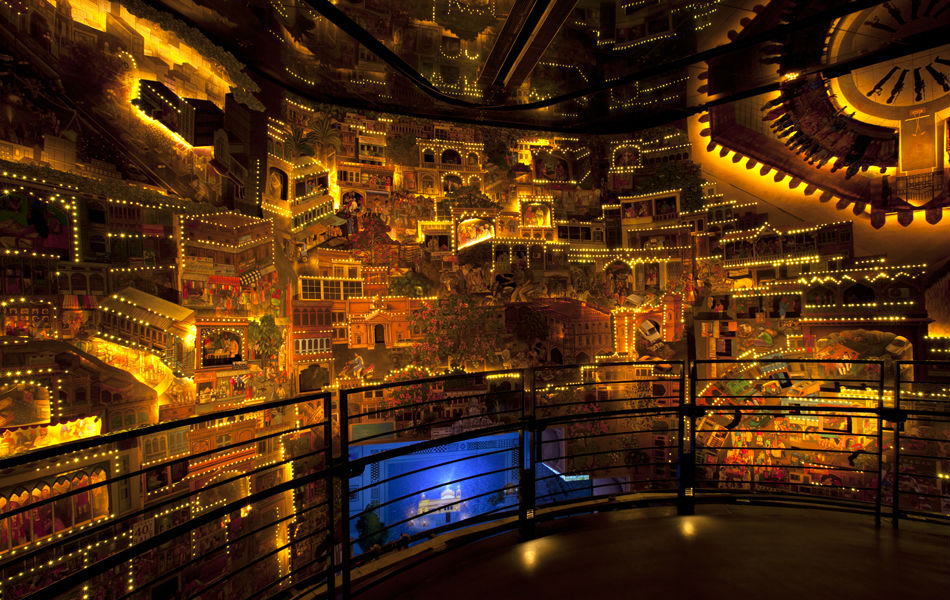
Two weeks ago, I had the pleasure of sitting in on a talk from George Jacob, currently the president of the Philip J. Currie Museum in Grand Prairie, Alta. In a former role, Jacob was the first director of Virasat-e-Khalsa, a religious museum in the state of Punjab in India, which opened in 2011. The museum traces 500 years of Sikh history. The massive complex has 14 galleries all without a single word or artefact.

NO TEXT, NO STUFF, NO PROBLEM


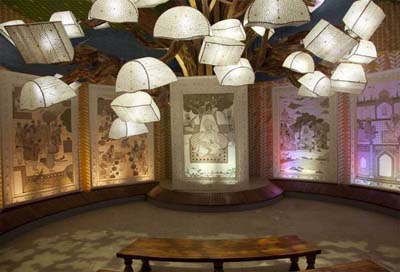
So, how does the museum get away with this? Jacob described how he and his team chose to concentrate on custom art and symbolism, audio guides, and on-site interpreters to help get the messages across to the public. This helped get around issues of multiple languages, varying dialects, and avoiding the museum becoming a potential religious shrine if it had objects.

First gallery with a giant 360-mural and walkway winding through.
The giant 360-mural in the first gallery. Source.

The first gallery, for instance, features a giant hairpin walkway surrounded by an intricate 360-mural that depicts the history of the community and the religion. Visitors are led through the mural's stories with the help of an audio guide. Another gallery relies on symbolism to tell the story of the martyrdom Guru Arjun, who was roasted alive when he wouldn’t stop preaching. The gallery features an empty wok and stylized smoke, representing this story.

Although those from the Sikh community may be able to pick out the symbols and piece together the interpretive messages, it's true others may be a bit lost. To overcome this issue, the museum provides gallery attendants and audio guides for more information.

Gallery #5 with handing lights and murals.
Gallery 5 for Guru Nanak. Source. 

DOING MORE WITH LESS

Some of these notions have been thrown around before in museums. In Steven Conn’s book Do Museums Still Need Objects?, he discusses how museums are moving away from 'things' to programs. Museum are focussing on creating other experiences that are no longer object driven. Furthermore, many disciplines (art history aside) are no longer reliant on objects to tell their stories like they were in the past. Technology has also redefined how interpretation and curation can be done, diversifying the toolbox to engage the public and create meaning.

Missing and Murdered Women installation with hanging red dresses.
The missing and murdered women installation at the CMHR. Source: Jenny Ford

Although not strictly object-free, the Canadian Museum for Human Rights (CMHR) has very few artifacts on display and relies mostly on art, symbolism, and technology to engage and educate audiences. In its Canadian Journeys Gallery, alcoves rely on custom-made art to tell different human rights stories. One alcove uses red dresses hanging in a forest to represent the stories of Missing and Murdered Women. However, there is text to explain the symbolic displays.

The Albis: Sigmar Polke 1963-2010 at MoMA has no text. Source.

On the other side, art museums have long played with the decision of “to label or not to label”, especially as content seems to be increasingly politicized. In many of the Art Gallery of Ontario’s galleries, for instance, labels are absent from cases and walls in favour of cards with tombstone information that visitors can pick up if they so desire. The art is not obstructed by text but perhaps provides more opportunity for reflection and personal meaning-making.

However, what the Virasat-e-Khalsa Museum shows is that museums are still thinking inside the box, in many ways. Messages (even in science centres) are always delivered in an object-text pairing. But are there other unexplored ways we can do this? And are there dangers in letting go of this age-old formula?

Thanks to all the readers and the Musings team! Signing off from my final post.

7 October 2014

HIGH-TECH HUMAN RIGHTS?

TECHNOLOGY TUESDAYS

BY: JENNY FORD

The Canadian Museum for Human Rights (CMHR) is not your typical museum experience. Sure you’ll see the regular text panels and artifacts, but a major component of the Winnipeg museum, which opened its doors on Sept. 20, is technology.

“We don’t just use technology as a hook, it’s about how we can best present the story that’s being told,” says Corey Timpson, director of exhibitions and digital media at the CMHR.

The 11-gallery museum has six theatre spaces, two soundscapes, a three-storey-high media projection, touch tables and interactive games, to name a few of the highlights. In the Canadian Journeys gallery alone there are 19 mix-media installations.

Visitors use touch screens in a gallery.
Visitors use touch screens in the Protecting Rights gallery.
The CMHR has been called an “ideas museum,” which leads technology to be a natural fit for allowing visitors to engage with different human rights concepts and access information in multiple ways, says Timpson.

“Human rights is a concept. If you compare other history museums or science museums or art galleries, ours is this really broad concept,” says Timpson. “Technology allows us the ability to be changeable. Changing a panel or a physical installation is expensive and changing the content digitally allows us to remain current with the domain and with the subject matter itself.”

Interactive games and touch tables are just some of the methods the museum uses. Role playing video games in the Actions Count gallery allow visitors to start their own virtual anti-bullying campaign, for example. The Breaking the Silence gallery features a giant 24-user touch table where visitors learn about different atrocities, such as the Rwandan Genocide and trans-Atlantic slave trade. A 360-degree theatre features a film about indigenous rights and responsibilities.

“Form and function and story really mesh well in this case,” describes Timpson about the 360-degree theatre. “It really does a good job of putting the visitor in a scenario to easily accept the message that’s being told.”

Visitors use an interactive floor game.
The "Lights of Inclusion" game in the Canadian Journeys gallery.
However, the most innovative technology at the CMHR is completely out of view from visitors, says Timpson. Be it a video, a touch table or website content, an enterprise content management system allows museum staff to update programs and content without having to install brand new displays or software. This is a first in museums, says Timpson.

“It means we can have a curator, researcher, or program staff sit at a computer and update that interface and publish it directly to that end point,” he says.

This not only allows the museum's content to stay fresh in a fast-changing digital world, but also allows them to update technology without starting from scratch.

“When it comes to maintenance and evolution of our technological landscape, we can actually deal with things, take a piece out and put a new piece in,” says Timpson.

Visitors look at a linear projection featuring pictures of houses.
Visitors look at one of the museum's many linear media projections.
Accessibility is another consideration incorporated in the technology. The museum’s design team developed a universal keypad so visitors with visual impairments, physical disabilities, or hearing loss can adjust volume, have images described, or interact with the touch tables.

The museum also incorporates Bluetooth technology so museumgoers with visual impairments can have text panels, images and artifacts described to them using a mobile program as they move through the museum.

“We think of the needs of everyone at the outset and that drives our design solutions,” says Timpson.

Only four of the 11 galleries are currently open to the public. The rest will see their first visitors on Nov. 11. Technology plays a crucial role in all spaces, says Timpson, and makes learning about human rights accessible to everyone.

“Technology is a facilitator of the dialogue and of meaningful experiences,” he says.

11 March 2014

TUESDAY NEWS DAY: CENSORSHIP IN CANADA'S HUMAN RIGHTS MUSEUM

BY: BRITTNEY SPROULE

As many of you may have seen in the news recently (and as one of our commentors brought up for discussion on Alex's recent Museum Monday post), there has been much controversy (and rightly so) surrounding a blog post written by Canadian Historian and specialist in the modern history of women and children in Canada, Veronica Strong-Boag. Strong-Boag's post was commissioned for International Women's Day by the new Canadian Museum for Human Rights (CMHR) in Winnipeg, MB and was then rejected by the CMHR's communications department for "not meeting some of the museum's objectives."

Canadian Museum for Human Rights, Winnipeg, Manitoba

You can read Strong-Boag's original post here, which she shared publicly on ActiveHistory.ca after being rejected by the CMHR. I should note that Strong-Boag's post was initially posted publicly by the CMHR for a few hours and she was notified of its successful posting. However, the post was withdrawn after further examination by the museum's Communications department, deeming Strong-Boag's comments on the current federal Conservative government as unacceptable.

You can  view here the response letter the CMHR provided to Strong-Boag after withdrawing her post, as well as Strong-Boag's subsequent (and disbelieving) response to the CMHR's actions. I highly encourage you to check out these links in order to gain a better sense of just how incredulous this entire situation is, particularly for a human rights museum and particularly in light of International Women's day.

ActiveHistory.ca

To give you an overarching idea of the content of Strong-Boag's CMHR post, below is an excerpt from her post, courtesy of ActiveHistory.ca. This was considered one of Strong-Boag's more "problematic" statements, in the eyes of the CMHR:
  
"By the close of the 20th century, the IWD feminist grassroots in Canada as elsewhere emphasized the role of class, race, sexuality, and (dis)ability in further jeopardizing particular groups. Although Canadians grew increasingly sensitive to human rights, state approval included the threat of cooptation. In 2014 Canada’s Conservative government left its anti-woman record unmentioned (which included withdrawal of plans for a national child care program and major cuts to Status of Women Canada [2006], the prohibition of civil servants taking pay equity complaints to the Human Rights Commission [2009], the denial of international funding for abortion [2010], and major cuts to public services that employ and serve significant numbers of women)[1] as it dedicated IWD week to the ‘valuable contribution of women entrepreneurs'."

And, to give you an idea of the kind of response the CMHR gave Strong-Boag, here are a few of the more unbelievable and, quite frankly, frustrating statements made by the CMHR's communications director Angela Cassie, courtsey of an article in the Winnipeg Free Press:

"We will more clearly ask that guest blogs consist of anecdotal accounts of first-person experiences that illuminate human rights themes, and that they include "rich media" relevant to the story (photos, images). We also make efforts to ensure that guest blogs not be used as, or be perceived as, a platform for political positions or partisan statements."

....mmmmm...perhaps some clarification is in order regarding what exactly constitutes an "anecdotal" and unpolitical human rights theme/experience. (Is that even possible?)

Dr. Veronica Strong-Boag

I think Strong-Boag summarizes my reaction (and I'm sure the reactions of many others) to this entire situation perfectly in her letter responding to Angela Cassie:

"Since museums and institutions of public memory are not normally intended to imitate Disneyland but to provide serious, although engaging and accessible, observations on the world, I have been a long time supporter of a Canadian Museum for Human Rights. Your letter has been extremely disheartening." (Winnipeg Free Press)


And so, I leave you now with some points to ponder (and invite any others that cross your mind!):

What does this situation say (if anything) about museums which rely on government funding - is this situation unique to the CMHR or would another government institution likely respond to Strong-Boag in the same way? Differently?

Would public/the CMHR's response be different if this post was not by a publicly prominent, well-educated female historian?

"The Museum fosters an appreciation for the importance of human rights, spurs informed dialogue and invites participants to identify the contemporary relevance of past and present human rights events, both at home and abroad" - this is an excerpt from the CMHR's mandate from their website. Do you think their reaction to Strong-Boag's blog post stays true to the CMHR's mandate?