Showing posts with label Interactive Elements. Show all posts

7 March 2020

WINNIE THE POOH: EXPLORING A CLASSIC

Weekend Edition | Elizabeth Cytko


This post for sure contains spoilers! Continue at your own risk. 

The Victoria and Albert Museum is capping off their world tour of "Winnie the Pooh: Exploring a Classic" at the Royal Ontario Museum. The exhibition explores the process behind the storytelling and art which created this beloved series.

I absolutely love the layout of this exhibition, it's fun, whimsical, and whisks you away to a different world. When you enter you are greeted  with large appealing words which immediately draw you in.


I literally feel as if I am in a story book! What is not shown in this photo are the large balloons hanging overhead, giving the room a sense of whimsy.
Photo courtesy of Elizabeth Cytko


On the right is the story of who Winnie the bear originally was and how they ended up in London to begin with - the Canadian connection is the ROM's contribution to the exhibition.  This then leads into the main parts of the exhibition that explores the life of Christopher Robin, the toys, and A.A. Milne (author) and  E. H. Shepard (illustrator).
How Winnie became Winnie the Pooh. The Canadian Connection.
Photo Courtesy of Elizabeth Cytko


The main text panels are books - books! Unfortunately due to the strange architectural layout of the building, we also get a preview of the ending of the exhibition.
Photo courtesy of Elizabeth Cytko
What I appreciated is that this exhibition has you physically inhabit the world of the books. You start in Christopher Robin's bedroom, move into E.H. Shepards shed where he did his illustrations, and pass through a portal into the Hundred Acre Wood itself.

Christopher Robin's Room.
Through the window you get a sneak peek of the Hundred Acre Wood.
Can you spot the books just waiting to be read?
Photo courtesy of Elizabeth Cytko

One of the main goals of the exhibition is to get people reading the books again. There are plenty of opportunities within the exhibition to sit down with the books - such as upon the very squishy and comfortable bed.

Shed of E.H. Shepard. This discusses the process he went through to illustrate the world.
Photo courtesy of Elizabeth Cytko.
What is not seen is the cozy seating area for children, and the books.
Another opportunity to read, and an inviting portal into the world of Pooh.
Photo courtesy of Elizabeth Cytko
Transported into the wood itself! I hear bees!
Photo courtesy of Elizabeth Cytko

Probably were wise not to provide Pooh Sticks... but the bridge and the river are very relaxing.
Photo courtesy of Elizabeth Cytko

Please note how throughout there are areas to sit and take things in (or possibly continue reading your book!)

Potential spoilers? Literally opening the cupboard as if we too are needing hunny!
Photo courtesy of Elizabeth Cytko
Technique and Composition.
Photo courtesy of Elizabeth Cytko
Another aspect that I loved about this exhibition is that it is geared to all ages. Instead of the adult awkwardly standing off to the side wistfully staring at the activity, a table is provided so that everybody can draw! If only more exhibitions incorporated this inclusive mentality - I too want to dress up as Boudicca/Ancient Egyptian Pharaoh/A Dinosaur/Winnie the Pooh!

Throughout are original planning sketches.
Photo courtesy of Elizabeth Cytko

A relatable mood.
Photo courtesy of Elizabeth Cytko

What I really appreciated about this exhibition is how it had me rethink this childhood classic. As a visual artist myself, I had never really "clicked" that Winnie the Pooh could fall into the comic book/graphic novel category of literature. How the images and text interplay with one another come to light here. I also appreciated how the process of E.H. Shepard is shown, the messy sketches, the trial of expressions, the scribbled out ideas.

Even if you do not care a jot or tittle about Winnie the Pooh, if you are an artist this is an absolute feast of inspiration. I definitely recommend you go, and take your time! Read a book or two! Perhaps allot at least two hours for exploration... or maybe go more than once!

The exhibition runs March 7, 2020 to August 3, 2020. 



11 July 2017

VIRTUALLY EFFECTIVE: TOP 3 CONCERNS WITH USING VIRTUAL REALITY AS AN INTERPRETIVE VEHICLE

MUSEUM INNOVATIONS

BY: HANNAH MONKMAN

In trying to innovate or even just to stay relevant, museums often look to the latest technology to reach their goals. Personally, I love the idea of using virtual reality (VR) as a vehicle of interpretation in museums (noting that yes, virtual reality and augmented reality are different). I believe VR could be used to effectively immerse the visitor in a new environment and provide another level of engagement in an exhibit. Eager to see this in practice, I recently visited two museums in London, ON that both featured VR options in their exhibits through the use of an Oculus Rift.

Roadtrip!! Source.

The first museum I visited was the Royal Canadian Regiment Museum (RCRM), which included a VR experience that takes you into the Battle at Vimy Ridge. Unfortunately, I couldn't get this experience to workwhether the machine was broken, turned off, or the instructions on how to use it were simply unclear, it was definitely a disappointing moment of the visit. The second museum was the Museum of Ontario Archaeology (MOA), which featured a VR longhouse that visitors can explore.


The virtual reality booth with Oculus Rift headset at the Royal Canadian Regiment Museum. Photo courtesy of Hannah Monkman. 

These experiences emphasized some of the risks involved with using high-tech of any sort in an museum environment, and helped inform my understanding of using tech in museums. Here's a rundown of what I learned:

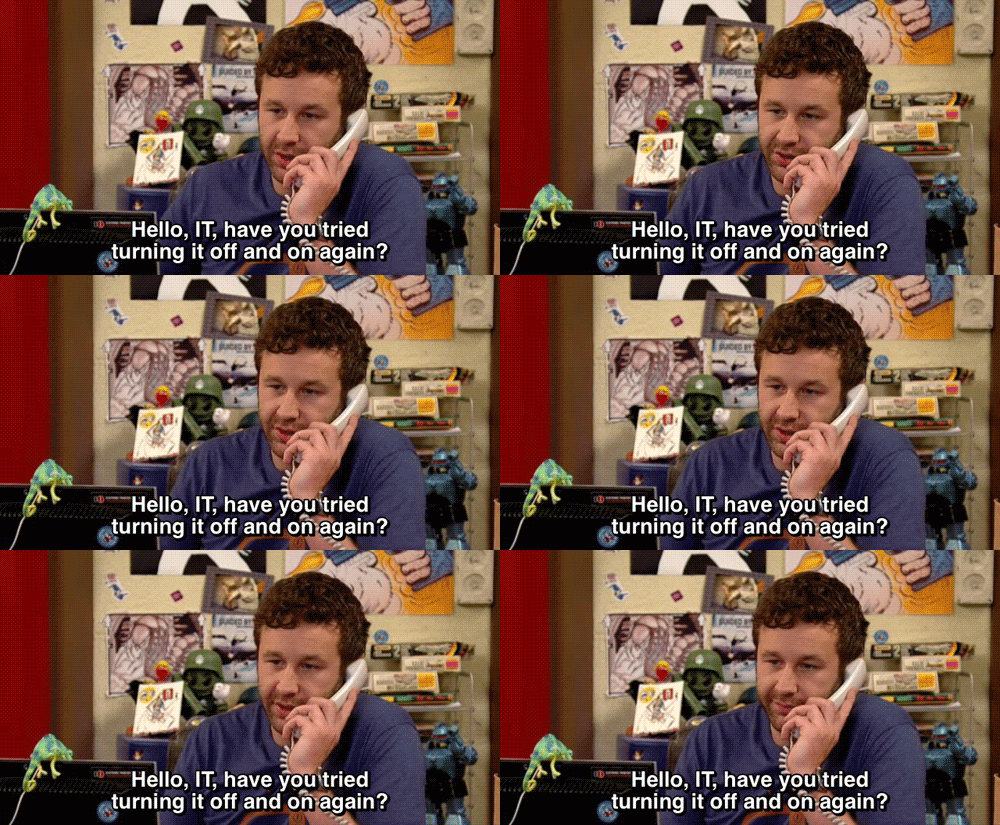
1. Digital technology generally requires specialized maintenance, and staff must be trained to troubleshoot any issues with the tech (especially if the creation of the tech was contracted to external companies). Whether that means simply turning it off and then on again, or fixing broken components, interactive components of displays should be working as often as possible. I visited the RCRM specifically to see the VR exhibit and was frustrated when it did not work. I felt that it was more disappointing to see the cool tech and then have it not work, than if they had not included the tech at all. If you don't have staff on hand who knows (or can learn) how to care for the outsourced tech, perhaps consider a less complex option.

Sometimes dealing with technology isn't as difficult as it may seem. Source.

2. Consider the ethical implications of your VR experience. The psychological impact and ethics related to virtual reality have not been studied much yet at this point. However, concerns have been voiced about the implications of inhabiting a virtual body along with the realistic levels of immersion VR experiences can offer. While I did not get to try the VR at the Regiment Museum, I do know that the experience takes the user to the front lines of the battle. Especially since the experience was designed specifically for grade school students, I question the ethics of such an experience—not that it will negatively affect all users, of course, but that it has the potential to do so since the explosions and gunshots are allegedly very realistic. The effects could be minimal, or be on opposite sides of the spectrum as the users become either desensitized to violence or traumatized in extreme cases due to their experience. Placing the user in the position of a soldier in a 4D virtual reality experience is very different from learning the content in other formats.

If simply watching a movie can affect how we perceive things like war, how would "living" it through VR affect us? Source.

3. Museums often have a habit of using tech for tech's sake—but this can be an ineffective way to engage your visitors. Before committing large amounts of resources to tech like VR, ask yourself: what is this adding to the exhibit? What am I trying to convey with this, and is it actually effective to use VR to do so? The virtual reality at MOA was interesting experience in VR, but less interesting in terms of the content. Walking through a longhouse and picking up objects within a 5 minute time limit provided no additional information for me, especially when physical longhouses were outside on museum grounds. Despite initially thinking that 5 minutes was not a very long time, I found myself running out of things to do or explore in the experience before it was over. After I finished, I found myself thinking, "Why is this here?" Especially since there was a small additional fee to use the VR here, it is definitely in the museum's best interest to make the visitor think it was worth it—whether they paid a few extra dollars or simply paid with their time.

So, while I stand firmly in the position that VR could be used as an incredibly effective way of interpreting content and engaging the visitor, museums have to be careful that they're not using technology like virtual reality "just because." Rather, it should be used because its unique qualities add something that couldn't be attained by another interpretive vehicle. Instead of chasing after the newest technologies, museums should focus on the interpretive potential and the resulting visitor experience when considering how to make exhibits innovative.

tldr; virtual reality has great innovative potential, but only with careful thought about the risks and benefits of using the technology. As long as you think it through and can justify using the tech, VR could be a great option for your museum.

With thorough consideration, you can definitely "follow your dreams" in innovative pursuits. Source.

5 April 2016

MUSEUMS WITHOUT OBJECTS OR WORDS

MUSEUM INNOVATIONS

BY: JENNY FORD

The title of this blog post seems rather impossible. If there’s not one there has to be the other, right? Without objects or text, doesn’t that just give us an empty museum?

The Virasat-e-Khalsa Museum
The Virasat-e-Khalsa Museum. Source. 

Two weeks ago, I had the pleasure of sitting in on a talk from George Jacob, currently the president of the Philip J. Currie Museum in Grand Prairie, Alta. In a former role, Jacob was the first director of Virasat-e-Khalsa, a religious museum in the state of Punjab in India, which opened in 2011. The museum traces 500 years of Sikh history. The massive complex has 14 galleries all without a single word or artefact.

NO TEXT, NO STUFF, NO PROBLEM


So, how does the museum get away with this? Jacob described how he and his team chose to concentrate on custom art and symbolism, audio guides, and on-site interpreters to help get the messages across to the public. This helped get around issues of multiple languages, varying dialects, and avoiding the museum becoming a potential religious shrine if it had objects.

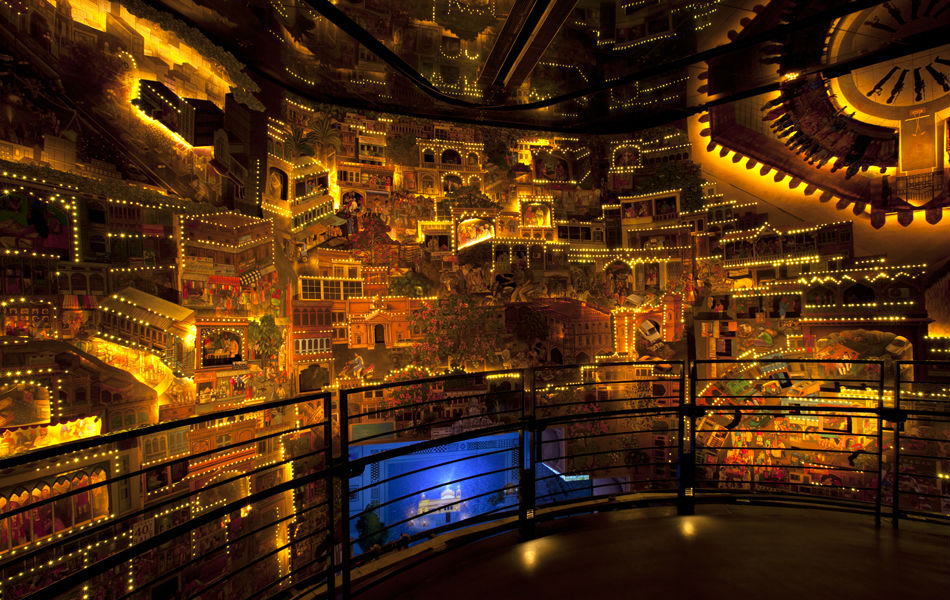
First gallery with a giant 360-mural and walkway winding through.
The giant 360-mural in the first gallery. Source.

The first gallery, for instance, features a giant hairpin walkway surrounded by an intricate 360-mural that depicts the history of the community and the religion. Visitors are led through the mural's stories with the help of an audio guide. Another gallery relies on symbolism to tell the story of the martyrdom Guru Arjun, who was roasted alive when he wouldn’t stop preaching. The gallery features an empty wok and stylized smoke, representing this story.

Although those from the Sikh community may be able to pick out the symbols and piece together the interpretive messages, it's true others may be a bit lost. To overcome this issue, the museum provides gallery attendants and audio guides for more information.

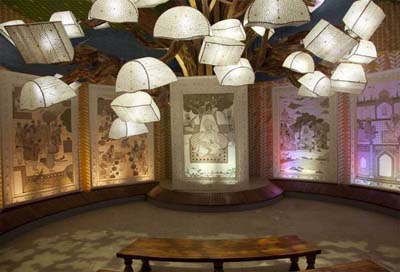
Gallery #5 with handing lights and murals.
Gallery 5 for Guru Nanak. Source. 

DOING MORE WITH LESS

Some of these notions have been thrown around before in museums. In Steven Conn’s book Do Museums Still Need Objects?, he discusses how museums are moving away from 'things' to programs. Museum are focussing on creating other experiences that are no longer object driven. Furthermore, many disciplines (art history aside) are no longer reliant on objects to tell their stories like they were in the past. Technology has also redefined how interpretation and curation can be done, diversifying the toolbox to engage the public and create meaning.

Missing and Murdered Women installation with hanging red dresses.
The missing and murdered women installation at the CMHR. Source: Jenny Ford

Although not strictly object-free, the Canadian Museum for Human Rights (CMHR) has very few artifacts on display and relies mostly on art, symbolism, and technology to engage and educate audiences. In its Canadian Journeys Gallery, alcoves rely on custom-made art to tell different human rights stories. One alcove uses red dresses hanging in a forest to represent the stories of Missing and Murdered Women. However, there is text to explain the symbolic displays.

The Albis: Sigmar Polke 1963-2010 at MoMA has no text. Source.

On the other side, art museums have long played with the decision of “to label or not to label”, especially as content seems to be increasingly politicized. In many of the Art Gallery of Ontario’s galleries, for instance, labels are absent from cases and walls in favour of cards with tombstone information that visitors can pick up if they so desire. The art is not obstructed by text but perhaps provides more opportunity for reflection and personal meaning-making.

However, what the Virasat-e-Khalsa Museum shows is that museums are still thinking inside the box, in many ways. Messages (even in science centres) are always delivered in an object-text pairing. But are there other unexplored ways we can do this? And are there dangers in letting go of this age-old formula?

Thanks to all the readers and the Musings team! Signing off from my final post.

20 May 2015

TO BE INTERACTIVE OR NOT TO BE INTERACTIVE: COMPUTERIZED CANOEING

EXHIBITION REVIEW

BY: MALLORY HORRILL

Source: http://www.canoemuseum.ca
While visiting friends and family in Peterborough over the long weekend I squeezed in a visit to the Canadian Canoe Museum.

In all honesty the museum far exceeded my expectations. I drove into the parking lot of the institution assuming that I would enjoy my visit but thinking that as a smaller town museum the institution would be limited in gallery space and traditional in its interpretation. I am happy to say I was wrong. 

Opening Night of Exhibit
Source: http://www.canoemuseum.ca
The museum is quite expansive, boasting two sizable floors that take the visitor on a journey through Canadian history from the perspective of the canoe. The institution also has a number of impressive interactive sections including a Metis dress up activity and a live viewing of a canoe being constructed. 

Currently the museum is featuring the special exhibition ‘Skimming the Surface: The Unfolding Story of Sprint Paddling’. The exhibit details the Canadian history of competitive paddling (both canoe and kayak). ‘Skimming the Surface’ showcases notable Canadian athletes of the sport, such as Adam Van Koeverden, who most recently received a silver medal in sprint kayaking at the London Summer Olympics. 

Me on the Kayak Training Ergometer
Source: Mallory Horrill
The exhibit features two impressive interactive portions. The first is a kayak training ergometer, which allows the visitor to take part in a mock kayak race, through the use of an exercise machine and computer program. I blew my computerized opponents out of the water (pun intended) in this activity, however, I will say that I did not have the resistance on the machine set extremely high. 

Unfortunately, my hope of a career in sprint paddling was broken in the second interactive activity called ‘Tippy Kayak Challenge’. The user is intended to kayak along the machine without tipping over. This was not as easy as it sounds. The machine simulates the unruly nature of a vessel on the surface of the water and was therefore extremely prone to motion. In my multiple attempts, I only managed to make it half of the distance along the machine.

Relative on the 'Tippy Kayak Challenge'
Source: Mallory Horrill
Despite my lack of physical prowess in the exhibit, I enjoyed the interactive activities. I received a refresher on Canadian history, learned about a sport I knew little about and even got to try my hand at it. However, I did find myself wondering if the exciting presence of the interactive machines did not detract from the panels and artifacts on display. While I personally read the panels and examined the artifacts, I can’t help but wonder if every visitor did the same. 

What do you think of interactive exhibitions? Can you think of an instance when interactive display was employed really well?

7 May 2014

EXHIBITION REVIEW: INTERACTIVE ELEMENTS AT THE CANADIAN WAR MUSEUM

BY: MEAGHAN DALBY

First off, welcome back to Musings for the summer!! I haven’t written much for the blog during the semester, but now I will be sharing Wednesday’s slot with Jaime and am pretty excited! I had wanted to do exhibition reviews as a theme for my posts, but since I’m in Ottawa for the summer (yay!) I may stray a bit from that because most of you wont be able to actually see any of the exhibits I’ll be visiting and reviewing. That being said, I couldn’t NOT do one right off the bat; so this week I’m looking at Witness: Canadian Art of the First World War at the Canadian War Museum.

 
Canadian War Museum Witness
The entrance to Witness 

Witness, is one of two art shows at the Canadian War Museum. The concept was to display works of art inspired by the experiences of the First World War. Soldiers, civilians, and others took to art as a way to express themselves. These were not always professional artists, though some of the works had been commissioned as official war art. There were beautiful giant paintings, but also tiny drawn on scraps of paper. Compared with Transformations (the other art show), which was strictly landscapes done by two different artists, Witness has a lot more room for interpretation and, in my opinion, can reach a wider variety of audiences.
 
Canadian War Museum Witness
An example of some of the art in Witness 
I saw proof of this in the interactive elements of the exhibition. It is not overly common to find interactive elements in art galleries, but part of what makes Witness unique is that it is an art exhibition in a museum which is definitively not an art gallery. I think that many visitors (particularly families, or even teenagers) would be pleasantly surprised by the activities they could do. There was a “Draw Your Own Canadian Flag” because A.Y. Jackson submitted a few designs for consideration in the 1960s. There are Post-Its with certain paintings on them; visitors are encouraged to make their own art with the designed Post-Its as inspiration. Finally, (my personal favourite) a magnetic scavenger hunt is available. A magnetic floor plan is given with pieces illustrating parts of paintings. Visitors search for these paintings and stick the pieces to the corresponding place on the floor plan. If they find all the hidden details there is a prize, of course! Perhaps the most inviting are the 8 iPads with an app to draw, and be inspired by the works of art around them. These “paintings” can be uploaded to the cloud, and then shared with the community.
 
Canadian War Museum Scavenger Hunt
A Volunteer Interpreter shows me the scavenger hunt

I liked these activities because it gave different age groups a chance to interact with the art in a way they most likely hadn’t been able to before. They are encouraged to think about what the art means to them, look closer to find details they might have missed, and be creative in their own right. Witness is unique to the Canadian War Museum; an exhibition dedicated strictly to art is a new venture for them. I think that the interactive activities provided do a good job of bridging the divide between an object based museum and these art shows.
 
Canadian War Museum Flags
Some visitor flag artwork on display!
However, visitors don’t realize these activities exist until they are already in the exhibition. I wish some better advertising was done outside the exhibition space to draw visitors in, especially younger families. Witness has a lot to offer, but I feel like it might get missed by the majority of the visitors.

What do you think? Do these interactive elements seem useful? Engaging? Would you suggest anything else? Have you ever seen an art installation in an object-based museum? What did they do?