Showing posts with label Hannah Monkman. Show all posts

3 April 2018

VISIONS FOR THE FUTURE: MMSt 2018

MUSEUM INNOVATIONS

BY: HANNAH MONKMAN

Hello and welcome to a special issue of Museum Innovations! As the last installment for the term, I decided to go out into our student community and ask our soon-to-be Museum Studies graduates where they think museums are headed in the future. Asking, "what's next for museums?" I wanted to highlight the fantastic ideas and insights of our grads in all areas of the museum field, from collections management to interpretation, diversity and inclusion strategies, and even museum management.

I'm so excited to see all the passion and ambition coming into the field, and with such drive amongst our graduates, we may... dare I say it? ... change the world. 

Source.
Do you agree with these visions for the future of museums? Let's see what our grads have to say!

Collections Management 

"Collections Managers & Conservationists should be more environmentally aware of their material consumption (plastics, crates, tissue paper, etc.) when protecting, shipping and storing objects. I want to learn how to lead the way in best practices and show our colleagues it is possible to waste less!"
- Jessica Baptista 

"Widespread acceptance of the use of deaccessioning in tailoring our overgrown collections to those that best fit our mandates, allowing us to properly preserve what needs to be preserved for future generations. But, of course, great power comes with great responsibility."
- Emily Welsh 

"Collections that are accessible, not just visibly but physically. Accessibility to fit a variety of communities' needs. There is a tendency to 'hoard' objects but at the same time, we say museum objects are for the public. I think museums will start to move towards using the collection to better fit the needs of the public in different ways."
- Kathleen Vahey 


Interpretation and the Visitor Experience 

"I would love to have more interpretation that immerses the visitor in a given experience to foster empathy. I don't think we need to sideline objects as a thing of the past - let's animate them in new ways and facilitate interaction (digitally, using replicas, etc.) through storytelling. Within this framework, I hope to encounter/create museum content that explores the idea of "place" at the heart of an experience. Can places be artifacts themselves?"
- Serena Ypelaar 
Source.

"I think museums are constantly learning and introducing inclusive practices. This proactive programming is preparing the future of museums to be even more aware of and engaged with different visitors’ needs that have historically been overlooked. Now museums are moving in a direction that acknowledges that there is no “average visitor,” and every person that comes into the museum has different needs - whether they are mental, physical, or emotional."
- Aurora Cacioppo

"Museums need to start to incorporating new technologies to become more inclusive and accessible for a wider demographic. I really think that museums are in a state of change already; it's just up to them if they want to take the blind leap into something new."
- Breanna Stephenson 

"Museums are in a transition in two ways. Firstly, the museum exhibition experience is becoming much more visitor-centric with an emphasis on creating a meaningful and memorable narrative with defined and tangible short- and long-term outcomes. Secondly, and especially in Canada, museums are reorienting themselves to embrace and mobilize the Truth and Reconciliation Commission (TRC) and continue to build better relations with our Indigenous communities. While it will be a long process, the results of this mobilization will change the face of museological practice in Canada."
- Bretton Weir

Source.
Diversity and Inclusion

"Where are museums headed? As a graduating class we should be asking, where can we take museums? Things I hope for (and these are just a few) include: Increasing interactivity within exhibits and during general programming. (For example, the sold out immersive Infinity Mirrors exhibit at the AGO). Museums that are more inclusive and work with communities to represent their diverse publics. I have every confidence that my graduating class will be able to lead the way in this respect."
- An Eager MMst Grad

"Becoming more relevant to a wider and diverse audience. I’d like to focus on how this can possibly be achieved through programming that is more accessible and applicable to a wider audience. I believe programming is powerful enough to engage, connect and teach a diversity of people."
- Julia Zungri

"I think - or at least I hope! - that we're going to see more concerted and sustained efforts at incorporating diversity and inclusion into museums at all levels. Community-based stories won't just be featured in exhibitions; communities themselves, as partners and staff members, will shape how collections are managed and how the museum operates. For a specific example, I think that we'll be seeing more women in positions of museum leadership in the coming years!"
- Sadie MacDonald 

"It's hard to tell, but I hope to see changes for the better. One thing I want to see is marginalized people (POC, LGBT+, disabled, ...) who are working in the museum field being represented and listened to more, and given more leadership roles."
- Anonymous 

Management and Operations

"More engagement with environmental concerns across the sector, both in programming/exhibitions and on an institutional level: carbon-neutral operations and climate justice programming especially."
- Jennifer Lee

"I believe that we are seeing a greater movement towards specialization in all sizes and facets of cultural institutions. Whereas previously some museums and heritage sites were able to operate with passionate, untrained staff curating and attending collections, developments in curatorial practice and collections management techniques mean that this tradition is no longer sustainable in the competitive cultural market. Small sites, which had previously rolled collections management and curatorial duties into one hybrid position, are moving to separate the two into individual staff members to better handle the rigors of each role and to offer a more appealing product to cultural consumers. Due to the strain this puts on the limited resources these institutions have, I foresee an increase in zero-hour contract labour, allowing these sites to reap the benefits of informed practice while saving money during off-seasons."
- Dan Rose


A sincere thank you to everyone who contributed!

6 March 2018

AN EMOTIONAL EDUCATION: WALKING "A MILE IN MY SHOES"

MUSEUM INNOVATIONS

BY: HANNAH MONKMAN

A recent trend in museum exhibition and programming has been to try to foster empathy for others, like we saw in Sadie's exhibition review for BAND Gallery and Cultural Centre. With the global political climate as it is, now more than ever we must promote understanding and compassion to our fellow humans. Since museums are in a unique position to educate our publics, many are trying to find ways to educate visitors on empathy with varying levels of success. Creating a truly affective impact is easier said than done, and museums will need to go beyond a simple object + label display. 

But what does learning empathy look like?  Source.
How can museums really foster empathetic development at an emotional level, rather than just a cognitive one? How do you innovate with a fundamental human process like empathy?

Once I found the Museum of Empathy and their innovative pop-up style project, "A Mile in My Shoes," I knew my questions had been answered. Operating out of a larger-than-life shoebox, the Museum of Empathy gives visitors the chance to listen to an incredibly diverse array of emotional narratives while walking in that same person's shoes. Literally. 

"Through a series of participatory arts projects with a focus on storytelling and dialogue, it explores how empathy can not only transform our personal relationships, but also help tackle global challenges such as prejudice, conflict and inequality."

The most recent physical iteration was hosted at the Migrant Museum in London, and brought in new stories of refugees and migrants. But in case you can't make it out to England—or wherever they next pop up—they have a handful of their stories posted on their website, available for anyone to listen. These stories range from love and hope, to grief and unimaginable pain. 

Listen to the joy of a florist as she delights in her community, in connecting with her customers who might be a bit shy, as she expresses a true love for her life and her work. 

Listen to the experiences of a man living with Achondroplasia, a bone growth disorder causing dwarfism, and the discrimination he has faced his entire life paralleled with the support he has received from his family and friends. 

Listen to the cracking voice of a mother whose daughter was murdered recount her memories of the worst time in her life, only to conclude that she was able to open her heart to empathy—even towards the woman who killed her daughter. 

"I choose not live my life in hatred." 

The participants in "Walk a Mile" have revealed themselves at their most vulnerable, allowing the solitary listener to emotionally connect with the storyteller—all while walking in the same shoes.

Boasting over 150 shoes and stories, and over 10,000 visitors since its first opening in September 2015, their strategies have clearly been successful. Source.

Now with the proven effectiveness of participatory programming with personalized stories, the model of "A Mile in My Shoes" may pave a future for emotional education in museums. As they say, if the shoe fits...

6 February 2018

FRAMEWORKS FOR THE FUTURE: 12 WAYS MUSEUMS CAN TAKE ACTION AGAINST CLIMATE CHANGE

MUSEUM INNOVATIONS

BY: HANNAH MONKMAN

Museums often specialize in preserving and exhibiting the past for the present publics, but what are we doing as a collective to ensure that the heritages we safeguard will even have a future to exist in? Climate change has been a hot topic for such a long time, advocates often seem to be shouting into the void. But we all need to take action, now more than ever - so what innovations are museums producing to lead the fight against climate change?

We have already surpassed some of the measurable limitations of our planet, so how can we get back into the "safe space" before it's too late? Source.

Museums are not neutral, and climate change is not a debate. 


As museums, we often look to educate our publics rather than to reflect inwardly, as I discussed back in May 2017. I want to reemphasize that now, as more resources along these lines have been produced since then and the case is growing more urgent every day. When the very core of many museum operations contribute to an enlarged carbon footprint, including the high cost of energy for environmental controls vital for the preservation of collections, should we not take responsibility for preserving our future as well as our past?

We should be empowered as cultural institutions to take responsibility for our roles in contributing to climate change, and take actions to mitigate our impact. Source.
Julie’s Bicycle, a company aimed at bringing climate action to the creative arts, has partnered with the Arts Council of England and numerous other institutions in the UK’s cultural sector to produce Museums’ Environmental Framework in November 2017. This new resource provides tangible and measurable actions that museums can take as leaders in the environmental practice. The outline identifies twelve main areas museums can integrate climate justice into their operations:
  • "Aligning environmental values and stewardship with museum values and mission
  • Embedding environmental sustainability in governance and management
  • Commitment to environmental improvement and action
  • Understanding environmental impacts and measuring what matters
  • Communicating and engaging internally on environmental impacts and action
  • Communicating and engaging externally on environmental impacts and action
  • Engaging visitors and audiences on environmental values, understanding and action
  • Taking action to make buildings and sites more environmentally sustainable
  • Developing environmentally sustainable practice for collections care and exhibitions
  • Embedding environmental sustainability in commercial services
  • Integrating environmental sustainability in financial and investment decision-making and fundraising
  • Developing environmental collaboration and partnerships"

This provides a solid framework that expands on previous models to include every facet of the museum’s activities, and that can be overlaid any current museum model. While each institution will have to find their own way to best incorporate climate justice into their operations, the Museums’ Environmental Framework concludes by drawing together examples across the world of museums leading environmental action – proving it can be done.

Just say NO to those deniers and defeatists! Source.
In order to truly preserve heritage in the long-term, we must face climate change with optimistic action rather than passive defeat.


What action will you take?

(Keep your eyes out for fellow Musings Contributing Editor Lana Tran’s piece tomorrow to look at what museums are doing now, here in Ontario!)

5 December 2017

BEYOND PHYSICAL SPACE: VIRTUALLY, A MUSEUM

BEYOND TRADITION

BY: HANNAH MONKMAN

Hi everyone, and welcome to Beyond Tradition's final post of 2017! The New Year will soon be upon us, and we may start looking towards our futures — but what about the future of museums themselves? In our efforts to remain relevant, will museums transform beyond recognition?

A question posed by Twitter user @museweb asks, "When is a museum not a museum?", as they share an article by Sarah Burke discussing the Kremer Museum—a new virtual reality museum created by George and Joël Kremer. (I encourage everyone to go read it here!)

Is a museum still a museum if its walls are made of code instead of brick and mortar? Source.

While museums have used virtual and augmented realities to supplement their physical institutions, this is the first that exists entirely in virtual space.

A constructed virtual reality has many benefits over a physical space. There is no daily maintenance of the architecture or displays, you can make sure the lighting on each painting is perfect without hassle, and you can even create displays with pieces located across the world that might never be able to stand next to each other in a physical exhibition. Visitors are free to explore and interact with the museum without crowds, and the technology allows them to visit from anywhere around the world (although how accessible this truly is should be questioned, since virtual reality hardware is still unaffordable to many).

However, while new technology may seem innovative and exciting, there are a lot of other questions we can—and should—be asking as well.

Source.
Perhaps the most concerning (in my opinion) is absence of social experiences in virtual reality—although a "multiplayer" version is certainly conceivable for the near future, museums are often highly social environments for most visitors. Would they be as interested if they had to "visit" alone, or take turns?

In addition, virtual reality is still primarily seen in the gaming world. Would this cheapen the museum experience, making it more game than museum? Would that even matter? The first visitors were children, who expressed excitement over the experience while relating it to games—would other demographics hold the same eagerness, or would they see it as trivial or "gimmicky"?

While virtual reality has other uses, it's still primarily associated with video games. Could museums break that mold, or end up being associated even more strongly with entertainment over education? Source.

As Joël Kremer asserts, his "goal is to expand the museum experience, not replace it." With this in mind, I think the virtual museum is incredibly exciting and I'm interested to see how it fares. 

But what do you think? Will the museum offer new and exciting alternatives to the traditional museum experience, or will it fall short of visitor expectations?

7 November 2017

PLEASE DO NOT FEED THE COLLECTION

BEYOND TRADITION

BY: HANNAH MONKMAN

Do you remember walking into a room at a museum and coming face to face with a piece of history or art that resonated with you? Perhaps you had the opportunity to visit the Rosetta Stone, to stand in the scenery of Starry Night, or to lock eyes with the Mona Lisa—or perhaps you can only still imagine as you save your pennies to travel to your dream museum.

Now think of the first time you went to a zoo. Seeing your favourite animals as they played with each other or were fed by their keepers—or maybe you left with a new favourite after you locked eyes with a young orangutan or an aging elephant. Regardless of what your experience was or what you dream it will be, there is no denying that both museums and zoos can create impactful and memorable experiences.

In both museums and zoos, we're often just looking for something—or someoneto connect with. Source.

Zoos have a lot in common with museums, to the point that they may be classified together as institutions. With a focus on education, conservation, and providing meaningful experiences for its visitors, museums and zoos have very similar goals with the primary difference being in the “collection” itself. It makes sense to refer to a zoo’s animals as its collection in this line of thinking, and certainly that’s what the animals were viewed as when the first zoos (or menageries) were established. But can we ethically place animals on the same level that we place any sort of artifact—regardless of its historic importance? While I would immediately answer “no”, it is worth thinking about the terminology since the words we use reflect our broader understanding of the concepts at hand.

Let's take a ride down the semantics slide. Source.

[Disclaimer: I am not arguing for or against zoos in general, nor delving into the highly problematic history of displaying humans in zoos / museum-like exhibitions; rather, I am simply musing about the ethical implications of classifying the animals they keep as a “collection” in the same sense as a museum’s collection.]

At least in North American zoos, the focus is mainly on conserving endangered species or individual animals who may be unfit to return to the wild while making these animals accessible to the public—much like a museum does with its objects. Zoos often embrace the “edutainment” aspect much more than the typical museum, but nonetheless, both aim to educate while providing some level of entertainment by providing unique experiences.

Where else can you learn about animals like red pandas up close and personal? Source. 

But if we use the same terms to refer to living collections as we do to standard collections of art and artifact, what does that mean from a collections management standpoint? Unlike the majority of museums (that make at least the core of their collections policy available to the public, if not a comprehensive document) I couldn’t find any similar policies available online for zoos in North America.

The lack of information on their collecting guidelines leads only to speculation. Are animals “deaccessioned” when they pass away? Are animals appraised before being acquired into the zoo’s collection? Which animals are determined to be relevant enough to the zoos mandate to house within the zoo, and does the appeal factor to visitors play a disproportionate role in selecting animals for display—and is this actually any different than current museum practice? And with each additional question in this line of thinking: what are the ethical implications of referring to animals as if they were on par with objects?

I firmly believe that by broadening our definition of museums to include a wider variety of informal education institutions, we can better understand our own practices at whatever kind of institution we happen to work at and improve our practices to reach a higher standard of professionalism. But in doing so, we need to be careful about which practices we’re equating, and what the implications of these comparisons may be.

Just something to muse about—until next time. Source.

10 October 2017

PUSHING THE LIMITS

BEYOND TRADITION

BY: HANNAH MONKMAN

Hello and welcome to round two of Beyond Tradition! In our last episode, Emily grappled with defining what exactly constitutes a museum. She concluded with her definition focusing on the educational aspect of museums—an aspect I agree with. But from the visitor’s perspective, is the potential for informal learning a motivation (or even an outcome) in their experience at the museum?

With this question in mind, I want to push the boundaries even further and look at some museum practices that we can find outside of places we might usually consider to be centres of informal learning: specifically, department stores.

Now you might be thinking: “Hannah, department stores definitely aren’t museums. So why are you comparing them?”

To which I might respond, “Why aren’t they considered museums?”

No two museums are the same, so how can we define what a museum isn't? Source.  

If you look at stores like IKEA, the layout (and the customer experience) looks pretty similar to a typical visitor experience in a museum. The customer explores through carefully curated exhibits, can stop at an in-house restaurant if they get hungry, and pass through a store on the way out that features items related to the exhibits they just experienced.

In other ways, IKEA could also be compared to the Ontario Science Centre, notorious for  being difficult to navigate for first-time visitors. Source.

While it can be argued that this is not “educational,” we should then be asking, “educational for whom?” 

An interior decorator may find inspiration from an IKEA exhibit just as an artist may be illuminated by a trip to the AGO. A fashion designer may explore Nordstrom just as a historian travels through the ROM. Although the content in museums is typically subjected to interpretation, the question of audience is always a driving factor in interpretive decisions on both sides – from lighting choices to paint colours, from considering how people move in the space to how the overall aesthetic will impact the experience, the visitor is typically first and foremost (perhaps only second to the safety of the more delicate artifacts – or more expensive merchandise). 

Department stores can be further compared to commercial art galleries with regards to their "collections." After all, is fashion not a subset of contemporary art? Museums with textile collections will display garments spanning all of history, and art galleries may sell pieces displayed in their show – both the practices of selling the art and displaying it for aesthetic purposes are found in department stores. Does the act of selling the collection itself deny the institution the right to call itself a museum? But then, in some ways, a department store might be more similar to a gift shop in an art museum than a commercial art gallery in that it sells reproductions of the pieces rather than the originals.

In addition to all of this, there has been movement within museums to focus less on the inherent value of the objects and more on the visitor experience. Conducting visitor research has helped museum professionals to identify why people come to museums and how they behave once they’re there. Analogous to this has been a trend in some retail stores, notably Nordstrom, to focus their efforts on creating memorable customer experiences with exceptional service rather than purely advertising their products.

Every visitor will have a unique experience – what one person walks past might have a huge impact on someone else. Source.

While I don't truly think that department stores are museums (or should be defined as such), I believe that we can strengthen our understanding of what a museum can be by looking at what a museum is not. If we look beyond the limits of what we understand a museum to be, we can find cases that mirror our own practices and may benefit the field of museum studies as we consider a more multidisciplinary approach.

11 July 2017

VIRTUALLY EFFECTIVE: TOP 3 CONCERNS WITH USING VIRTUAL REALITY AS AN INTERPRETIVE VEHICLE

MUSEUM INNOVATIONS

BY: HANNAH MONKMAN

In trying to innovate or even just to stay relevant, museums often look to the latest technology to reach their goals. Personally, I love the idea of using virtual reality (VR) as a vehicle of interpretation in museums (noting that yes, virtual reality and augmented reality are different). I believe VR could be used to effectively immerse the visitor in a new environment and provide another level of engagement in an exhibit. Eager to see this in practice, I recently visited two museums in London, ON that both featured VR options in their exhibits through the use of an Oculus Rift.

Roadtrip!! Source.

The first museum I visited was the Royal Canadian Regiment Museum (RCRM), which included a VR experience that takes you into the Battle at Vimy Ridge. Unfortunately, I couldn't get this experience to workwhether the machine was broken, turned off, or the instructions on how to use it were simply unclear, it was definitely a disappointing moment of the visit. The second museum was the Museum of Ontario Archaeology (MOA), which featured a VR longhouse that visitors can explore.


The virtual reality booth with Oculus Rift headset at the Royal Canadian Regiment Museum. Photo courtesy of Hannah Monkman. 

These experiences emphasized some of the risks involved with using high-tech of any sort in an museum environment, and helped inform my understanding of using tech in museums. Here's a rundown of what I learned:

1. Digital technology generally requires specialized maintenance, and staff must be trained to troubleshoot any issues with the tech (especially if the creation of the tech was contracted to external companies). Whether that means simply turning it off and then on again, or fixing broken components, interactive components of displays should be working as often as possible. I visited the RCRM specifically to see the VR exhibit and was frustrated when it did not work. I felt that it was more disappointing to see the cool tech and then have it not work, than if they had not included the tech at all. If you don't have staff on hand who knows (or can learn) how to care for the outsourced tech, perhaps consider a less complex option.

Sometimes dealing with technology isn't as difficult as it may seem. Source.

2. Consider the ethical implications of your VR experience. The psychological impact and ethics related to virtual reality have not been studied much yet at this point. However, concerns have been voiced about the implications of inhabiting a virtual body along with the realistic levels of immersion VR experiences can offer. While I did not get to try the VR at the Regiment Museum, I do know that the experience takes the user to the front lines of the battle. Especially since the experience was designed specifically for grade school students, I question the ethics of such an experience—not that it will negatively affect all users, of course, but that it has the potential to do so since the explosions and gunshots are allegedly very realistic. The effects could be minimal, or be on opposite sides of the spectrum as the users become either desensitized to violence or traumatized in extreme cases due to their experience. Placing the user in the position of a soldier in a 4D virtual reality experience is very different from learning the content in other formats.

If simply watching a movie can affect how we perceive things like war, how would "living" it through VR affect us? Source.

3. Museums often have a habit of using tech for tech's sake—but this can be an ineffective way to engage your visitors. Before committing large amounts of resources to tech like VR, ask yourself: what is this adding to the exhibit? What am I trying to convey with this, and is it actually effective to use VR to do so? The virtual reality at MOA was interesting experience in VR, but less interesting in terms of the content. Walking through a longhouse and picking up objects within a 5 minute time limit provided no additional information for me, especially when physical longhouses were outside on museum grounds. Despite initially thinking that 5 minutes was not a very long time, I found myself running out of things to do or explore in the experience before it was over. After I finished, I found myself thinking, "Why is this here?" Especially since there was a small additional fee to use the VR here, it is definitely in the museum's best interest to make the visitor think it was worth it—whether they paid a few extra dollars or simply paid with their time.

So, while I stand firmly in the position that VR could be used as an incredibly effective way of interpreting content and engaging the visitor, museums have to be careful that they're not using technology like virtual reality "just because." Rather, it should be used because its unique qualities add something that couldn't be attained by another interpretive vehicle. Instead of chasing after the newest technologies, museums should focus on the interpretive potential and the resulting visitor experience when considering how to make exhibits innovative.

tldr; virtual reality has great innovative potential, but only with careful thought about the risks and benefits of using the technology. As long as you think it through and can justify using the tech, VR could be a great option for your museum.

With thorough consideration, you can definitely "follow your dreams" in innovative pursuits. Source.

13 June 2017

THE SUCCESS IN FAILING: LIFE LESSONS FROM THE MUSEUM OF FAILURE

MUSEUM INNOVATIONS

BY: HANNAH MONKMAN

Hi everyone! Today I want to put the spotlight on failure. The vast majority of the time when we talk about innovations (including in this column), we talk about success. We look at new things that work well, why they work, and see if we can adapt them to our own lives, careers, or projects. We emphasize success to the point that we become afraid to fail—whether it be fear of getting a low mark in class, fear of messing up a project at work, or fear of trusting someone in a relationship in case we get hurt.

Can we just avoid all the sad, rainy montages in our lives please? Source.

These fears aren't unfounded by any means. Especially in the museum world, one "failure" could cost you anything from a temporary setback, to next year's budget, to a wide-scale controversy spanning decades ("Into the Heart of Africa," anyone?).

Ouch... File that under: blunders we never want to make in our own careers. Source.

But nothing will ever change if we don't innovate, and a big part of successful innovation is accepting failure - or at least the risk of it. This concept was a point of inspiration for the founder of the Museum of Failure, Samuel West, who remarked that he was "kind of fed up with everybody's worshipping of success all the time". This museum, which just recently opened in Sweden, brings together some "failures" of innovation, including some by big-named brands like Google Glass and "Bic for Her." 


Wise words, from the front page of the Museum of Failure's website. Source.

We can learn a lot from both our own and others' failures. But beyond learning about specific examples, highlighting these failures in a museum context may normalize them, making those who visit more comfortable with accepting failure as a part of life and encouraging them to take their own risks on the road to success—it's OK to make mistakes!

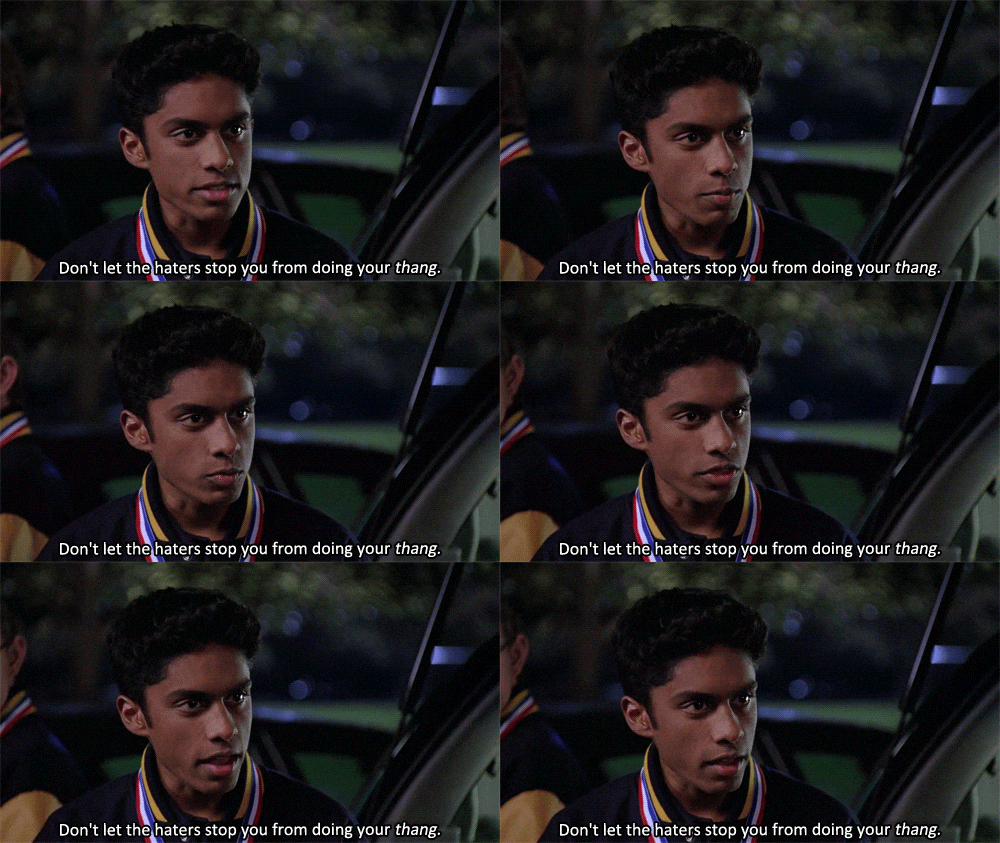
"Don't let the haters stop you from doing your thang." Source.

After all, the true measure of success is not whether or not we fail - but rather if we have the courage to get up, learn from our mistakes, and try again. The very concept of innovation would not exist if we always played it safe.

So, fellow emerging museum professionals and enthusiasts, I encourage you all to take chances, make mistakes, and get messy as we go out and make our mark on the world!

(Just try not to get baked into a pie!) Source.

16 May 2017

IT'S NOT EASY BEING GREEN: MUSEUM ACTION IN THE FACE OF A CHANGING EARTH

MUSEUM INNOVATIONS

BY: HANNAH MONKMAN

Hello all! I am very excited to join the Musings team as the Contributing Editor for Museum Innovations this summer! Today, I wanted to explore a topic near and dear to my heart (and one often neglected in discussions of information studies): environmental sustainability. While many Canadian museums are addressing sustainability in terms of cultural relevance and community involvement, less seem to be integrating green strategies in their operations – perhaps the idea of "going green" is daunting to museum professionals who are already struggling with a lack of resources. Whatever the situation, environmental sustainability should be a concern to all museums on some level.
After all, museums must navigate not only changing societies, but also a changing planet. So, what are museums doing to address this issue, and how can we incorporate those innovations into our future actions as museum professionals?

Educating Our Publics: The first (and more intuitive) role museums can take on with regards to environmental sustainability is that of the interpreter or educator. Through events and programming, art installations, exhibit displays, or even through the dedication of entire galleries, museums can help to educate the public about any and all of the issues related to the environment, including climate change, pollution, and species at risk of extinction.


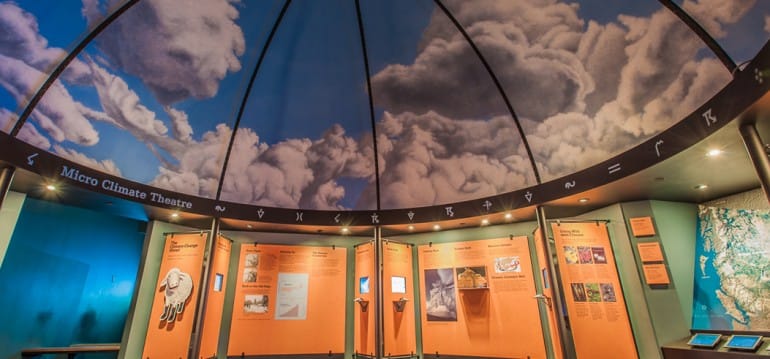
"Climate Rules!" at the Royal BC Museum in Victoria is "one of the first galleries ever built that explains how climate is changing as a consequence of global warming."  Source. (Photo © RBCM.)
Of course, natural history galleries and science centres lend themselves more readily to these kind of programs, and some museums may feel that programming related to environmental sustainability is (rightly) well outside of their mandate. So I asked myself – what can ALL museums do?

Reflecting Within: Museums can – and should – address environmental sustainability by being mindful of their own internal operations. Some museums have already gone to great lengths in their pursuit for sustainability. For example, the Auckland War Memorial Museum in New Zealand has reduced its carbon footprint by 50% and reduced their waste to landfill carbon emissions by 72% since 2010. With such impressive numbers, there's a good reason to be optimistic about implementing our own initiatives in more Canadian museums!

Yayy!! Source.
But where do we start? At the Summit on Sustainability Standards in Museums 2013, the American Association of Museums worked to address the particular concerns museums face in environmentally sustainable development. "A Sustainable Development Guide for Canada’s Museums" was subsequently published in 2015, detailing the importance of sustainable development in Canada and how museums might approach it. However, the uptake of these guidelines seems to have been slow or nonexistent thus far in the majority of Canadian museums. These standards can help guide museums to be more environmentally conscious when considering their own internal practices.

Rooftop solar panels in Hanover, Germany. Source.
Just to get our brains thinking about how we might integrate environmental sustainability in practice, I've summarized some of the most important and/or easiest strategies to implement:
  1. A Sustainable Building. New museums or those undergoing renovations have the advantage of establishing sustainable buildings or building components into the design of the new architecture, such as by installing solar panels. The Kentucky Coal Mining Museum is doing just that – perhaps ironic due to the nature of the museum's theme. This project is not just a shift to a green energy source for the sake of being environmentally conscious, but is also expected to pay itself off in 5-7 years and then start saving the museum a substantial amount of money in energy costs. How's that for incentive?
  2. Energy-efficient Operations. From maintaining vital climate controls for collection preservation to powering computers in office spaces, the daily operations of a museum can consume a huge amount of energy. Lighting is typically a major part of this, but costs can be cut down by using automated systems to light rooms only when in use, or even simply by using energy-efficient bulbs. Of course, if the rooms are housing collections, energy-efficient lighting should always be in sync with preservation considerations. LED lights are typically ideal, since they cut down on energy usage as well as not producing excess heat or UV rays that may damage artifacts. The Biosphere (the Environment Museum in Montréal) models this strategy – amongst other green technologies  with motion sensor lights in its washrooms and offices, in addition to an automated system throughout the building so that its lights are only on during opening hours. Water consumption is also a concern, and it's typically a good idea to install water meters to monitor usage.
  3. Green Exhibit Design. On a smaller scale than the building itself, museums can also look to their future exhibits when thinking about sustainability.  In 2013, the AAM published a "Green Exhibit Checklist" through a project called exhibitSEED, which promoted sustainable practices for exhibit design  –  unfortunately, its website is no longer running. Nevertheless, the checklist helps guide museum professionals in thinking about their exhibits in terms of sustainability by focusing on five main areas: reducing new material consumption; using local resources; reducing waste; reducing energy consumption; and reducing products with toxic emissions.
  4. Management and Documentation Policies. All organizations produce large amounts of waste as a by-product of their operations, and museums are no exception; however, museums can reduce their waste by implementing policies across their organization. For example, creating a printing and paper policy that requires employees to physically print documents only when absolutely necessary, or to only print double-sided, can cut down on the number of paper documents destined for the recycling bin. It is also important to ensure that your museum has a thorough waste management policy. As a general guideline, it's good to follow the 4R's: reduce at the source, reuse, recycle, and reclaim
This is not even close to an exhaustive list of potential actions a museum might take to address environmental sustainability, and it is important to remember that any strategy is flexible to match each individual institution – whether that means undergoing extensive renovations or simply implementing policies to reduce waste. As stewards of our past and present for our future generations, museums have an obligation to be mindful not only of their authority in educating their publics, but also of their own environmental impact as institutions. After all, unless you're a certain frog, it's really pretty easy being green.