Showing posts with label Virtual Reality. Show all posts

10 March 2021

VIDEO GAME NARRATIVES IN EXHIBIT DESIGN: THE THESIS OF ANDREY MINTCHEV

Final Project ReflectionsCaitlin McCurdy


The number of students who choose to do the thesis stream of the MMSt program is considerably smaller than those who choose the exhibition project route. One of these students is Andrey Mintchev, and he very kindly took the time to answer some of my questions about his path to the thesis stream.

His decision to pursue a thesis occurred after taking Velian Pandeliev’s course INF2164H: UX Research and Design for Video Games. He described the class as a study of the positive impact that UX-forward thinking has on elements such as level design and gameplay in video games. He then thought to himself, “Is anyone doing this in museum studies? How awesome would it be if museums felt like videogames?” As he discussed this idea with Prof. Pandeliev and continued learning more about human-computer interactive (HCI) sciences and their research methods, he realized that there wasn’t a particular class on this topic, and that his new conception of an amalgamation of gaming and museology would be best realized in a thesis. 

Courtesy of Andrey Mintchev.


Andrey has a very interesting story about how he came to meet his thesis supervisor, Tony Tang:

“I was waiting for the light to go green on Saint George and Bloor, when I overheard a conversation between two people, who were discussing something about AR. The one guy responded with a “I don’t know Tony, but that sounds interesting” and I immediately assumed that it was Tony Tang. I sheepishly interrupted with a “hi, sorry, but are you Tony Tang? I want to talk to you about turning museums into a VR world”, to which he pleasantly offered up his email.

Andrey then fulfilled his research methods course requirement with a reading course overseen by Prof. Tang, where he was able to make connections between HCI and museology and began to work out his ideas for his thesis. Andrey’s final thesis proposal was the fourth or fifth iteration of his initial idea, and it was at this point that he approached Costis Dallas about being his second reader.

When I asked Andrey for the elevator pitch for the current iteration of his thesis, he was kind enough to give me the short elevator ride pitch, the slightly longer elevator ride pitch, and the elevator ride to the penthouse pitch. Here’s what he said:

“My thesis is on applying videogame level design and narrative design to exhibit design. What I’ve done is record 14 hours of gameplay between five games that boast a compelling narrative, recorded every instance where the story was being conveyed and what the level in that moment looked like, and then produced 598 lines of code to synthesize each screenshot into qualitative data. The idea is to use my synthesized data to identify the best practices for level design and narrative design and apply them to the reinterpretation of an existing museum exhibit. The final deliverable should produce a compelling exhibit that improves on the existing one.”

Courtesy of Andrey Mintchev

This all sounds very fascinating to me, as someone doing an almost entirely theoretical thesis based in historical research and epistemological philosophizing. I’m excited to see the final product of Andrey’s work, I think his research could definitely shed light on how video game practices could innovate our approaches to exhibit design.

Courtesy of Andrey Mintchev

I asked Andrey to give one tip for prospective students considering the thesis stream, and his answer was very insightful.

“There is no right or wrong stream at our school, but if you’ve got this awesome idea, I promise you that our faculty will do everything it can to help [you] walk out of this program with a publication that you’ll be proud of.”

Ultimately, if you have an idea you can’t get out of your head that you’ve brought into the program with you, you can make the thesis stream work for you, and you control the subject, process, and end result of your work, with insight along the way from your very knowledgeable supervisor(s). Andrey also pointed out that this control is fairly unique to the thesis stream, as the final exhibition project is subject to variables like the makeup of your student group and the flexibility of your industry partner. To give Andrey the last word, “Real-talk, it’s the most academically satisfying thing you can do if you hate group work.”

9 December 2020

VR MUSEUMS AROUND THE WORLD: IS IT THE FUTURE?

 Musings Abroad | Jingshu Helen Yao


With the second wave of the pandemic picking up, museums and galleries around the world are forced to shut down once again. Many of them were only able to be back in business for a few months. More and more institutions are looking for alternatives to in-person visits that allow a more immersive experience.

Virtual Reality | Source

The use of virtual reality technology is not new to museums around the world. Museum Next
recently published a list of the top pre-pandemic VR experiences in museums around the world. The use of VR prior to 2020 is usually featured during on-site visiting to enhance the experience. Some allow the audiences to view famous artwork up-close, such as Mona Lisa: Beyond the Glass at Louvre. Others create an experience across space and time such as The Opening of the Diet 1863 by Alexander II in the National Museum of Finland. Previous Musings articles have touched on this topic, for example, Virtually Effective: Top 3 Concerns With Using Virtual Reality As An Interpretive Vehicle.” However, I will be exploring how COVID-19 might impact the use of VR in museum spaces. It is yet to be determined whether VR can transform into a necessary part of museum experiences instead of a special element that features in limited programs.

Tokyo’s National Museum of Nature and Science | Source

Earlier this year Tokyo’s National Museum of Nature and Science and the Virtual Reality Innovation Organization worked together to move the entire museum collection onto virtual reality. With the use of 360 degree cameras in 1500 locations inside the museum, a flawless video footage of the whole museum was put together using AI. The visitors will see the overall structure of the museum as if playing with a dollhouse, and can access the specific exhibition they are interested in. Considering the fact that not everyone has the high tech equipment to allow them to access to the VR experience, the same footage can also be viewed on a regular computer screen. With these innovations, it seems that using VR to explore the museum space from the comfort of one’s own room will be something achievable in the near future. 

Victoria and Albert (V&A) Museum | Source

Alice: Curiouser and Curiouser is a much anticipated exhibition scheduled in March 2021, in London’s Victoria and Albert (V&A) Museum. Using VR cameras, the visitors are put into the role of Alice. The exhibition experience is similar to gameplay; the visitors have 14-20 minutes to participate in some of the classic moments of Alice in Wonderland, including helping the rabbit to find the lost glove, playing croquet with the Queen of Hearts, and answering riddles. However, as Hilary Lamb pointed out in her exhibition review for Engineering and Technology, despite the highly immersive environment, the content itself is rather simple. Since the glove is always hidden in the same place, and the riddle is always the same, it can only be used as a one time experience. What is different about this exhibition however, is that VR is not used as a method to mimic the real world. In this case, virtual reality brings the colourful and fascinating wonderland directly out of an age-old novel.

VR Concept Art | Source

With the announcement of multiple countries achieving success in developing vaccines for COVID-19, it seems that lock down may not last too much longer. However, even if normal museum operations resume in several months, it is likely that some methods developed during the pandemic will continue. For museums, digitalization seems to be an important part of their transformation and VR will certainly play an important role in future programming.

26 November 2018

THE LAST GOODBYE: BEARING WITNESS THROUGH VR

Muse News | Amy Intrator


When you listen to a witness, you become a witness.
― Elie Wiesel

Elie Wiesel was a Holocaust survivor and a prolific writer; his powerful message is a reminder to hear survivors speak, so we can bear witness to their testimony. But as time passes and there are fewer living survivors, how can we ensure future generations bear witness? In today’s edition of Muse News, I’m going to explore the USC Shoah Foundation’s virtual reality film The Last Goodbye, the first VR to take viewers to a concentration camp. In this film you walk alongside Pinchas Gutter, a Toronto-based Holocaust survivor, as he returns to the former concentration camp Majdanek, where his entire family was killed during the Holocaust. Over the last month, I have had the privilege of working on the Neuberger Holocaust Education Centre’s special presentation of this film in partnership with the USC Shoah Foundation. Today, I’m going to consider how this precedent-breaking, newsworthy project may shape the future of memory.

Promotion for USC Shoah Foundation's VR film, The Last Goodbye. Source.


Background: Creating The Last Goodbye

The USC Shoah Foundation is an organization dedicated to preserving and sharing the testimonies of individuals who have survived genocide. The Foundation was born from the making of the film Schindler’s List, when the director, Steven Spielberg, understood the need to capture survivors’ complete testimonies and preserve their narratives. Today, the Foundation’s Visual History Archive includes over 55,000 video testimonies of survivors and witnesses of genocide.

The Last Goodbye is the Foundation’s latest effort to re-imagine the future of survivor testimony using computer technology. In July 2016, Pinchas Gutter, a Holocaust survivor based in Toronto, returned to the concentration camp where his entire family was killed during the Holocaust. To create the film, Pinchas was accompanied by a filming crew that captured thousands of photos that were stitched together to create 3D images that were then paired with his video testimony. The result: a haunting VR film where the viewer has the feeling that they are walking alongside Pinchas as he returns to Majdanek, while hearing him reflect on this place of suffering and loss.

The film premiered in April 2017 at the 2017 Tribeca Film Festival. In September 2018, The Last Goodbye premiered at four museums located in New York,  Los AngelesChicago, and St. Petersburg, Florida.


Today: Finding New Audiences in Toronto

Over the last month, I have helped facilitate The Last Goodbye during its Toronto premiere, presented by the Sarah and Chaim Neuberger Holocaust Education Centre and the USC Shoah Foundation.

The special presentation is a part of the Neuberger Centre’s annual Holocaust Education Week programming, but this program is completely unlike anything offered in the past. The presentation is hosted at Ctrl V North York, a venue that offers virtual reality experiences year-round. Hosting the program at this venue, which is equipped with VR technology and a purpose-built space, means that up to 17 viewers can experience the film simultaneously. The Neuberger Centre offered open hours where members of the public could experience the film, as well as private bookings for school groups.


I have facilitated several public viewings and heard from visitors after the extremely moving experience. When you are in the film, you are prompted to walk around and look at the terrible place as Pinchas recounts his own history. The film is playing simultaneously in individual stations, which means each viewer can interact with the VR film on their own, but afterwards there is a group of people that have all experienced this powerful, immersive testimony.


Tomorrow: Navigating the Future of Memory

The Last Goodbye represents an important innovation: using virtual reality technology to share survivor testimonies. The technology may provide a route to connecting to future audiences who live in a time where there are no more first-hand witnesses of the Holocaust. The VR experience simulates returning to a concentration camp with a survivor, and for a future generation, this may be the closest they can get to walking alongside a survivor as they hear first-hand testimony.

More and more museums are beginning to incorporate technology like VR to create immersive experiences for visitors, but I wanted to understand current impressions of VR from the perspective of someone studying user-centered technology. I asked Vipasha Shaikh, a student studying User Experience Design (UXD), if VR has the potential to engage future generations. Vipasha commented:


          I think VR is certainly an emerging field … it's well suited for digital storytelling and I
          wouldn't be surprised if it gets adapted on a wider scale in this capacity by museums.
          I'm uncertain if this will be the case for other industries.


In addition to this “digital storytelling,” others have compared VR to an “empathy machine” where individuals literally see the world through another’s eyes. The Last Goodbye is a critical intervention in the trajectory of both VR and Holocaust education, as it asks the viewer to experience the testimony of a survivor and see a site where thousands were killed.

The film transforms the viewer into a witness, and for future generations without living Holocaust survivors, this experience could be transformational.

21 October 2018

INDIGENOUS, INGENIOUS, iNDIGITAL

Weekend Edition | Samantha Summers


Now nineteen years old, the imagineNATIVE Festival is best known for its wide variety of Indigenous films from across the world, engaging with Indigenous artists both here on Turtle Island and abroad. However, films are not the only medium represented at imagineNATIVE. As I discovered in the iNdigital Space, this festival also provides a platform for Indigenous virtual reality (VR), game, and media artists beyond film and from around the world.


The iNdigital Space is a carefully curated and interactive exhibit which is free to visit, located on the ground floor of the TIFF Bell Lightbox at 350 King Street West, Toronto. The Space is headed by Meagan Byrne, the Digital + Interactive Coordinator for imagineNATIVE. A game designer by trade and founder of Achimostawinan Games, Byrne joined the imagineNATIVE team in April 2018 with a vision to expand the space allotted to game and digital artists at the festival. This year’s iNdigital Space, the first-ever, is a prototype of her vision: to see the best of VR, gaming, and interactive digital art by Indigenous artists from around the world brought together in one space. “Let’s keep supporting our new wave of Indigenous creators,” Byrne says. The best way to do that? By providing spaces dedicated to Indigenous creators and creations, and by making it clear that these creators are priorities at imagineNATIVE and within the Canadian media scene more broadly.


A visitor in the iNdigital Space playing Abenaki creator Ashlee Bird's One Small Step.
Photo courtesy of Samantha Summers.

Byrne’s commitment to the idea that screen-based media goes way beyond the box office is attested to with every piece in the iNdigital Space. Helpful and friendly volunteers pointed me toward experience after experience, each unique and profound. While the website Fafswagvogue.com (by Tanu Gago, a Samoan artist based in Aetearoa) had me coordinate and then judge a vogue battle, it also allowed me to engage with the artists represented (all real vogue dancers) and learn about their stories. ~2700 was designed by Métis artist Travis Mercredi as a tribute to the approximately 2700 missing and murdered Indigenous people in Canada. This experience had me walking through a large field, passing by 2700 white tombstones. It was a sombre and important reminder of a major human rights crisis. In Biidaaban: First Light, on the other hand, Anishinaabe artist Lisa Jackson allows visitors to experience a Toronto in which nature has reclaimed much of our modern infrastructure, and Indigenous languages - Wendat, Kanien’kehá:ka, and Anishinaabemowin - provide a path forward through reconciliation.


These are just a few among the many incredible experiences awaiting you at the iNdigital Space, an exhibit that is equal parts fun, thought-provoking, and awe-inspiring. These experiences can be capped off with a laser-cutting demonstration provided by the Maker Bean Cafe in the iNdigital Makerspace. See cookies and coasters laser-cut with the Festival logo and Festival pins 3D-printed before your very eyes, all free to visitors of the Space.


Aided by imagineNATIVE staff, a visitor to the iNdigital Space experiences Ngarluma artist Tyson Mowarin's VR simulation, Thalu: Dreamtime is Now. Photo courtesy of Samantha Summers.


When we sit down to talk, Byrne emphasizes the importance of spaces like this. Speaking as a Métis creator, she is familiar with the kind of pain, anger, and conflict Indigenous peoples across Turtle Island face, and she is familiar with the power of art to explore and confront those experiences. She speaks to the challenges of Indigenous creators, who she says are often forced to ask themselves, “Do I belong? Where do I belong?” Here in this incredible exhibition during this very special festival, Byrne creates a space in which Indigenous artists and their art not only belong, but thrive.


Sugar cookies are marked with the imagineNATIVE logo and slogan ("Original. Indigenous.") by representatives from the Maker Bean Cafe. Photo courtesy of Samantha Summers.


The imagineNATIVE Film + Media Arts Festival closes on Sunday, October 21.

The author would like to acknowledge and thank the staff, volunteers, and attendees of the iNdigital Space for their cooperation and for the use of their images. 

5 December 2017

BEYOND PHYSICAL SPACE: VIRTUALLY, A MUSEUM

BEYOND TRADITION

BY: HANNAH MONKMAN

Hi everyone, and welcome to Beyond Tradition's final post of 2017! The New Year will soon be upon us, and we may start looking towards our futures — but what about the future of museums themselves? In our efforts to remain relevant, will museums transform beyond recognition?

A question posed by Twitter user @museweb asks, "When is a museum not a museum?", as they share an article by Sarah Burke discussing the Kremer Museum—a new virtual reality museum created by George and Joël Kremer. (I encourage everyone to go read it here!)

Is a museum still a museum if its walls are made of code instead of brick and mortar? Source.

While museums have used virtual and augmented realities to supplement their physical institutions, this is the first that exists entirely in virtual space.

A constructed virtual reality has many benefits over a physical space. There is no daily maintenance of the architecture or displays, you can make sure the lighting on each painting is perfect without hassle, and you can even create displays with pieces located across the world that might never be able to stand next to each other in a physical exhibition. Visitors are free to explore and interact with the museum without crowds, and the technology allows them to visit from anywhere around the world (although how accessible this truly is should be questioned, since virtual reality hardware is still unaffordable to many).

However, while new technology may seem innovative and exciting, there are a lot of other questions we can—and should—be asking as well.

Source.
Perhaps the most concerning (in my opinion) is absence of social experiences in virtual reality—although a "multiplayer" version is certainly conceivable for the near future, museums are often highly social environments for most visitors. Would they be as interested if they had to "visit" alone, or take turns?

In addition, virtual reality is still primarily seen in the gaming world. Would this cheapen the museum experience, making it more game than museum? Would that even matter? The first visitors were children, who expressed excitement over the experience while relating it to games—would other demographics hold the same eagerness, or would they see it as trivial or "gimmicky"?

While virtual reality has other uses, it's still primarily associated with video games. Could museums break that mold, or end up being associated even more strongly with entertainment over education? Source.

As Joël Kremer asserts, his "goal is to expand the museum experience, not replace it." With this in mind, I think the virtual museum is incredibly exciting and I'm interested to see how it fares. 

But what do you think? Will the museum offer new and exciting alternatives to the traditional museum experience, or will it fall short of visitor expectations?

29 September 2017

HOLDING A VISION OF THE PAST AND FUTURE

GHOSTS OF TORONTO'S PAST

BY: KATIE PAOLOZZA

As a kid in the 1990s who loved video games and history, I remember being truly excited at the prospect of virtual reality being the next big thing. There was a general buzz about the technology, along with its educational and social implications. My fellow Simpsons nerds will also remember the numerous references the show made to the idea of VR saturation:


Source.
The show assumed that in the next few years the technology would pop, so to speak. And they weren't the only ones who thought so:

Source.
Virtual reality's applications are limitless in theory, but the practical science behind it has lagged for various reasons. Wareable published an interesting article a couple of years ago about why VR failed in the 90s, and Kill Screen's VR tags are a fascinating look at what the future of VR might be now that it has been updated and re-branded for millennials. FYI I was still dying for a VR set in the 90s. I didn't care that it seemed like a bit of a rip-off.

Source.
What does this have to do with Ghosts of Toronto's Past, you ask? Don't ask me, ask EnvisionTO. As part of my internship this year, I had the pleasure of meeting and speaking with Summer Leigh, the creative force behind EnvisionTO. I'll let the online description of the project speak for me:

"EnvisionTO is a portal for experiencing and re-imagining Toronto’s historical topography. Using Toronto’s data diverse catalogue, city archive documents, and artwork by the incomparable Mathew Borrett, our city will be re-created from pre-confederate Toronto to the present – in 3D. Toronto is an integral part of our home and native land; it is our imperative to preserve and glorify its rich history."

Summer will be at Mackenzie House this Saturday for Nuit Blanche, where the project will be exhibiting its first future view. If you are attending the festivities, I strongly encourage you to check it out. The artwork alone is spectacular, and Summer was very up-front about her vision for an app that everyone can use without it being too buggy or sucking up too much data. Being inclusive is an important part of the project.

I was already familiar with artist Mathew Borrett's work because of his cool, dystopian reimagining of the city that went viral some time ago. However, when fellow Muser Jennifer Lee and I spoke to Summer Leigh about her hopes and goals for EnvisionTO, our nerdy selves went into overdrive. History seems to be the driving force and ethos behind Summer's dream. What better way to gain perspective on our present and future as a city than to walk the streets of the past? If we have a better understanding of Toronto's evolution, we can take stock of how far we've come. We can also plan for a better future. How many wonderful things have been lost to disasters like fire, social inequality, unchecked privatization, and socioeconomic imbalance?

Source.
I love Toronto, and nothing is going to change that. If we are critical of how our city fails us it is only because we love our home. We see what it can be, and in some cases what it has been, and we don't see why it is so impossible to make things better. Virtual reality is like any other technology: it's not inherently bad in and of itself. I have no qualms about the technology existing, but I do care deeply about whose hands it falls into. If Summer is as creative, thoughtful, and nuanced as she appears, then we Torontonians have something really great to look forward to in our future.

11 July 2017

VIRTUALLY EFFECTIVE: TOP 3 CONCERNS WITH USING VIRTUAL REALITY AS AN INTERPRETIVE VEHICLE

MUSEUM INNOVATIONS

BY: HANNAH MONKMAN

In trying to innovate or even just to stay relevant, museums often look to the latest technology to reach their goals. Personally, I love the idea of using virtual reality (VR) as a vehicle of interpretation in museums (noting that yes, virtual reality and augmented reality are different). I believe VR could be used to effectively immerse the visitor in a new environment and provide another level of engagement in an exhibit. Eager to see this in practice, I recently visited two museums in London, ON that both featured VR options in their exhibits through the use of an Oculus Rift.

Roadtrip!! Source.

The first museum I visited was the Royal Canadian Regiment Museum (RCRM), which included a VR experience that takes you into the Battle at Vimy Ridge. Unfortunately, I couldn't get this experience to workwhether the machine was broken, turned off, or the instructions on how to use it were simply unclear, it was definitely a disappointing moment of the visit. The second museum was the Museum of Ontario Archaeology (MOA), which featured a VR longhouse that visitors can explore.


The virtual reality booth with Oculus Rift headset at the Royal Canadian Regiment Museum. Photo courtesy of Hannah Monkman. 

These experiences emphasized some of the risks involved with using high-tech of any sort in an museum environment, and helped inform my understanding of using tech in museums. Here's a rundown of what I learned:

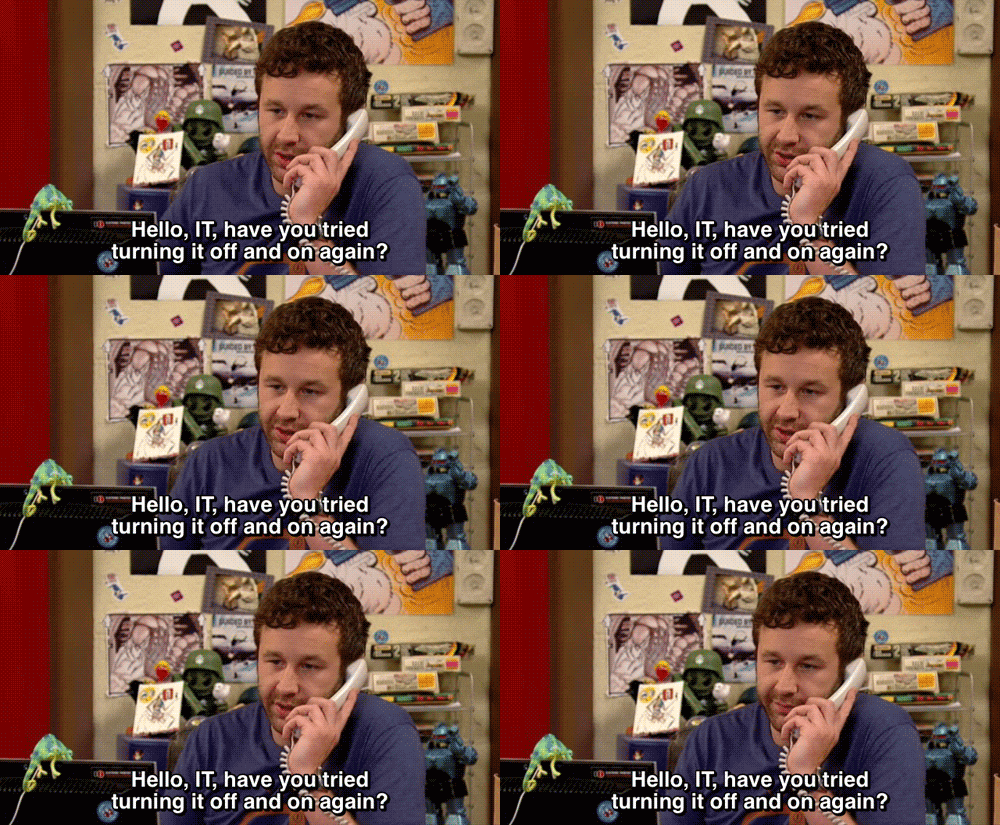
1. Digital technology generally requires specialized maintenance, and staff must be trained to troubleshoot any issues with the tech (especially if the creation of the tech was contracted to external companies). Whether that means simply turning it off and then on again, or fixing broken components, interactive components of displays should be working as often as possible. I visited the RCRM specifically to see the VR exhibit and was frustrated when it did not work. I felt that it was more disappointing to see the cool tech and then have it not work, than if they had not included the tech at all. If you don't have staff on hand who knows (or can learn) how to care for the outsourced tech, perhaps consider a less complex option.

Sometimes dealing with technology isn't as difficult as it may seem. Source.

2. Consider the ethical implications of your VR experience. The psychological impact and ethics related to virtual reality have not been studied much yet at this point. However, concerns have been voiced about the implications of inhabiting a virtual body along with the realistic levels of immersion VR experiences can offer. While I did not get to try the VR at the Regiment Museum, I do know that the experience takes the user to the front lines of the battle. Especially since the experience was designed specifically for grade school students, I question the ethics of such an experience—not that it will negatively affect all users, of course, but that it has the potential to do so since the explosions and gunshots are allegedly very realistic. The effects could be minimal, or be on opposite sides of the spectrum as the users become either desensitized to violence or traumatized in extreme cases due to their experience. Placing the user in the position of a soldier in a 4D virtual reality experience is very different from learning the content in other formats.

If simply watching a movie can affect how we perceive things like war, how would "living" it through VR affect us? Source.

3. Museums often have a habit of using tech for tech's sake—but this can be an ineffective way to engage your visitors. Before committing large amounts of resources to tech like VR, ask yourself: what is this adding to the exhibit? What am I trying to convey with this, and is it actually effective to use VR to do so? The virtual reality at MOA was interesting experience in VR, but less interesting in terms of the content. Walking through a longhouse and picking up objects within a 5 minute time limit provided no additional information for me, especially when physical longhouses were outside on museum grounds. Despite initially thinking that 5 minutes was not a very long time, I found myself running out of things to do or explore in the experience before it was over. After I finished, I found myself thinking, "Why is this here?" Especially since there was a small additional fee to use the VR here, it is definitely in the museum's best interest to make the visitor think it was worth it—whether they paid a few extra dollars or simply paid with their time.

So, while I stand firmly in the position that VR could be used as an incredibly effective way of interpreting content and engaging the visitor, museums have to be careful that they're not using technology like virtual reality "just because." Rather, it should be used because its unique qualities add something that couldn't be attained by another interpretive vehicle. Instead of chasing after the newest technologies, museums should focus on the interpretive potential and the resulting visitor experience when considering how to make exhibits innovative.

tldr; virtual reality has great innovative potential, but only with careful thought about the risks and benefits of using the technology. As long as you think it through and can justify using the tech, VR could be a great option for your museum.

With thorough consideration, you can definitely "follow your dreams" in innovative pursuits. Source.

5 December 2016

IT'S A SMALL WORLD AFTER ALL: LOOKING AT OBJECTS USING VIRTUAL REALITY AT THE AGO

MUSEUM MONDAYS

BY: EMMA HOFFMAN

Remember that scene from Alice in Wonderland where Alice drinks from a bottle labeled "drink me" and shrinks down to the size of a peanut? Or how about the crazy antics that resulted from a household experiment gone wrong in the 1990's classic, Honey, I Shrunk the Kids? If you've ever imagined what it would feel like to be able to wear a lentil as a hat, use a raisin as a bean bag chair, or hang-glide on a Dorito (Marcel the Shell references intended), look no further than the virtual reality (VR) experience that is being offered this week as part of Small Wonders: Gothic Boxwood Miniatures at the Art Gallery of Ontario.

Watch the magic happen at 1:20. Source.

The Gothic boxwood carvings on display at the AGO are intricate sculptures, originally whittled from the wood of evergreen trees (hence, boxwood). Most of the sculptures in the collection date to the 1500's and comprise miniature Christian and Catholic religious paraphernalia, including pocket-sized prayer beads, altarpieces, and rosaries (AGO, 2016). 

The VR experience of Small Wonders debuted at the December edition of AGO First Thursdays, and will run throughout this week, until Sunday December 11th. According to the AGO's website, the Canadian Film Centre's Media LabSeneca College School of Creative Art and Animation, the AGO, and artist Priam Givord have collaborated to produce a VR experience where visitors can actually walk through a prayer bead (!!!). It's basically the real-life manifestation of Alice sipping from that "drink me" bottle, except instead of galavanting through Wonderland, the experiencer literally becomes immersed within the artifacts on display. 

One of the prayer beads in the exhibition. Source.
The inside of the above prayer bead. Amazing: I know. Source.
As a self-professed technophobe and lifelong skeptic, I'm always a bit cautious to put myself in a situation during which my sense of reality might become compromised. The director of Stanford's Virtual Human Interaction Lab, Jeremy Bailenson, argues that, "Immersion comes at a cost...it's perceptually taxing at times, and it's not something that we can use the way we use other media, for hours and hours and hours a day" (Manjoo, 2016). Surely, not everyone wants to give up being able to see their immediate surroundings to traverse unfamiliar territory. However, for those brave enough to put on a pair of VR goggles and step outside of their comfort zone, VR can be an enthralling experience. VR experiences like Clouds Over Sidra: an experience that takes the participant into a Syrian refugee camp; have the potential to engender empathy in the participant through their immersion within a new reality. In the case of experiencing boxwood miniatures, the AGO's VR experience could possibly imbue participants with a better visualization of the sculptures presented in the exhibition and could incite participants to engage in further learning and research on the artifacts and related topics outside of the gallery space. Check out Small Wonders: The VR Experience for yourselves, and make sure to holler at me with your thoughts about using VR in museums and galleries in the comments!


Resources:
AGO. (2016). Small Wonders: Gothic Boxwood Miniatures. The Art Gallery of Ontario. Retrieved from https://www.ago.net/small-wonders-gothic-boxwood-miniatures. 

Manjoo, F. (2016, June 22). Tripping Down a Virtual Reality Rabbit Hole. The New York Times. Retrieved from http://www.nytimes.com/2016/06/23/technology/tripping-down-a-virtual-rabbit-hole.html.