Showing posts with label diversity. Show all posts

17 December 2021

适量 "SHILIANG" THE APPROPRIATE AMOUNT

Colour the Canvas | Jingshu Helen Yao


Back in 2020, I submitted a Chinese rice cake recipe to Cooking the Past, an online cookbook collected by a group of food historians. During the correspondence with my editor, I was asked to provide specific measurements for the amount of flour and glutinous rice that was used.

I had no idea.

Rice Cake by Helen, Courtesy of the author.


When I made the rice cake, I just raised the bag of flour over the mixing bowl and shook it. I watched the white powder pile up like snow covering a hill, a mountain in winter. I then poured water and watched it stream down the sides of the mountain of flour, like waves washing over a sandcastle. I stirred them up with chopsticks and when they refused to form a dough, I added more water, and then more flour, until the dough was neither too dry nor too wet. 

That was an honest description of me making a dough but not something I could share directly. Not without stating how many cups of flour I used, even though I don’t have a measuring cup in my kitchen; not without saying how many grams of sugar I added, even though I think it depends, none at all or a whole lot of it – both measurements make sense.

On one hand, I understand why precise amounts are needed. If someone wants to recreate the dish, four cups are much easier to follow than the “appropriate amount.” But that wasn’t how the food was made at home, not how the recipe was taught to me. Both my mother and grandmother often used 适量 (Shiliang) or “The Appropriate Amount” to describe the amount needed for each ingredient. Even if they were asked to quantify it, they would say “as much as you think is needed” or “give it a try and you will know.” To me, recipes were never written; they were told over a steaming pot, over the sizzling sound of oil, over the aromatic smell of species. That was how I learned to cook, not through words and numbers, but through watching, listening, and smelling.

Eventually, I made a guess for my recipe submission and wrote two cups of flour and half a cup of glutinous rice. But I have no idea if someone followed these instructions strictly, whether or not they could make the rice cake that I’m familiar with. Subconsciously, I felt a little ashamed for not being able to provide a more accurate answer, for not having a drawer of kitchen supplies that have numbers and measuring units encrypted. But I didn’t give the feeling much thought and forgot about it soon after.

Amazon Best Sellers Kitchen Measuring Tools, Screenshots from Amazon.ca.


When I watched Mama Put’s story in Ozoz Sokoh’s documentary, Rice and Beans, I heard the following narration: “She has neither pastry cutter or cupcake plunger but she knows how deep to stick her knife…she will not win any awards for sophistication, her own people won’t let her... and because she does it anyway, without language. Do we not call her unskilled labour?” The memory of writing that rice cake recipe came back to me. Like many videos of street food vendors that went viral online, people may look in awe at the skills, eyes wide open. But these videos would not be categorized the same as the ones that feature a clean kitchen, shiny tools, young and attractive chiefs, and measurements. Not yet.

I was really excited to connect with Ozoz Sokoh through MSL4000: Exhibition Project, where she was a guest speaker at one of our lectures. I brought up how the documentary had moved me and inspired me to think deeper about my own culinary traditions. I shared my dilemma with her about measurements in recipe writing. Ozoz replied, “I think people have to understand the difference between conceptual recipes… by sight, taste, and deep understanding; versus precision cooking by following a recipe and measuring… they co-exist and one is not necessarily better than the other.” She then introduced me to the Persian word “Andaaza/ loose estimation”, discussed by Shayma Saadat (one of Ozoz’s friends and a food writer and blogger) in an article about her mother’s Ginger Chicken. It sounded a lot like how my mother would use 适量, which made me wonder how many cultures had, or used similar terms this way – to represent knowledge that is passed down from generation to generation without defining, specifying, or measuring.

In my first draft of this article, I titled it “The Opposite of Sophistication.” But what Ozoz said reminded me of is that cooking without precise measurement is not necessarily unsophisticated, but simply a different kind of sophistication related to a different culture, a different way of teaching. Therefore I renamed it with a term that I am familiar with and have been for a long time but had not yet fully explored: 适量 The Appropriate Amount.

29 November 2019

CONSCIOUS DESIGN: ALUMNI CHECK-IN WITH BRITT BRAATEN

 Alumni Check-In | Elizabeth Cytko


Britt Braaten poses wearing a vintage apron.
Photo courtesy of Britt Braaten

Britt Braaten is the Creative Development Specialist at the Canadian War Museum. She graduated from the Museum Studies program in 2009, after switching from a law career to museums. Her museum internship was at the Immigration Museum in Melbourne, Australia where she worked in the Community Engagement/Curatorial department. 

The Canadian War Museum
Photo Courtesy of Britt Braaten

What does a typical day entail at your job?


My job is focused on the development of exhibitions; given the staff size (small!) and pace of work (fast!) at the War Museum, that means on any given day, I can expect to bounce between several different exhibitions and that each project will be at a different stage. For example, today, I reviewed and corrected design elevations for a traveling war art exhibition; reviewed English and French text for our major temporary exhibition about the Second World War, working with the historian, comparative editor, my manager and the project manager to finalize text; reviewed preliminary graphic layouts for that same exhibition and prepared comments for the designer; met with the historian to determine how we were going to fulfill a request from our Directors by adding content to that same exhibition; brainstormed potential visitor experiences for a proposed major temporary exhibition about war games; and corresponded with a colleague at another museum about balancing fun and learning in museum interactives.

What’s the best way to communicate with a team while creating exhibitions?

I think it’s important to be strategic in how you work with people:
I figure out what each person’s preoccupations are, and show that the approach I’m proposing addresses that—or, if it doesn’t, acknowledge that and invite them to help share their expertise.
I pay attention how each person likes to work—in person or on paper? Informal walk-and-talk conversations or extended workshops? —and tailor my work style to meet theirs.

It comes down to respect: respecting each others time, expertise and genuine desire to do good work. The more I’m able to understand my colleagues, the more I’m able to demonstrate my respect for them, and the better our long-term work relationships are. I find this kind of deliberate relationship management to be a critical ingredient in getting the support I need to do my job effectively.

Accessibility Guidelines
Photo courtesy of Britt Braaten

How do you approach creating visitor focused exhibitions?


In this role, my role as “visitor’s advocate” it’s my job to ask the right questions, and push back where needed.

Here is a list of the questions I consider:

Can visitors get to the exhibition?
Will they be comfortable in there?
Can they participate in a full and meaningful way?
Can visitors understand the exhibition?
Are we assuming prior knowledge in a way that will alienate people?
Will visitors care about what we have to say?
Have we totally missed the point?
Are we talking about what the subject-matter expert wants to talk about or what the visitor actually cares about?
How do we know what we know about visitors?
Can we actually talk to visitors to test our ideas before they make it on the floor?
Do we have research from past projects that could inform current decision-making?
Can we learn from our peers at other museums? Or am I relying on my own opinion and/or unreliable anecdotes?

Each of those questions plays out in innumerable ways, from intellectual decisions around the interpretive approach and content selection, to design decisions around fonts and colours, etc.

What’s the best way to include community voices/diversity in museum work?


A lot of it comes down to calling attention to instances where colleagues are treating “white man” as human-neutral (to borrow a phrase from comedian Hannah Gadsby) and see if there are other options that make sense in that case—sometimes it is a white man because that is what is authentic, accurate and appropriate for the topic. Other times, it’s just laziness, or a feeling that using someone other than a (straight, able-bodied) white man is somehow controversial or a “statement” in a way that defaulting to white-man isn’t. This isn’t always (or even often) a conscious decision, and I’ve found that calling attention to it and offering alternatives is an important and effective way to push for more diverse representation in exhibitions.

There are real impediments to representation—including attitudes and weaknesses in the collection—but I believe that this is an area where doing the work can pay off in real ways.

Britt Braaten delivering a talk during construction.
Photo courtesy of Britt Braaten

What is one of your failures that was a great learning experience?


One example that I think legitimately counts as a failure and that has influenced my approach to my job ever since comes from my first temporary exhibition at the War Museum. It was a pretty traditional art exhibition, but I was quite happy with it.

 What was the problem?

We had to reprint all of the labels—an unnecessary cost to the institution—because I had failed to account for two factors: first, in choosing fonts and colours, I worked exclusively in my office space. I didn’t think to print out samples and bring them down somewhere where the lighting matched the exhibition conditions. If I had, I would have increased the font size. But since I didn’t, it meant many visitors had to get in close to read the label. Unfortunately, I also didn’t account for how our decisions on security would impact the visitor experience: while some high-value artworks had individual alarms, for most of the exhibition, we opted for the less-expensive approach of curtain alarms—which were triggered when visitors stepped too close to the artwork. The combination of these two factors meant that many visitors were not able to get close enough to read the labels without also triggering the alarms. So the alarms went off all the time. We were able to correct this by reprinting the labels at a large enough font.

But I learned some important lessons. Now, I ALWAYS look at panels in as-close-to-real conditions as I can, early enough in the design stage that we can make changes. I also have developed a more holistic approach to exhibition development, and more of an awareness of how a decision in one department affects things in another department.

How does someone become the best ambassador for their museum?

Preparing in advance makes a real difference. In my undergraduate program, there was an unstated attitude that we should all be aiming for effortless brilliance at all things. Winging it was the highest ideal, while advanced preparation gave away that your brilliance was maybe not so effortless after all. It took me longer than it should have to move beyond that attitude and understand that what seems like effortless brilliance in others is usually the result of a lot of preparation. So the other part of being a good ambassador for the museum is being willing to do the work behind the scenes so that what you put forward into the world feels spontaneous and compelling, while in fact being very well planned.

Is there anything you wish you had done while you were in the program? 

I’m not a “regrets” sort of person. So while I’m sure there are things I could have done “better” in the sense that I half-assed a few assignments (especially in second semester of second year), I gave it the amount of time and effort that I was able to given the other competing priorities—working two part-time jobs, enjoying hobbies, seeing family and friends, etc. In fact, to answer the opposite of the question you asked, here’s a tip: nobody, not once, has ever asked me what my grades were. So, yes, I could have focused more on schoolwork and dropped one of my jobs—except that one of those jobs turned into a full-time gig after graduation, and the other covered food and rent and resulted in lifelong friendships. Or, yes, I could have stopped doing hobbies or seeing friends and put more time into my schoolwork—but those hobbies and friendships were what kept me happy and sane. So the lesson I really learned was: do what you have to do to get the degree, but not at the expense of your health and your future. Be kind to yourself, and understand that there’s a lot more to life than school.

3 April 2018

VISIONS FOR THE FUTURE: MMSt 2018

MUSEUM INNOVATIONS

BY: HANNAH MONKMAN

Hello and welcome to a special issue of Museum Innovations! As the last installment for the term, I decided to go out into our student community and ask our soon-to-be Museum Studies graduates where they think museums are headed in the future. Asking, "what's next for museums?" I wanted to highlight the fantastic ideas and insights of our grads in all areas of the museum field, from collections management to interpretation, diversity and inclusion strategies, and even museum management.

I'm so excited to see all the passion and ambition coming into the field, and with such drive amongst our graduates, we may... dare I say it? ... change the world. 

Source.
Do you agree with these visions for the future of museums? Let's see what our grads have to say!

Collections Management 

"Collections Managers & Conservationists should be more environmentally aware of their material consumption (plastics, crates, tissue paper, etc.) when protecting, shipping and storing objects. I want to learn how to lead the way in best practices and show our colleagues it is possible to waste less!"
- Jessica Baptista 

"Widespread acceptance of the use of deaccessioning in tailoring our overgrown collections to those that best fit our mandates, allowing us to properly preserve what needs to be preserved for future generations. But, of course, great power comes with great responsibility."
- Emily Welsh 

"Collections that are accessible, not just visibly but physically. Accessibility to fit a variety of communities' needs. There is a tendency to 'hoard' objects but at the same time, we say museum objects are for the public. I think museums will start to move towards using the collection to better fit the needs of the public in different ways."
- Kathleen Vahey 


Interpretation and the Visitor Experience 

"I would love to have more interpretation that immerses the visitor in a given experience to foster empathy. I don't think we need to sideline objects as a thing of the past - let's animate them in new ways and facilitate interaction (digitally, using replicas, etc.) through storytelling. Within this framework, I hope to encounter/create museum content that explores the idea of "place" at the heart of an experience. Can places be artifacts themselves?"
- Serena Ypelaar 

Source.

"I think museums are constantly learning and introducing inclusive practices. This proactive programming is preparing the future of museums to be even more aware of and engaged with different visitors’ needs that have historically been overlooked. Now museums are moving in a direction that acknowledges that there is no “average visitor,” and every person that comes into the museum has different needs - whether they are mental, physical, or emotional."
- Aurora Cacioppo

"Museums need to start to incorporating new technologies to become more inclusive and accessible for a wider demographic. I really think that museums are in a state of change already; it's just up to them if they want to take the blind leap into something new."
- Breanna Stephenson 

"Museums are in a transition in two ways. Firstly, the museum exhibition experience is becoming much more visitor-centric with an emphasis on creating a meaningful and memorable narrative with defined and tangible short- and long-term outcomes. Secondly, and especially in Canada, museums are reorienting themselves to embrace and mobilize the Truth and Reconciliation Commission (TRC) and continue to build better relations with our Indigenous communities. While it will be a long process, the results of this mobilization will change the face of museological practice in Canada."
- Bretton Weir

Source.
Diversity and Inclusion

"Where are museums headed? As a graduating class we should be asking, where can we take museums? Things I hope for (and these are just a few) include: Increasing interactivity within exhibits and during general programming. (For example, the sold out immersive Infinity Mirrors exhibit at the AGO). Museums that are more inclusive and work with communities to represent their diverse publics. I have every confidence that my graduating class will be able to lead the way in this respect."
- An Eager MMst Grad

"Becoming more relevant to a wider and diverse audience. I’d like to focus on how this can possibly be achieved through programming that is more accessible and applicable to a wider audience. I believe programming is powerful enough to engage, connect and teach a diversity of people."
- Julia Zungri

"I think - or at least I hope! - that we're going to see more concerted and sustained efforts at incorporating diversity and inclusion into museums at all levels. Community-based stories won't just be featured in exhibitions; communities themselves, as partners and staff members, will shape how collections are managed and how the museum operates. For a specific example, I think that we'll be seeing more women in positions of museum leadership in the coming years!"
- Sadie MacDonald 

"It's hard to tell, but I hope to see changes for the better. One thing I want to see is marginalized people (POC, LGBT+, disabled, ...) who are working in the museum field being represented and listened to more, and given more leadership roles."
- Anonymous 

Management and Operations

"More engagement with environmental concerns across the sector, both in programming/exhibitions and on an institutional level: carbon-neutral operations and climate justice programming especially."
- Jennifer Lee

"I believe that we are seeing a greater movement towards specialization in all sizes and facets of cultural institutions. Whereas previously some museums and heritage sites were able to operate with passionate, untrained staff curating and attending collections, developments in curatorial practice and collections management techniques mean that this tradition is no longer sustainable in the competitive cultural market. Small sites, which had previously rolled collections management and curatorial duties into one hybrid position, are moving to separate the two into individual staff members to better handle the rigors of each role and to offer a more appealing product to cultural consumers. Due to the strain this puts on the limited resources these institutions have, I foresee an increase in zero-hour contract labour, allowing these sites to reap the benefits of informed practice while saving money during off-seasons."
- Dan Rose


A sincere thank you to everyone who contributed!

16 October 2017

THE SMITHSONIAN REALLY WANTS YOU TO THINK ABOUT FOOD

A MUSE BOUCHE

BY: JENNIFER LEE

How much time do you spend thinking about your food? The everyday business of shopping for, buying, cooking, and eating food consumes enough attention that we can miss opportunities to consider the cultural, economic, and historical processes that shape our diets. If you’ve ever wondered why nutrition labels look the way they do, or who decided that carbs were bad for you anyway - or if this is the first time you’ve pondered this - the Smithsonian’s National Museum of American History might be able to help you out.


Take a moment to stop and think about food. Source. 

From Oct 26 to 28, the Smithsonian Institution will host the third annual Smithsonian Food History Weekend under the theme ‘Many Flavors, One Nation’. The weekend brings researchers, culinary practitioners, writers, and the general public to the National Museum of American History to discuss and understand the history and role of food in America. The meat of the weekend lies in the moderated roundtable discussions (free to attend and streamed online) and Saturday’s Food History Festival, a day stuffed full of food-related public programming.

Commendably, the SI keeps its yearly weekends topical; last year’s theme was ‘Politics on Your Plate’, in keeping with the end of the 2016 election campaign season. Each Food History Weekend wrestles with big and often difficult questions and themes, including identity and the politics of farm labour, nutrition, and health. In 2016, participants and attendees asked, “Whose voices are influencing food policy today? What are the critical issues, and what role does democracy play in the future of food in America?” This year, the weekend will centre on stories of migration, cultural exchange, tradition, and identity. The theme suggests that the weekend will embrace pluralism and emphasize the diversity of American food history: the ways in which all of our foodways and traditions influence each other. A public discussion on culinary diplomacy (“A new soft power, culinary diplomacy has the ability to bridge conflicts in situations where traditional forms of diplomacy have been ineffective”) seems almost comically well-timed for the current political climate.

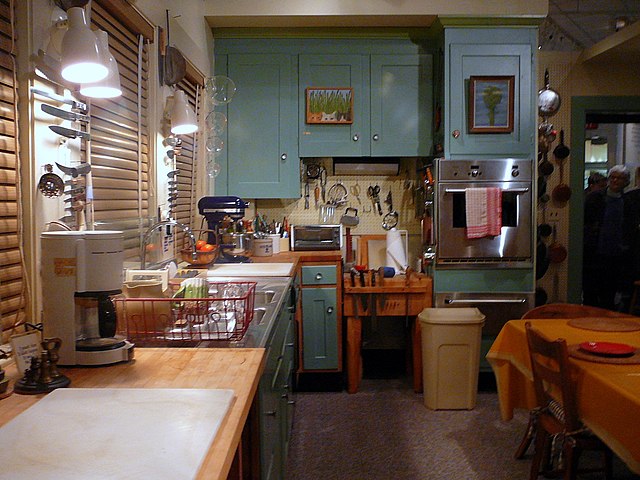
The Food History Weekend is only one pea in a pod full of food-history initiatives at the Smithsonian. The NMAH boasts a full slate (or perhaps a full plate?) of exhibitions and programming that examine why and how Americans eat the way they do. Most famously, the museum houses Julia Child’s kitchen, which was featured in her later cooking shows and relocated from her home in Massachusetts, complete with her signature copper pans.

Julia Child's iconic kitchen, preserved at the NMAH. Try to resist doing the Voice. Source. 

Child’s kitchen serves as the gateway to the ongoing exhibition FOOD: Transforming the American Table 1950-2000, which examines the changes wrought by innovation, industry, and cultural change on American diets. A demonstration kitchen hosts regular historically-inspired demos hosted by Smithsonian staff and guest chefs, and the museum runs programming outdoors in its gardens, including a recreated wartime Victory Garden. 

The Smithsonian’s commitment extends into the history of beverages. In January of this year, it hired Theresa McCulla as overseer of its American Brewing History Initiative (described by more than one media outlet as ‘the best job ever’). McCulla, a Harvard scholar whose background is in social history and food literacy, began by surveying the museum’s beer-related collections. She stated in January that she especially hopes to illuminate the overlooked role of women, immigrants, and enslaved people in the early history of American brewing.


Cheers to that. Source. 

Why this commitment to food history, and why does it matter?

Food history as demonstrated in museums (one of the most publicly accessible media through which people can learn about food) often takes the shape of demonstrating pre-industrial processes and recipes from the history of white settlement in North America: this is how pioneers made bread and brewed beer. Less frequently, museums and heritage sites may expose visitors to Indigenous foodways, usually also rooted in the distant past. These approaches are limited in time and scope: food history isn’t just about what white pioneers ate, but how all people have fed and continue to feed ourselves. What’s missing is a discussion of how we got from breadmaking in the eighteenth century to Yelp reviews of sushi in 2017, how culinary traditions have been adapted to meet the needs of the recent past and the present, and a critical look at how we think about food, including diet culture, food labour, and food literacy.

Food is both universal and highly specific. The ways in which we eat and think about eating are determined by and reflect our time, place, class, ethnicity, and gender. The universality of food as an experience makes it an ideal starting point for education: visitors already have a strong personal connection to the subject.

It’s loaded with meaning, and that means it’s well worth talking about everywhere in the public sphere, but especially in museums. At the same time, food can act as a gateway to topics we need to address more than ever: health, politics, labour, the environment, and racial and cultural difference. The Smithsonian’s food history programming recognizes that we are what we eat, and if what we eat isn’t ideal, that’s an interesting avenue to discuss, too. 

Can food history programming tell me why millennials are obsessed with pizza? Actually, yes, it probably can. Source. 

The Food History Weekend programming champions diversity, research, and critical thinking, which will be increasingly important as we face a changing intellectual landscape, in which there are facts, "facts", and Twitter. 

As stewards of material culture and historical record, heritage institutions are well-placed to help people think through historical processes and current events, and institutions like the NMAH have the resources to do this in a big way. The museum was the third most-visited Smithsonian institution last year, after the Air and Space and Natural History Museums, and welcomed 3.6 million visitors. Even without the impact of online content such as podcasts, blog posts, and the streamable Food History Weekend roundtables, that’s a pretty impressive reach, and it represents 3.6 million opportunities to get people thinking critically about their food.

If you’re interested in food history at the Smithsonian, I suggest checking out the NMAH blog's food history tag and the Food History Weekend page for videos of past roundtable events. If you're podcast-inclined, there's an interview with beer historian Teresa McCulla on the Smithsonian podcast, Sidedoor.

15 June 2016

BEER WITH ALIENS: EMP MUSEUM IN SEATTLE, WA

A MUSE BOUCHE

BY: ERIKA ROBERTSON

My post today is part exhibit review, part restaurant review, and aims to answer the question: can I imagine an exhibit without food? (If you're not sure what I'm talking about, check out my first article). 

It's that sign again! Photo by Erika Robertson

I think any stay in Seattle should include a visit to the EMP Museum. I have fond memories of the EMP's music-focused exhibits on the Beatles and Nirvana, but its mission has expanded since I was little. Today it's dedicated to “the ideas and risk-taking that fuel contemporary popular culture” (source). It feels like the astonishing building, designed by starchitect Frank O. Gehry, houses miles of exhibits. They delve into such diverse subjects as video games, guitars, and horror movies. The centerpiece of the museum is the “Sky Church,” a concert venue by night and massive HD LED screen used to display music videos during the day. I overheard a visitor ask if it was a projector and a staff member responded, “It’s the real deal—only in Paul Allen’s museum!” This museum is a place to let your imagination run wild.

Sky Church: the real deal. Photo by Erika Robertson
 
But I was there for the blockbuster exhibit, “Star Trek: Exploring New Worlds.” I know as much about Star Trek as an average person, but I wondered if an exhibit about science fiction would involve food. The EMP also boasts an in-house restaurant called Pop. Would their menu be a continuation of the galleries?

Sextant used by Benjamin Sisko, captain of the Enterprise in Deep Space Nine. Photo by Erika Robertson
 
The exhibit presented Star Trek as a positive influence on society through its diverse cast and optimistic vision for the future. The first floor touched on each of the series and movies, which gave outsiders like me a good introduction to Star Trek culture. The second floor focused on how the franchise has inspired scientists and engineers to build the utopian vision of the future through hand-held communicators and voice-activated computers. But would there be food in the future?

After ogling the beautiful artifacts, I finally spotted food in the galleries. Not surprisingly, the hit franchise has inspired a lot of merchandise, including Cardassian cookbooks and Romulan ale. The drinks were available in the gift shop, but I wasn't brave enough to try them. I wish I could report on what Cardassians cook, but the only copy was behind glass. I had evidence that even science fiction exhibits include food. My curiosity partially satisfied, I headed to Pop for more substantial fare.

The restaurant itself looks a bit like a spaceship. Photo by Erika Robertson
 
Pop’s happy hour specials were delicious, if not topical. I enjoyed the Pop burger, but it did not deepen my appreciation for popular culture. Our fabulous server revealed that she was the genius behind the “rocktails,” or cocktails named after classic hits. I stuck to my local red ale, which I definitely recommend. Classic music videos played on overhead TV screens, extending Sky Church's impact. Music added to every part of the museum without being intrusive.

Pop is a Wolfgang Puck restaurant contracted to the EMP. Because the celebrity chef’s name is not on the sign, the location has more creative freedom. Our server was enthusiastic about an upcoming remodel and seasonal specials. Maybe next time I visit, Cardassian specialties will be on the menu.

If anyone has insights into alien cookbooks, let me know. I’m really curious now!