Showing posts with label Art. Show all posts

6 December 2021

CATHERINE THE GREAT... ART COLLECTOR?

 Collections Corner Kara Annett


The art conisseur herself. Source. 

​​Like many of my peers, I’m eagerly counting down the days until the end of the semester. It won’t be long before we can catch up on sleep, spend time with friends and family, and, most importantly, have a chance to catch up on shows. For me, this means binge-watching The Great (can you tell I did my undergrad in history?). In honour of the second season being released, what better collection to highlight than that of the Hermitage Museum in Russia?

Sometime during the 1750s, a Berlin merchant named Johann Gotzkowski began travelling around Europe to purchase artwork at the request of King Frederick II of Prussia who hoped to expand the royal collection. This would never come to be, as the Seven Years War devastated Prussia in Gotzkowski’s absence, leaving Frederick unable to afford the 225 paintings that had been collected for him. Luckily for Gotzkowski, one man’s misery is another (wo)man’s fortune. In 1764, Catherine the Great bought the collection – if only to rub it in Frederick’s face that Russia could still afford to make such lavish and expensive purchases. These 225 paintings would eventually grow to a collection of over three million pieces.

Cupid and Pysche by Antonio Canova. Source. 

Catherine had a bit of a shopping addiction and by 1771 her collection had outgrown the Small Hermitage. As anyone in this situation would do, Catherine had a second building constructed to accommodate her new collection, aptly called the Great Hermitage. Since there was no point in letting all this newfound space remain empty, the museum wasted no time in acquiring the collection of Baron Pierre Crozat in 1772, closely followed by that of Sir Robert Walpole’s in 1779, and the John Lyde Browne’s ancient sculpture collection in 1787.

Rembrandt's Portrait of a Young Bachelor, part of the Hermitage collection. Source

Some of the highlights from her impressive collection include multiple Rembrandts, Raphael’s Holy Family, Pieter Paul Ruben’s Bacchus, and the infamous Peacock Clock that her lover Grigori Potemkin commissioned for her in 1766. The collection housed at the Hermitage became the envy of Europe, especially amongst the French who thought they were cheated out of the Crozat’s collection by Dennis Diderot (yes, that Diderot). This didn’t deter Catherine, who remained an avid collector up until her death. Throughout the last three decades of her life, Catherine employed several agents to travel across Europe and purchase works for her rapidly expanding collection. By 1796, she had amassed nearly 4,000 paintings and established herself as one of the greatest art collectors in Europe.

The Peacock Clock. Source

It wasn’t just all fun and games though; by building up such a prestigious collection, Catherine was able to transform Russia’s global reputation from one of supposed backwardness and barbarism to the epicentre of cultural enlightenment. However, it came at a cost: while millions of rubles were being spent on art, Catherine was also quashing growing unrest amongst peasants and serfs, who continued to suffer under feudalism. Amid the Great Hermitage’s construction, a military officer named Yemelyan Pugachev led hundreds of thousands into a rebellion in response to Russia’s continued conflict with Turkey. Pugachev ended up burning Kazan and captured Tsaritsyn before he was ultimately caught and executed by Catherine’s army, along with other members of the rebellion.
 
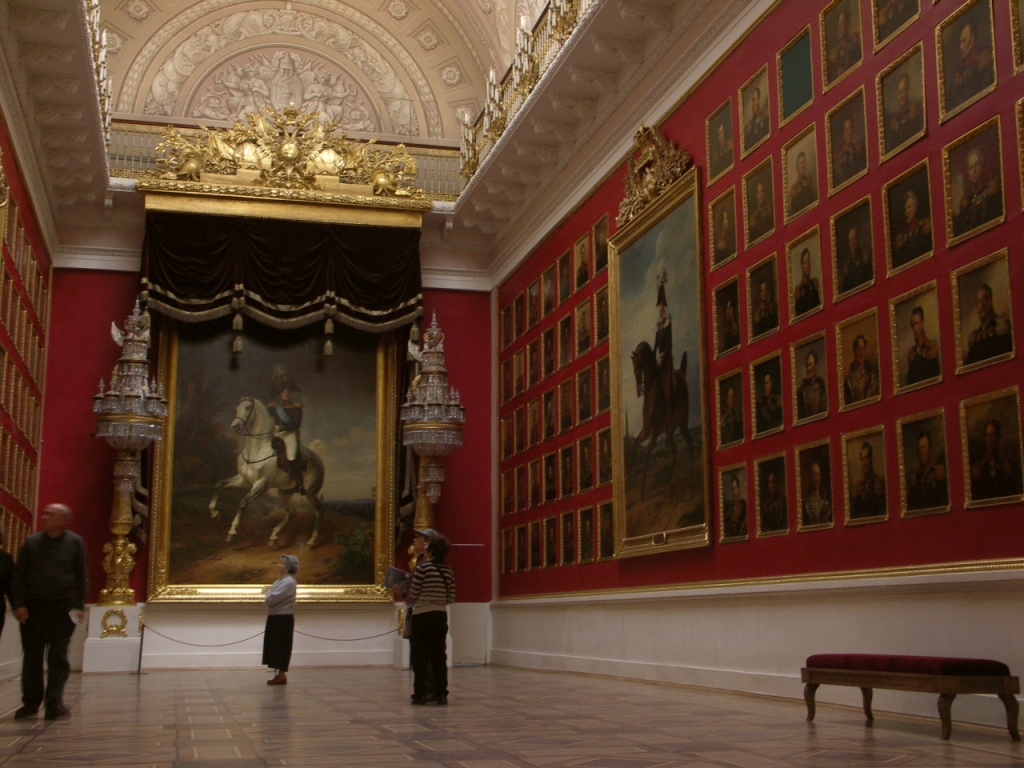
The Hall of Military Fame. Source. 

It’s undeniable that Catherine the Great transformed Russia’s reputation during her rule, leading the country to become a major power in terms of arts, sciences, and education. She supposedly embraced Enlightenment ideals with the promotion of education and freedom, yet she failed to abolish serfdom and kept thousands of people enslaved in the name of maintaining power. While her ideals were at odds with her actions, her expansive collection altered the Russian cultural landscape, establishing the country as an enlightened power to be reckoned with.

25 November 2021

THE ENDURING RELEVANCE OF PIONEERING OCCULT ARTIST ROSALEEN NORTON


____________________________________________________________________________________

"I came into this world bravely, I'll go out bravely."

~ Rosaleen Norton, artist, occult practitioner, daughter of Pan, before her death in 1979

Rosaleen Norton has only recently begun to get the cultural recognition she deserves. Despite being a tremendously influential and defining artist of the mid 20th century, Rosaleen’s unapologetic artistic legacy remains relatively obscure compared to her counterparts. Perhaps this has to do with how she was outcasted, crudely mocked and relentlessly hounded by the media. She was branded by most as a depraved, satanic witch. In the 1940s and 1950s, she became a national fascination and was perceived as a major threat to the social norms and moral orthodoxy of a predominately Christian Australia. Her artwork, tragically misunderstood, was torched by the government, confiscated by police and censored by major museums and galleries in Melbourne. She remains the only Australian artist whose work was physically destroyed by order of the courts. Rosaleen also faced charges of obscenity for her provocative paintings depicting Greek gods and goddesses, female sexuality and ritual magic. In a recently made film about the artist, director Sonia Bible proclaims that Rosaleen was once “the most persecuted artist in Australia.”


Rosaleen Norton with one of her paintings, c. 1945-1950. Source.


Born in Dunedin, New Zealand in 1917 and plagued with spiritual visions as a child, Rosaleen had always been fascinated by the otherworldly. What seems now to be an instance of cosmic foreshadowing, at 14 she was expelled from school for supposedly corrupting fellow schoolgirls with her “deviant” drawings. By her twenties, Rosaleen was mastering her occult and artistic skills, practicing Aleister Crowley trance magic and creating paintings that fused her search for transcendence with her spiritual beliefs. Being openly bisexual – in addition to her unconventional appearance, love for animals, bohemian lifestyle and penchant for worshipping and painting figures like Pan (a Greek god who resembles and is often mistaken for Lucifer) – made her a true outsider amidst the hyper conservative landscape of mid-century Australia. A 1949 exhibition of her work held at the Rowen-White Library in the University of Melbourne ended with a police raid and charges of obscenity. Later, her book The Art of Rosaleen Norton with poems by Gavin Greenlees (published by Walter Glover in 1952) was heavily censored in Australia and banned in America, and resulted in Glover also facing charges.


Rosaleen with her cat, c. 1945-1950. Source.
Rosaleen Norton with her cat, c. 1950. Source.


Even though she was admired by visionaries like Carl Jung and Kenneth Anger, the scope of Rosaleen’s far-reaching cultural impact has yet to be fully realized and appreciated. She was a subversive, fearless artist who spearheaded a path forward for generations of eccentric and bold female artists to be themselves. Her unprecedented body of work has endured despite decades of backlash and unlawful attempts at suppression. Over half a century later, her art has begun to slowly resurface in various Australian exhibitions— such as one held in 2000 that was solely dedicated to the display of her paintings in Kings Cross, Sydney (where she lived most of her life) by enthusiasts of her work. Others include the S.H. Ervin Gallery’s Windows to the Sacred: An Exploration of the Esoteric in 2013, and the City Gallery Wellington’s Occulture: The Dark Arts in 2017.


Rosaleen Norton sketching, c. 1945-1950. Source.


Despite renewed interest in Rosaleen, her work is not easy to access. Other than a handful of articles and images on Google, there is no widely accessible digital archive documenting her work, nor is it featured in any permanent exhibitions. Most of it resides in archives, private collections and rare books that are hard to come by. Rosaleen’s legacy and life’s work could have easily been lost to history. That begs the question: how many brilliant female artists have we lost due to museum censorship and government persecution? How can we ensure that the bodies of work produced by visionary artists who challenge the status quo are not lost due to museum practices that support nationalistic agendas? How can we reconcile with the fact that exclusion and censorship remain prevalent issues in museum spaces, and what can we do about it? All of us have the responsibility to continuously challenge and unsettle cultural institutions by questioning what gets to be remembered and who is included.


24 November 2020

HOW THE GUERRILLA GIRLS HOLD THE ART WORLD ACCOUNTABLE

She's My Muse | Jaime Meier


The first time I saw artwork by the Guerrilla Girls in person was during the exhibition "The Incomplete History of Protest" at the Whitney Museum, which displayed the group's criticism of said museum for its sexist and racist collection. It was impressive to see that the impact of the group was so large that it not only pushed for the institution to change, but the institution displayed the works to publicly hold itself accountable and acknowledge its shortcomings. One of the most interesting things about the Guerrilla Girls is that, in addition to their impactful art, they are able to organize group action through anonymity and intersectionality

"History of Wealth and Power" by the Guerrilla Girls | Source

The Guerrilla Girls are known for their posters that call attention to gendered and racial inequality within art institutions, with their most famous poster comparing the amount of female artists and amount of naked women on display at the Met. Natalie Sherman's article gives a great overview of the group's history, beginning in 1985 and continuing to the present. A consistently relevant 35-year career is no easy feat within the art world and I believe this success is due to the 55 members that have joined the group over the decades. Some members stay for weeks while others stay for years, with the fluctuating membership allowing for new talent and ideas to keep the group relevant. A major part of their appeal to so many members is their dedication to intersectionality.


"Traditional Values and Quality Return to the Whitey Museum" by the Guerrilla Girls | Source

While the title "Guerrilla Girls" instantly associates them with women, the heart of their organization is feminism, which transcends gender. One of my favourite things about the group is that they do not homogenize by only looking at gender, they also consider racial implications that impact artists of colour. Their earliest works, such as "Traditional Values and Quality Return to the Whitey Museum," important demonstrate the distinction between gender and race. Most recently, they created a video in response to the ongoing police brutality in the United States. 

"NYC Recount" by the Guerrilla Girls | Source

Every few years the Guerrilla Girls update their posters to analyze how and if things have changed within the institutions they have critiqued. The continued accountability and calls to action are crucial for continued and sustained change. The updates often reveal minor improvement and quickly remind the institution that a one time or slight improvement will not be accepted in the place of sincere change. I believe the Guerrilla Girls are creating an art world that will allow for more people to enjoy art institutions because they will actively see themselves reflected and be more likely to engage. 

31 July 2020

“THE MONA LISA WAS DISAPPOINTING:” THE MYSTERIOUS WAYS THAT ART BECOMES A MASTERPIECE

Museum Mysteries | Jaime Meier


The "Mona Lisa" by Leonardo da Vinci (Source)
The “Mona Lisa” by Leonardo da Vinci is known by art lovers and avoiders alike. The painting resides in the Louvre Museum in Paris, which is one of the most visited museums in the world as evidenced by its 9.6 million visitors in 2019. Contrary to what you may believe, the Mona Lisa does not loom in popular culture because of her beauty and cheeky smile. Rather, her notoriety is concertedly preserved by the people and institution which house her.

When the “Mona Lisa” was acquired by the Louvre in 1804 and subsequently hung, the painting “wasn’t even the most famous painting in its gallery, let alone in the Louvre.” But on August 21, 1911 the painting was stolen and swiftly hurled into the international art scene by sensational media coverage. The painting was regained 28 months later when one of the thieves attempted to sell it to an art dealer in Florence. The “Mona Lisa” was hence returned to the Louvre a new woman.

The international media sparked an interest that has led millions of people in the century since to traverse the Louvre and whirl past statues and paintings to reach the “Mona Lisa,” only to be disappointed by its size, quality, or the swarm of people surrounding it. This is because the “Mona Lisa” has been deemed a masterpiece, and thus people must be able to recognize its splendor on sight, right? The problem is that the idea of subjectivity in art and pronouncing certain artworks as masterpieces are two ideas that cannot coexist. To truly allow all people to enjoy art, the hierarchy and status of certain mediums and painters must be dismantled. The expectation that one can recognize and feel a great work of art on sight is upheld by an upper class who have access to knowledge about art history but establish their elite and special status as art connoisseurs by spreading the idea that a great work of art is simply “known.”

A crowd in front of the "Mona Lisa." (Source)

Advertisement on the Louvre website. (Source)
The act of seeing the “Mona Lisa” is also hardly about the artwork; it plays into a social game, as established by Pierre Bourdieu, that relies on continuous interest and participation by visitors to ensure its continued status as a must-see masterpiece. Many people grow up hearing and learning about the “Mona Lisa,” creating an investment in it that may urge them to travel and see the painting for themselves. By visiting the painting and spreading positive or negative reviews, this very act ensures the continuation of the game by either encouraging others to experience its enchanting brushstrokes and chaotic crowd or become an art topic to complain about.

The Mona Lisa is not inherently a masterpiece – no artwork is. That is simply the value invested in by an elitist culture that seeks to prevent others from fully enjoying art. If art is indeed subjective, then one should enjoy it on their terms, not the ones decided for them. Whether you are interested in art or not, I, a resident art lover, encourage you to re-examine why certain works of art and their makers are given a certain status over others. Come to your own conclusions about the art you enjoy and the art you would prefer to avoid.

20 May 2020

THE UNKNOWN CREATOR: THE MYSTERY BEHIND INDIGENOUS CRAFT ARTISTS


Alongside art and cultural objects, museums preserve the names of those who created the items, except in the case of Indigenous peoples whose personhood often fails to appear in the official museum record. One of these reasons is due to the unfortunate binary created between craft and art. We typically think of art as paintings, sculptures, or drawings, while craft denotes pottery, textiles, or woodworking. This gap has been greatly contested over the past decade and my use of “craft” is of great respect for the practice that rivals or exceeds other art practices. Emerging craft artists are more readily recognized for their works, especially due to the growth of social media, but museums are still left with many brilliant craft items created by unknown Indigenous artists.

Coiled Tlingit basket made by Unknown (Artist). (Source)

Many Indigenous craft items, such as woven Tlingit baskets, are utilitarian and used by various family or community members. A special acknowledgement of the creator was not a necessity, as members of the community knew who the item was created by and it was created for public use rather than just visual appreciation. When these objects are brought into museums, the makers are listed as “Unknown.” Dolores Churchill, a Haida elder and basket weaver, has said, “As long as Native art remains in museums, it will be thought of in the past tense.” The use of the “Unknown" artist only reiterates the idea of a past culture by amplifying knowledge that was lost to time and does not continue into the present. The item was not created by a Tlingit artist, but a depersonalized and uniform Tlingit culture.

"Peace Treaty Belt" made by a Haudenosaunee Artist. Photo courtesy of Jaime Meier. 

As of now, the names of the artists involved in Indigenous craft are either irrecoverable or museums lack the resources or to solve the mystery. The National Gallery of Canada has made the decision to move past listing unnamed Indigenous artists as “Unknown” and have relabeled to acknowledge the artist in connection to their nation. For example, as an “Haudenosaunee Artist,” thus bridging the gap between artist and community. The artist is no longer an unidentified person, but rather an artist who carries the spirit of their community. The Royal Ontario Museum (ROM) has taken similar steps in their online collection, listing the maker based on the Indigenous community who created it rather than simply an affiliation.

"Lacrosse Stick" made by a Haudenosaunee Artist. (Source)
Museums are closely drifting away from the use of the “Unknown Artist" to the benefit of the public, the original artist, and the artist's community. Social media has made it difficult for Indigenous craft artists to remain unknown, as many have thriving social media accounts and online shops. Whether it's beadwork, tufting, or birch bark, Indigenous artists are reclaiming craft, identities, and their places in the art world. 

5 March 2020

LOOKING FROM BEHIND THE GLASS: CHALLENGES WITH DISPLAYING FASHION

Sew What | Natalie Heaton
The trend to display fashion and textiles is becoming increasingly popular in museums. Curators often run into issues when it comes to displaying garments, like many objects within institutions.  For decades, fashion exhibits were struggling to be accepted because they were not seen as "real art" because it was controlled by the female sector. This article will dive into these challenges and try to understand how these challenges came to be.

Christian Dior Exhibition, Glenbow Museum, June 2019
Photo Courtesy of Natalie Heaton
The National Scottish Museum, May 2019
Photo Courtesy of Natalie Heaton
One of the largest obstacles that institutions face that the guests are unable to touch the garments. When it comes to clothing, the main sense that guests use is touch as it is what is familiar to them. Most museums do not allow the guest to touch the artefacts and more often than not, the garments are kept in glass cases while on display to protect and ensure its longevity. An example of a museum that does this is The National Scottish Museum in Edinburgh. This institution keeps all its garments in glass cases while on the floor. Since guests are not able to handle the clothing, the curator of the exhibition must find a creative way to solve this problem.

An additional obstacle that fashion and textile exhibitions often encounter, despite curator’s best efforts, is the affiliation with shopping or consumerism. Often, guests will associate what is in an exhibition to what is familiar in their lives. In this case, the guest will be related to one’s personal experiences of shopping or the clothing that they are wearing. This may be a strength because the institution does not have to contextualize the item, but with that being said, the museum may struggle to make the guest understand the object in a different way; to understand it as a form art.

Christian Dior Exhibition, Glenbow Museum, June 2019
Photo Courtesy of Natalie Heaton


This struggle with guests understanding fashion and textile as a form of art is nothing new. In fact, this has been a struggle for as long as museums have been around. “The European 19th century’s male-centric curatorial view understood fashion as a form of feminine folly.” This legacy has continued to be associated with fashion and textile exhibitions within the museum setting. Critics of these exhibitions continually undermine these exhibitions as they view them as a highly feminine, and just a way to keep the institution trendy, but never as art.


However, there has been a shift in recent years within fashion exhibitions to look at the construction of the clothing instead of just the garment. Through this shift, fashion is being considered as an art form based on the construction that goes into the different aspects of a garment. An example of this would be Iris Van Herpen: Transforming Fashion at the Royal Ontario Museum (ROM) in 2018. The exhibition focused on the creation of Van Herpen’s extravagant dresses, with videos, images and didactic stations. The emphasis on craftsmanship and the creation of Van Herpen’s garments is an example of how fashion is considered a form of art.

Iris Van Herpen: Transforming Fashion, ROM, October 2018.
Photo Courtesy of Natalie Heaton
Overall, fashion and textile exhibitions continue to evolve with the times. While, there continues to be a struggle for these exhibitions to be taken seriously and viewed as a form of art, they remain some of my favourite exhibits to visit.

13 February 2020

A MUSEUM WITHOUT STUFF?: NON-COLLECTING MUSEUMS

Collections Corner | Jaime Meier 


It is safe to say that collections are a major part of museums and their adjacent institutions. While collections can serve as a cultural cornerstone of museums and galleries - defining their mission and values - there has been a unique departure in many contemporary art institutions. Many modern and contemporary art galleries have defined themselves as non-collecting institutions, meaning that they have no permanent collection. Contemporary art appears to find itself at uncommon intersection, it is deemed important for institutions to make available but not important enough to own. But, the issue is more complex than that.

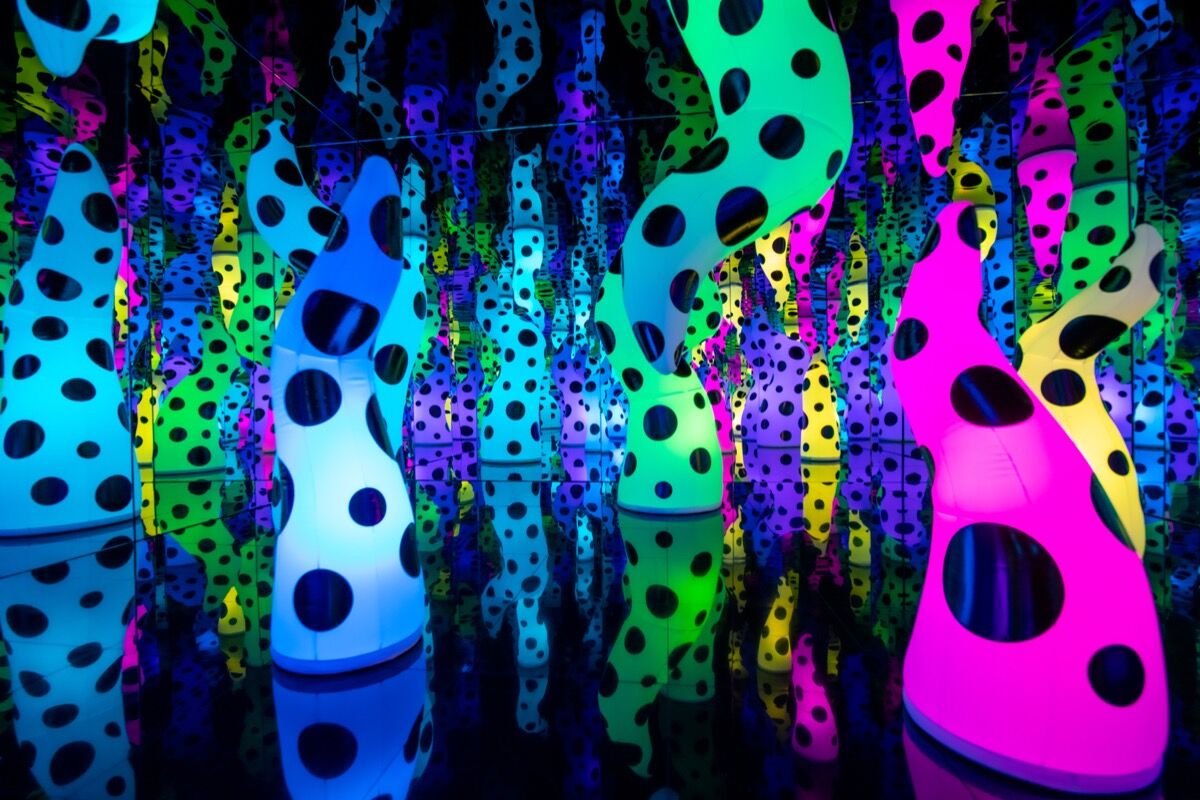
Yayoi Kusama's work is beautiful but if we focus on finding its specific meaning, it can be hard to decipher. (Source)
Contemporary art easily confounds and intimidates the public (myself included), it should be of some consolation that it also intimidates collectors. All of us have seen an abstract contemporary art form, whether it be a Warhol or Pollock, and know it has immense monetary value and yet the reason completely escapes us. Contemporary art can be experimental and strange, that deciding on the value can be nearly impossible. If an institutions invests in an artwork too early and risk never seeing the money pay off or wait too long and have the art become too expensive to purchase. The premise behind non-collecting for contemporary art emerged for these fears coupled with the desire to promote and raise awareness of challenging and evolving art practices.

With a non-collecting museum, ownership is de-centered as the foundation of the museum structure, allowing for cultural exchange to occur in other forms. Documentation fills the gap of collecting by recording visual or written information about the context, concept, and process of the art and exhibition. Instead of physically collecting and item, interaction and mediation is preserved. The lack of collections also means precious money is saved by not employing conservators and collections staff. Processes such as accessioning, deaccessioning, and repatriation become a non-issue. The lack of funds being spent on collections can be redirected into high quality public programming, outreach, and education.

Image result for powerplant toronto
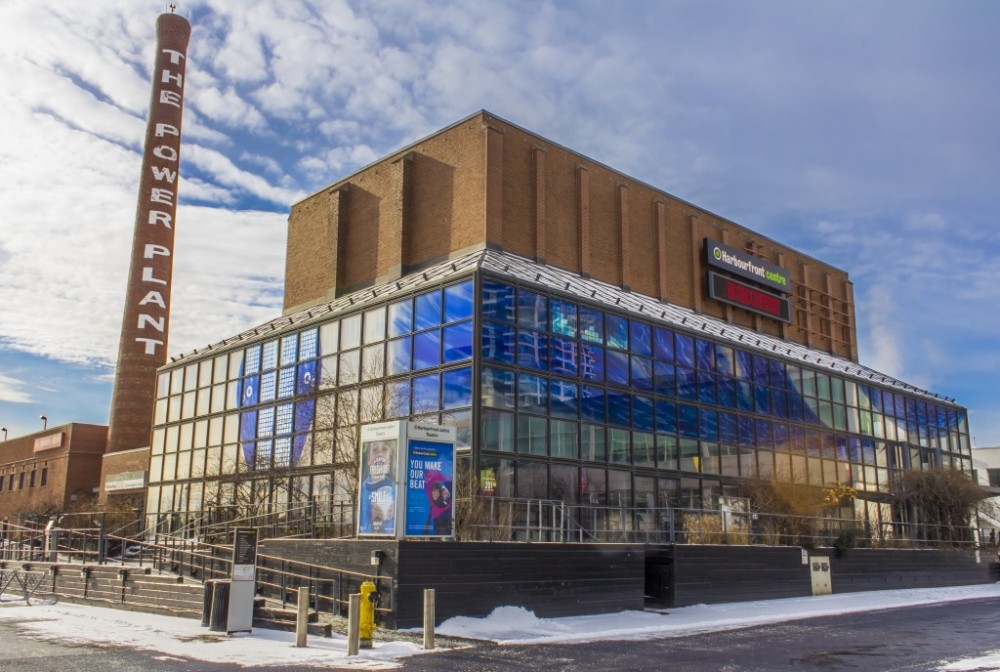
The Power Plant Contemporary Art Gallery, Toronto. (Source)
While there are many benefits  surrounding the collection of contemporary art, it brings up important concerns surrounding the livelihoods of artists. It is impossible to have a functional and thriving art community without providing monetary support to the artists. The Power Plant in Toronto has become a place, that despite its lack of collecting, provides a beneficial relation to artists. Their strategic plan for 2019-2022 outlines their mission to commission new works of art, therefore not collecting but still funding important projects. As a part of their 2018-2019 programming schedule, they also provided portfolio nights and other events for their artist members.

Non-collecting museums and institutions are almost exclusively found in the contemporary art sector. While this allows for more money to go into public engagement and projects, money is not always being used to directly support artists. I am curious to see if this model will continue and the longterm role it will play in the expansion or depreciation of contemporary art.

4 December 2019

KIDS THESE DAYS: THE AGE OF YOU AT MOCA


Exhibition Reviews | Mary Wallace 

Toronto's Museum of Contemporary Art’s current show focuses on a very intimate and socially relevant topic: “You” or rather the concept of “you” in the face of the internet age. The Age of You examines what individuality means in an age where we have constant internet access and the internet has constant access to us. The show features work from over 70 artists in various mediums, curated by Shaman Basar, Douglas Copland and Hans Ulrich Obrist. Most of the show appears in the form of posters with images of art and related text; these posters are divided into thematic chapters. Many of my fellow editors and likely you reading this, have seen The Age of You and have probably formed a strong opinion of it. The show is divisive (I would guess intentionally so) which is why I was initially hesitant to write about it. I, personally, did not enjoy the show but I didn’t want to write a review that just amounted to venting. So after gaining some distance and taking some time to think about it, I am ready to share my opinion in my professional capacity as a critic.

I, personally, did not enjoy the show but I didn’t want to write a review that just amounted to venting.

(Photograph courtesy of Mary Wallace)


Well maybe with a little venting.

What is this exhibition saying? What is its Big Idea? I was not able to figure this out. Of course, the job of art is not always to inform; asking a question is a perfectly valid driving force for a show. However, The Age of You does not ask a lot of questions, it prefers to make statements.


(Photograph courtesy of Mary Wallace)

Lots of them.

(Photograph courtesy of Mary Wallace)

Most of the exhibition’s text is written in the second person, as though speaking to “you” directly. The use of the second person creates a sense of urgency but it has the unintended side effect of making the writers’ assumptions about the reader very clear, especially when those assumptions are wrong. For instance, the exhibition presents a very specific notion of what individuality is (or used to be) and does consider other potential versions of “the self” in a serious way. A good example of these incorrect assumptions appears in the chapter labeled “The New Crowd”.


The centre text reads: "Do you feel safe in a crowd? Do you feel in danger in a crowd? Do you feel alone in a crowd? Do you form bonds in a crowd? When does a crowd become a mob? Is a social movement a global crowd? Is it hard to be an individual when being in a crowd has never been easier?" (Photograph courtesy of Mary Wallace)

The text on the left reads: "What is the opposite of you? ...me? ...a crowd? ...a machine? ...some yet-unnamed entity?" (Photograph courtesy of Mary Wallace)


At the very least this section asks questions of the viewer. I found the question "what is the opposite of you?" very compelling but I did feel the same way about the exhibition's answer. The Age of You is deeply nostalgic for a lost sense of “classic individuality”. Classic individuality in this case is presented as some kind of Golden Age of the self; one that I don’t think has ever existed. Was the opposite of “the self” ever “the crowd”, was the opposite of “man” ever “nature”? I would hope not. To consider the notion of individuality as simply being separate from the world around you and from other people, to me is a deeply cynical position. I myself find the prevalence of social media anxiety inducing, but to long for separation from everyone and everything is not a healthy response to that anxiety.

Was the opposite of “the self” ever “the crowd”, was the opposite of “man” ever “nature”? I would hope not.

There are also sections where the text is outright mean-spirited.

The small text reads: “Dating sounds as old fashioned as courting. Chaste, consequence-free messaging, communal laptopping, asexual cuddling and body contact negotiated through legalistic consent dialogs, all followed by ghosting. The relationship’s never over, because it never really started.” (Photograph courtesy of Mary Wallace)

It sounds like this poster was written after a disappointing Tinder date or maybe the writer is upset that they had to do consent training at work. Once again, I could not relate to the exhibition’s nostalgia for a time when “consent dialogue” was not considered in the dating scene; I know very few people who would. Maybe if I knew what “communal laptopping” meant I could relate more.

The small text reads:"For a few centuries, smart people— who, being smart— more or less ran the world. The flattening effect of the internet has allowed the world to be run by people with an IQ of 100. It is the revenge of the bell curve." (Photograph courtesy of Mary Wallace)
Similarly, I could not understand this poster's longing for a time when smart people "more or less ran the world". When was that exactly? I cannot think of a time, much less a few centuries, when intelligence was the only determining factor in running the world.

This void emoji is calling to me, or maybe it's just the emergency exit. (Photograph courtesy of Mary Wallace) 
I had a hard time determining the level of irony in this exhibition; whether I was supposed to agree with these statements or if they were meant to be like the inflammatory statements of an internet troll. If that is the case then this exhibition is brilliant. It perfectly captures the feeling of reading a rant on an internet forum. One of the reasons I was hesitant to write about The Age of You was because I didn’t want to prove the exhibition right by ranting about it on the internet (the very thing that is supposedly robbing me of my very soul) but what is the alternative? Letting an artwork dictate my internet usage? Not exactly the actions of a classic individual either.

But don't just take my word for it. The Age of You will be on at MOCA until January 5, 2020.  

18 October 2019

IS NUIT BLANCHE WORTH IT?


Exhibition Reviews | Mary Wallace

Transformation by Fezz Stenton and Daniel Lanois (Photograph courtesy of Mary Wallace)

Full disclosure. I stopped going to Nuit Blanche a few years ago after a particularly poor experience and have not revisited it since. I found the crowded streets and party atmosphere more anxiety-inducing than enriching. However, for the sake of this review I thought I’d put the past behind me and give Nuit Blanche another chance. After all, how could hundreds of people spending their hard-earned Saturday night enjoying art be a bad thing? Here are some of the best and worst experiences Nuit Blanche 2019 had to offer.

Tile-Scape by Kevin Winn, Archer Pechawis and L.C.I. CyberARTS (Photograph courtesy of Mary Wallace)
Tile-Scape.1555 Danforth Ave.

I began the evening by visiting one of the Danforth’s two listed works. Tile-Scape, a collaboration between Kevin Winn, Archer Pechawis and L.C.I. CyberARTS, consisted of a long table of interconnected scrabble boards interrupted by hand-made recreations of the forest floor. Each participant was given a small bag of letter tiles and set loose to create words in amongst the leaves and roots. The experience is meant to remind the participant to think about the mark they leave on the earth and in their community. I was delighted to find that my fellow participants had not left any rude messages but instead put in the effort to create some interesting words, highlights included “BOBA_TEA”, “PUTRID” and the surely not scrabble dictionary approved but none-the-less evocative, “BADPAIN”.

Tile-Scape detail (Photograph courtesy of Mary Wallace)


Tile-Scape was a fun community art piece, that encouraged creative interaction between neighbours. While not as flashy as other installations, it had clear heart and effort behind it. This piece was definitely worth the visit.

Project GUNK. Bay and Albert St.

Project GUNK by Reza Nik and Matthew Davis (Photograph courtesy of Mary Wallace)

In the shadow of the larger piece in Nathan Phillips Square, Reza Nik and Matthew Davis’s Project GUNK might have been easy to miss, but by the time I had reached it there was already a line to view the installation. Outdoor artworks in the Downtown area were almost universally surrounded by metal barricades with lines outside to enter, not unlike rides at the EX. Once I had gotten through the line, I was ushered into a small area filled with found object sculptures. I examined them, a little unsure of what to think, since I had not been able to read the accompanying text panel without leaving my place in line. Once I had left the barricade pen, I was able to circle back and read the text. The sculptures were made from roadside trash found in each of Toronto’s 25 wards, as a way to find use for the discarded items the city produces.

I enjoyed the idea of Project GUNK and will keep an eye out for their work in the future but the experience was hindered by the limitations of Nuit Blanche’s display methods. I could see this idea working if the sculptures were larger or had been manipulated by the artists more. As it was, even for a self-described art lover, waiting in line to see artfully stacked patio chairs was a hard sell.

Transformation. 661 University Ave. MaRS Discovery District.

Transformation by Fezz Stenton and Daniel Lanois (Photograph courtesy of Mary Wallace)

Transformation by Fezz Stenton and Daniel Lanois was among the weaker pieces available at Nuit Blanche. Inside the building’s main lobby, mammoth blow up versions of plastic trash loomed over the crowd, all under the glow of a massive LED sun. The pieces were accompanied by video footage of activists and scientists explaining the reality of climate change and how important it is that we, the audience, take action. While I fundamentally agree with the idea of Transformation, standing next to large installations made of plastic, surrounded by hundreds of electric lights and LED screens, the message rang a little hollow.

The actual experience of Nuit Blanche as an event often undermines the enjoyment and understanding of the art. It’s hard to be inspired or moved by these heavy hitting topics when you are shuffling through a line as though you’re about to ride Space Mountain. The best way I can explain this feeling is through this photo I took in the MaRS building, in which futuristic glowing Lilly pads are plastered with hastily printed signs warning the crowd not to step on the art, lest it be ruined I suppose.

Transformation by Fezz Stenton and Daniel Lanois (Photograph courtesy of Mary Wallace)

Ultimately, the piece I enjoyed the most that evening was the smaller artwork in my own neighbourhood and I don’t think this is a coincidence. Nuit Blanche is at its best when it’s displaying accessible, community oriented art that gives audiences a new chance to engage with contemporary artists right in their own backyards. If you are considering going next year, my advice to you is the same advice I’d give for picking a restaurant: skip the major installations downtown and check out the independent projects in smaller neighbourhoods, where there are some hidden gems waiting to be found.

14 June 2019

CULTURAL HERITAGE QUIZ: PART 2

Heritage Moments | Selin Kahramanoglu


Ready to test your knowledge?

This month's post will focus on the varying levels of significance associated with cultural heritage. Now, we could easily write a whole book series on this subject, but I want to give you a light-read for the summer. So... here is another quiz to get you thinking about it!

As mentioned in the last post, this quiz is a little challenging because the significance given to a cultural heritage item will be different for everyone. Often, museum professionals and archivists (my other love) are faced with the problem of limited storage space and resources. As much as we'd like to, we can't keep everything! This quiz will hopefully give you an idea as to why some cultural heritage is worth keeping over others.

Image result for holi
An image depicting Holi, the Hindu Festival of Colours. Source.
For the following items, decide whether we should SAVE or TOSS each example of tangible or intangible cultural heritage. Remember: Cultural heritage can be material or immaterial, and it represents the legacy of a group of people, which has been preserved for future generations.
  1. Oral History of Lake Saint Anne: A Métis story about the healing properties and spiritual energy associated with the waters.
  2. "The Entombment": An unfinished painting by Michelangelo, depicting the burial of Jesus Christ after the crucifixion.
  3. "Purple Rain" Cassette Tape: A 1984 song by Prince.
  4. Two thousand pieces of pumice stone: These tiny 3 cm x 3 cm pieces of volcanic debris are from Pompeii.
  5. Mapuche Language: Spoken primarily in parts of Chile and Argentina, there are approximately 100,000 speakers in the world.
Here we go! Answers will follow!


Oral History of Lake Saint Anne: SAVE

The whole purpose of oral histories is to keep telling them to the next generation! We cannot discard an example of intangible heritage that is closely linked to the present-day functions of a culture. Storytelling that is representative of a culture's ideologies and practices can be preserved by talking in-person, or by audio-visual recordings, and should be considered a priority. This is particularly important for indigenous groups, but intangible heritage is generally valuable for every culture.


"The Entombment": SAVE

Now, if an artwork is incomplete and we cannot communicate with the owner, there are all kinds of debates about whether the piece should be sold or displayed at all. However, unfinished work by a famous artist, such as Michelangelo, now that's definitely a keeper. For art historians, it is rare and fascinating to study the creative process of a well-known painter. To add, it is rumored that Michelangelo stopped working on this painting, because he was commissioned to start his best known work, the "David" sculpture. The context of the cultural heritage item is important!


"Purple Rain": TOSS

I'm not saying that Prince's music is bad. I'm saying that cassette tapes are not worth keeping. In this technological era, music is digitally preserved. If an archive chooses to keep a cassette tape, this means that they also need a cassette player, and they need to keep it in good condition for a long, long, time. How many cassette tapes should they keep? For how long? There will be a time when these formats are no longer accessible, so we should update these records to their latest versions, before discarding the old ones. 


Pumice Stones: TOSS

Do you know how many pumice stones exist from the eruption of Vesuvius? Many. I don't have space in my storage closet for all of those rocks. Not only that, but pumice stones are created all the time, and are not unique to just Naples. (You can even buy them at the drug store.) It's true that the ancient site of Pompeii is historically significant, which is why I suggest the local museums keeps a couple of stones from that particular event, if any. No more than that! It's interesting to preserve a piece of history, and perhaps new information can be discovered about the artifact in the future. Most importantly, this piece of natural heritage needs to stay at it's site of origin, preferably in situ.


Mapuche Language: SAVE

Real talk: The sad truth is that you don't always have the power to save cultural heritage. The amount of money your institution may have, the number of resources, or the level of expertise of your staff does not matter. Much like oral histories and ceremonies, languages are difficult to preserve because it depends on the participation of the public. You cannot keep having Mapuche speakers, if no one is willing to learn the language. We cannot force people to see the value in preserving cultural heritage. The best we can do is educate others on why it is important to keep, work as a team, and try to save it for as long as possible.


That's it for this month's post! Deciding to save or toss cultural heritage is never easy, because we hope to keep it all. Everyone has their own opinions on what is important to preserve. To help facilitate our choice, we assess the needs of the public, the item's importance to future generations, and our available resources for preservation. See you next time for our final quiz!

Further Reading
- "Lake Saint Anne" as told by Marge Friedel, a Métis Elder from Edmonton
- University of Saskatchewan Indigenous Studies Portal for oral histories
- More examples of unfinished artwork
- The Guardian's list of endangered languages in the world