16 April 2018

BREAKING MUSE: BRIEF HIATUS AND TWO NEW EDITORS-IN-CHIEF

LETTER FROM THE EDITORS

BY: AMY INTRATOR & KATHLEEN LEW

Your incoming Editors-in-Chief! Left: Kathleen Lew; Right: Amy Intrator.
Photo Courtesy of MUSSA.
Hello Musings readers! We are delighted to introduce ourselves as Musings’ incoming Editors-in-Chief for 2018/2019. That’s right, in Musings’ 5th year and approaching MMSt’s 50th anniversary you get two Editors. 

Source.
You may know us from our duo debut with the MUSSA Women and Leadership panel coverage. Amy was previously the Musings Administrator, and a Contributing Editor for the Greatest Hits and Beyond Tradition columns. Kathleen was a Contributing Editor for the She’s My Muse column. We have both immensely enjoyed writing about museums this past year, and we cannot wait to further our involvement on the blog as Editors-in-Chief. Writing for Musings has been a highlight of our MMSt experience thus far, and this is an incredible opportunity to lead the blog that has brought us so many wonderful memories.

We love engaging in dialogue about museums and Musings is an outstanding digital platform to explore writing and social media engagement. We hope to continue to evolve the Musings platform with our own ideas and goals over our term as Editors. 

Outgoing Editor-in-Chief Serena Ypelaar (Center) passes the throne to Kathleen Lew (Left) and Amy Intrator (Right)!
Photo Courtesy of Aurora Cacioppo.
We would like to thank our outgoing Editor-in-Chief, Serena Ypelaar, for her exceptional leadership and guidance throughout the last year. To say we have big shoes to fill would be an understatement! Serena fostered a sense of stability and community for all of the Musings Contributing Editors, and she also built Musings’ digital presence and community engagement. Musings has lost one of our greatest muses, but the museum world just gained a brilliant emerging professional. We can’t wait to see what you do next, Serena!

To the team of individuals Musings relies on: Professor Costis Dallas, for your guidance and support, iSchool faculty and students who read and share our work, and our phenomenal team of Contributing Editors, both first and second years – thank you. Musings wouldn’t be able to publish thought-provoking, dialogue-starting work without you!

To the graduating class, best of luck in future endeavors! Our first-year of the Museum Studies program was shaped by our excellent friends and colleagues in their second year of the program. We have no doubt that the graduating class will make their mark on the museum world, especially after attending some of the fantastic student exhibitions openings!


Finally, thank you to every one of our readers. Musings depends on the dialogue and support of our readers worldwide, and we hope you will all join Musings on our next journey!

Musings will be on a brief hiatus for the rest of April, but starting in May we will return with exciting new content! If you’re interested in the museum internships our students are completing across the country, stay tuned for Internship Check-In. If you’re an incoming Museum Studies student… welcome! Our Grad School Guide column will provide you with some tips and tricks for hacking your first year of the program.

During our brief intermission, keep an eye on Facebook, Twitter, and Instagram for all your Musings updates, and if you’re really fearing two Musing-less weeks, catch up on a year of phenomenal Musings content! See you all in May!


13 April 2018

THE NEXT GREAT ADVENTURE: TIME TO SAY GOODBYE

LETTER FROM THE EDITOR

BY: SERENA YPELAAR

Well, this is it ... this week our #MMSt2018 cohort finished our coursework for the Master of Museum Studies! I'm so proud of my colleagues for all the amazing things we've accomplished together these last two years!

Of course, graduating from the iSchool means leaving the position of Editor-in-Chief. It's been a whirlwind year of growth, learning, and community, and I'm having a hard time writing this post as I know it will be my last for Musings.

I really, really don't! Source.
Having had the privilege of being your Editor-in-Chief this past year, I want to express how grateful I am for this invigorating role. Every week brought a new challenge, but I can readily say that each one taught me so much about leadership, the museum world, and the importance of working together to make good things happen.

Some of the lovely Musings team members at the Holiday Party!
From left (r): Emily Welsh, Julia Zungri, Kristen McLaughlin, Katlyn Wooder, Kathleen Lew, Amy Intrator;
(f): Jennifer Lee, Leore Zecharia, Sadie MacDonald, and yours truly. Photo courtesy of Serena Ypelaar.

When I stepped into the Editor-in-Chief position last April, I sought to enrich our digital presence through social media and facilitate more inclusive conversations by tackling challenging and underrepresented topics. We looked at how we commemorate individuals and events, especially difficult legacies. We looked at environmental sustainability and the future of museums. How can - and more importantly, how should - we do things differently?

We have the power to change the direction of museums and public dialogue through our work. Source.
There are so many directions we can take museums, as long as we don't overlook the possibilities. This week I've been listening to Hamilton band Arkells' new political anthem, "People's Champ", and I realized the lyrics sum up some of the themes we've tried to confront this year on the blog: You've got no vision for the long run / You've got no sense of history / You've got the world at your fingertips ... I'm looking for the people's champ! 

It hit me: museums can be the "people's champ".

We've learned that museums aren't neutral spaces. If we look back at what they've done in the past, what they're doing now, and what we can do going forward (which we've examined in our program and on this blog), we can actively initiate a more inclusive future in which museums truly serve their diverse and rich communities.

Talking about digital relevance with the Musings Panel at the 2018 iSchool Conference! Photos courtesy of Kathleen Vahey & Nicholas Ypelaar.
With their ideas, conviction, and professionalism, Musings' Contributing Editors have consistently impressed me from day one. I'm so grateful to have worked with such fantastic writers. Thank you all for the excellent content you've produced and for the discussions you've generated. It was a dream come true working with you and I can't wait to see what you do next!

A special thank you to Musings Administrator Amy Intrator for your positive attitude, enthusiasm and dedication. You're amazing and I couldn't have done any of this without you! Amy will join fellow writer Kathleen Lew to lead the blog as Co-Editors. Congratulations to you both! You are assets to the team and I know Musings is in good hands.

The wonderful Contributing Editors found me the perfect card...
Photo courtesy of Serena Ypelaar.
To our Museum Studies professors in the Faculty of Information - thank you for all your positive encouragement and support. We've learned so much from you, and your wisdom has helped us make the blog a thoughtful and engaging professional platform for museum-related discussion.

Best of luck to all my colleagues who are graduating this year, as well as those about to embark on their summer internships! I've loved being a part of the MMSt community and I know everyone will do great things.

Finally, to you, the readers - thank you for reading and for joining the conversation! The Musings community thrives thanks to you. Even though I'm leaving now, I can't wait to visit the blog in the future and see what Musings talks about next.

I had to, okay? Source.

12 April 2018

FIVE JOB TITLES YOU MAY NOT HAVE CONSIDERED WITH YOUR MMSt DEGREE

ALUMNI CHECK-IN

BY: EMILY WELSH

Welcome to this season's final edition of Alumni Check-In! I wanted to take this opportunity to highlight five of our alumni whose job titles represent positions which may be unique or often overlooked by those considering what they may like to do with their own MMSt degrees. Where can our degree take us?


FIVE JOB TITLES YOU MAY NOT HAVE CONSIDERED

1. Registrar and Project Organizer, Archaeological Excavation

Alum: Kapua Iao
MMSt: 2010
Employer: Gournia Excavation Project

Since 2010, Kapua has worked as Registrar and Project Organizer for the Gournia Excavation Project. The Gournia Excavation Project by the University at Buffalo in New York studies the Late Bronze Age Minoan site present at Gournia, Crete. Kapua's responsibilities include organizing the project's personnel, budget and resources; creating collections procedures (accessioning, cataloging, handling); supervising and instructing summer collections volunteers; building and maintaining the databases; and acting as liaison to scholars and the public.

2. Heritage Information Analyst

Alum: Heather Dunn
MMSt: 1995
Employer: Canadian Heritage Information Network

Since 1996, Heather has worked with the Canadian Heritage Information Network under the title of Heritage Information Analyst. In this role, Heather has had the opportunity to work on a variety of interesting projects including working as co-editor on the Nomenclature 4.0 Museum Classification System and leading national working groups assessing, developing and implementing documentation standards for museum collections. Heather's work with metadata, taxonomies and open data projects is contributing to the interchange of museum information. 

3. Development Officer, Annual Giving

Alum: Meaghan Duffy
MMSt: 2009
Employer: Toronto Symphony Orchestra  

Since 2017, Meaghan has been employed in the Development & Donor Relations Department at the Toronto Symphony Orchestra. Previously, Meaghan worked as Development and Marketing Administrative Assistant & Direct Response Coordinator at the Canadian Cancer Society.

It is important to remember that with your MMSt degree you are not bound to careers in strictly defined heritage organizations! Your skills are valuable to many organizations and you should follow your heart to where you best fit in!

Remember to think outside of the box and always follow your heart. Source.

4. Service Design Lead

Alum: Stephanie Nemcsok
MMSt: 2008
Employer: Calgary Public Library 

Since 2016, Stephanie has been employed as one of the Calgary Public Library's Service Design Leads. The Calgary Public Library describes their responsibilities as follows:
"Service Design Leads design, develop and evaluate a range of system-wide Library programs and services in the following key areas: civic and digital literacy, early literacy, and services for Indigenous communities, newcomers, children, teens, and readers."
If you would like to learn more about this job's role in the shifting vision of the library, you can check out this expired job posting.

5. President and CEO

Alum: Shelley Falconer 
MMSt: 1994
Employer: Art Gallery of Hamilton 

Shelley has been the President and CEO of the Art Gallery of Hamilton since November 2014. After graduating from the MMSt program in 1994, Shelley's career has moved through a variety of positions including Director of Exhibitions and Programs at the McMichael Canadian Art Collection, Adjunct Faculty at the University of Toronto, and CEO of Cultural Asset Management Group.

Don't limit yourself in your hopes and dreams for your career after receiving a MMSt degree! If upper management is your dream, or if you have another dream position, aim for it and set yourself up for success. Never stop believing!

"Don't let your dreams be dreams." Source.

 If you are interested in learning more about where the MMSt degree has taken our alumni, check out this interactive map which pinpoints alumni we have discovered around the globe.

The interactive alumni map was created by this column's creator, Kate Seally.


Best of luck with all of your own career aspirations!

11 April 2018

MUSEUM OF THE FUTURE

COLLECTIONS CORNER

BY: KATLYN WOODER


 Wow this video's dramatic music and special effects are going are going to be hard to live up to.

At the end of winter I can't help but think of next year, and one of the things that I don't expect to find in a profession that historically has been about history is a Museum of the Future. In 2019, this 200 million pound museum will open in Dubai. The futuristic focus of the musuem's collection will be on invention. They are set to emphasize the trends of tomorrow rather than inform people of the past. They are also going one step further in their museum programming, in that they are planning to offer support, so that people can realize their ideas. This museum is set to be a place of international change.

The act of hosting a site where the best of international invention can be seen, and ideas shared, is not a new innovation. World expositions have been happening since 1851 in London. The 1855 Paris expo showcased the architectural marvel of the Eiffel Tower, the first ever building whose parts were constructed elsewhere and assembled on location. Canada itself has hosted world expos in Montreal 67 and Vancouver 86. But the expo is a festival, something that comes together and disperses after it's done. The Museum of the Future is interesting in that it has built itself a single, stationary location, and proposes that it won't stagnate.

I can't help but wonder how they are going to collect their collection, and disperse their collections when they are no longer innovative. Is this museum going to emulate some modern art galleries. Who have no permanent collection, instead choosing to showcase exhibits where the artifacts come from multiple points of origin? What does a futuristic collection look like? How are they going to curate it? Will they be experimental in their museum practices or will the use conventional museology practice to situate the unfamiliar in a familiar setting?

I can't wait to see how this museum of the future uses technology in new ways. Hopefully one of the applications is a database or web design that makes this museum - which exists on a different continent - accessible for us here in North America.

10 April 2018

WHY WE SHOULD BOTHER WITH EXPANDING OUR GLOBAL MUSEUM EXPERIENCES

MUSINGS ABROAD

BY: KRISTEN MCLAUGHLIN

There is one thing that writing this column over the last year has made me realize: that in this field, people have the tendency to get comfortable. Comfortable in our knowledges, comfortable in our practices, and comfortable in our circles, whether it is Southern Ontario, West Coast, or East Coast. Whether it is America, Canada, the UK, or Australia.


In writing this column and wanting to have varied topics for each new post, I learned about so many stories going on around the world that are pertinent, useful, and humbling, to our experiences working in Canada. I have written about how nations deal with memorializing traumatic pasts in Eastern Europe and had friends bring forth recent and touching related family stories. I have discovered the powerful stories of women at work in museums in Australia and the intriguing trends of new museums around the world that we should be paying attention to.

I am passionate about the idea of museums as political players on a global scale, as sites of international relations, and got to write and research about that. I've learned so much more about the current tensions in the Philippines and how corrupt governments lead to interesting (and often incorrect) museum creations and the severe obstacles that museums in India face that can be easily related to small museums in our own country and continent. I learned about what it means to keep or erase memory through the lens of the horrific history of comfort women in Japan and the exciting local community heritage preservation work being done in Peru.

For example, go visit a heritage site or museum in a different country! Here's 19-year-old me, 
taking a bad selfie at Angkor in Cambodia. 

This alone is so much, and yet, barely anything at all. Museums, heritage practitioners, legislators, and visitors all across this world are doing interesting and amazing things in this field. There is also a lot of trauma, erasure, frustration, and obstacles that are valuable to learn about and appreciate, and can put your own experiences into perspective.

I like to learn. I think many people do--human curiosity is a trait we all possess. It is this curiosity that leads to exciting new steps in fields, to new discoveries, to paving the way and making a better world for all of us. The optimistic part of me has to believe that. So to sit back and get comfortable in our museum desk chairs, concerned only with what is happening in our vicinity, may not always be in our best interest. Local focus has its purpose and its need; this I will not deny.

However, by taking two steps out of our worlds and into someone else's--reading their stories, understanding their government museum structure, or hearing about what amazing work is being done by them--can inspire us, reinvigorate us, and give us new goals, directions, and ideas. I am a firm believer in this concept. Nothing beautiful or new or world-changing happens in isolation.

Our big/little world. Source.

So as I graduate this program and leave this column behind, I ask my readers to do this: take a step out of your world. Go apply for a job or an internship abroad. Volunteer at an international heritage or art organization. Go read a different country's heritage laws, just for kicks. Learn. Grow. And take what you learn and apply it to all your future endeavours. After all, we are not so far apart from each other in today's world.

9 April 2018

I'D LIKE TO PROPOSE A TOAST

A MUSE BOUCHE

BY: JENNIFER LEE

Delectable readers, our time has come: this is my last Musings article. Thank you for joining me at the table this year as I explored food in and out of museums and libraries. As my colleagues and I leave the iSchool and get ready to move up to the grown-ups’ table, I’d like to propose a toast. While I have your attention, and while our champagne flutes, wine glasses, and teacups are raised, perhaps we can use this last column to ponder an area of food history that I’ve neglected a little: the history and politics of drink.

I hope that I’ve managed to convince you in this column that food is political. What we eat (and what we don’t eat), when and how we eat it, how we talk about it, and who gets invited to sit at the table are not random happenstance, but the end results of historical processes that have been working for decades, centuries, or even millennia. Of course, drinks are political for the same reasons. What we serve, where it comes from, and who is drinking are all worth thinking, talking, and museum-ing about, because they tell us a lot about ourselves.

What is a museum for, if not to tell us about ourselves?

W.D. Cooper's engraving of the Boston Tea Party demonstrates how political a drink can be. Source. 

 I propose three ideas to bring drink history into the museum in ways that matter now and will matter more and more in the future. Gentle reader, let us slake the public’s thirst for knowledge together.

1. Make your narratives inclusive

Everyone needs to drink something, and all kinds of people have been involved in making and serving drinks. We’ve already talked about the work that Teresa McCulla is doing at the Smithsonian to diversify the history of early American beer brewing, bringing to light the role of women, enslaved people, and immigrants. When we research and talk about members of historically disenfranchised groups and their work, we emphasise their agency and make the stories we tell more interesting, more diverse, and more true to historical fact.

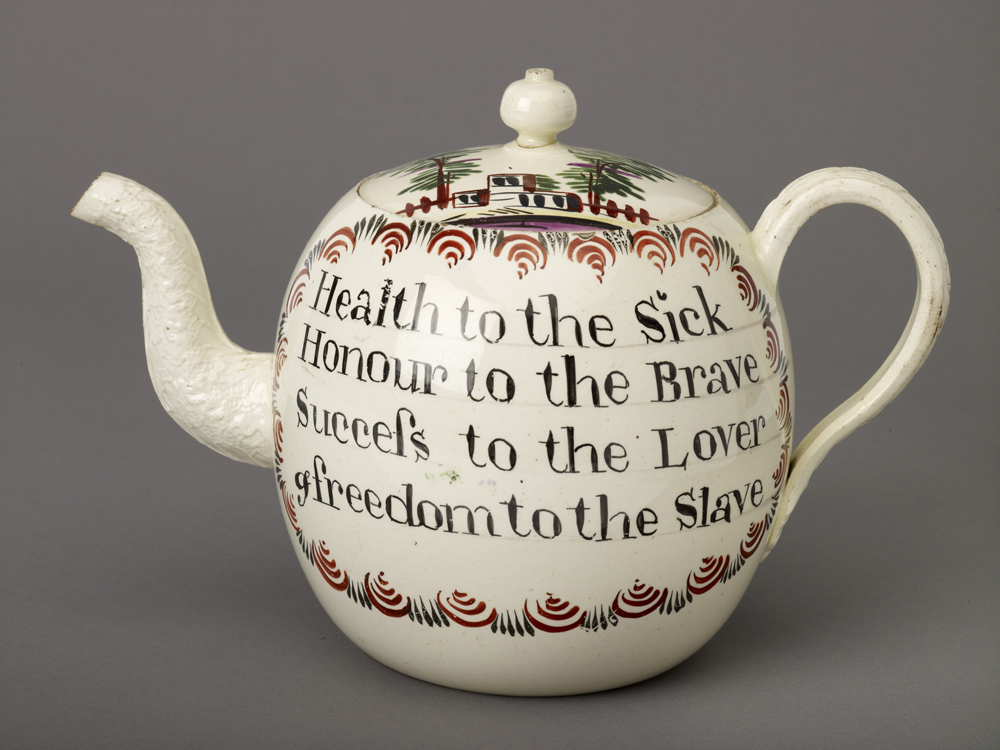
Abolition Teapot, by Josiah Wedgwood & Sons, c. 1760. Birmingham Museum and Art Gallery. Source. 

2. Find the politics in the everyday object

I’ve told everyone I know about this incredible article in Lapham’s Quarterly. Patricia A. Matthew writes about the late 18th-century consumer movement to boycott sugar from slave plantations. In the material record, this manifested as teapots and drinking utensils with snappy anti-slavery slogans, which allowed British women to organize around a political cause when they were not permitted to vote. Although we tend to think of teapots as the most domestic and innocuous of objects, their use speaks to complex issues of gender, colonialism, class, and globalization. Spin out the meanings of everyday objects, and you will often find that they have been more controversial than you think.

3. Make a political statement.

Indigenous water protectors protest the Dakota Access Pipeline at Standing Rock, ND; oil pipelines endanger drinking water and coastlines in addition to violating treaties. Source. 

It is not an accident that the communities without access to safe drinking water are disproportionately poor and non-white. In Canada, 107 First Nations reserves were affected by boil-water advisories at the end of last year. In the United States, citizens and water protectors are still fighting for access and regulation, and against fracking and pipelines, in communities like Standing Rock and Flint. Governments, regulatory bodies, and corporations have failed these communities. In a few decades we may all be in their position, with our access to fresh water jeopardized by government mismanagement and corporate interests.

Museums must work toward water justice – for disenfranchised communities now and for everyone in posterity. There are many ways to do this: through advocacy, ensuring that organizations obtain and sell water in ethical ways (Nestle’s water operation in Michigan, for example, violates a treaty which protects the land for Grand Traverse Band and Saginaw Chippewa tribal use), and, of course, through the interpretation of art and objects.

Ruth Cuthand's Don’t Breathe, Don’t Drink highlights the First Nations water crisis in Canada. 2016. Source.
The AGO’s acquisition and display of Ruth Cuthand’s arresting piece Don’t Breathe, Don’t Drink drew attention to the water crisis on reservations across Canada. Unless we resolve the inequalities that persist around access to safe drinking water, drawing attention to water justice and empowering visitors to act will only become more important in the future. While some necessary action, including divesting from fossil fuels and selling ethically-obtained water, represent big changes for museums, mindful acquisition and display of objects which speak to inequality is not only a possibility but a duty.

Cheers, santé, and prost, Musings readers! This is my final Musings column; it’s been a pleasure to connect with you and with my wonderful fellow columnists this year. Stay hungry, thirst after knowledge, and feed your souls. I’ll see you around the table.

6 April 2018

PRINCE ALBERT & HENRY COLE: WHAT'S SO GREAT ABOUT THE GREAT EXHIBITION?

WALK OF FAME

BY: SERENA YPELAAR

Hi, Musings readers! This is my penultimate post for the blog (!!!). Reflecting on my MMSt journey and all that I've learned about what museums were, what they are, and where they are going, I wanted to take this final Walk of Fame back to one of the earlier iterations of museums: The Great Exhibition.

The Great Exhibition of the Works of Industry of All Nations was an international exhibition organized by Prince Albert, prince consort of Queen Victoria, and Henry Cole. Their intention was to showcase British imperial prosperity and the might of the Industrial Revolution by exhibiting manufactured goods. Exhibitions comprised the display of raw materials and their manufactured counterparts, which of course included resources and products from overseas. The Great Exhibition was housed in the Crystal Palace in Hyde Park, built specifically for the event. It took place between May 1st and October 15th, 1851.

Crystal Palace in Hyde Park, from Dickinson's Comprehensive Images of the Great Exhibition of 1851. Source.
At this point you may be wondering, "why are you using your final post to talk about two Victorian white men who created the Great Exhibition?"

In short, I'd like to use the Great Exhibition to explore the colonial origins of museums. How can we respond to these early conventions to operate modern museums that serve their diverse and multicultural communities, especially in a place like Canada? The two individuals below represent members of a hierarchical society that don't necessarily make up the visitor population today, but their work can inform what we do.


Henry Cole
Henry Cole.
Source.

An inventor and British civil servant, Henry Cole (1808-1882) sought support for the exhibitions through his involvement with the Society for the Encouragement of Arts, Manufactures, and Commerce (RSA). He was dedicated to improving the standards of industrial design, and ultimately secured Prince Albert's patronage for exhibitions on art manufactures between 1847 and 1849.

After visiting the 11th Quinquennial Paris Exhibition in 1849, Cole aspired to expand the RSA's planned exhibitions for 1850 and 1851 to international participants, so in 1850 he obtained Queen Victoria's backing to establish the Royal Commission for the Exhibition of 1851.

Cole's dedication to artistic and scientific pursuits led to his creation of what's considered the first commercial Christmas card, in 1843. He was adamant that the Great Exhibition's profits be allocated to the purchase of land for the South Kensington Museum, of which Cole was the first director. Established in 1852, the museum is now the Victoria & Albert Museum, and has a Henry Cole wing.


Prince Albert 


Prince Albert, c. 1848. Source.
Prince Albert (1819-1861)'s role in the Great Exhibition reflects his class in relation to Cole; while Cole and the RSA were the mobilizing force behind the Exhibition, the Prince Consort was enthusiastic in his support of it.

Prince Albert was lauded as the mastermind of the Exhibition, and his vision resulted in the profit of the showcase, bringing in £186,000. It was by Prince Albert's decree that the funds be used to “increase the means of industrial education and extend the influence of science and art upon productive industry”, ultimately contributing to the creation of what is now known as the V&A.

Beyond the Royal Family, who visited the Exhibition three times, prominent Britons at the time also made appearances, such as Charles Darwin, Charlotte Brontë, Lewis Carroll, Charles Dickens, George Eliot, and Alfred, Lord Tennyson. Though other individuals such as Karl Marx disapproved of the Exhibition for sensationalizing capitalism, six million people visited in total.


What does remembering the Great Exhibition mean for us today?

Countries from the world could exhibit their industrial accomplishments, but the Great Exhibition was primarily intended to prove British superiority. As a colonial engine, therefore, the Exhibition is an example of how museums and their exhibitions can perpetuate a hegemonic agenda.

Nevertheless, we don't have to resign ourselves to this prospect. Rather, we know that through conscious and responsible interpretation we can subvert and overturn these notions of superiority - whether by class, race, gender, sexual orientation, or culture - and aspire to capture empathetic responses to the human experience.

Rather than exhibiting differences in a way that creates hierarchies, we can celebrate those differences and learn from them with a positive vision. That's my hope for the general direction of museums today, and in the future - but as museum professionals we're responsible to go beyond hope and create change through action.

Thank you all for coming on this Walk of Fame with me all term. Going forward, I hope we don't simply dismiss the past as something irrelevant to us, but instead examine it in a way that serves our commitment to progress today.

5 April 2018

OPEN DOOR POLICY: CONSERVATION LABS ON VIEW

CONSERVATION TIPS & TRICKS

BY: SERENA YPELAAR & AMY INTRATOR

Some of the most popular features of many museums are their open conservation labs, in which visitors can see conservators at work (often through glass). It's another nod to visitors' love of behind-the-scenes opportunities, and seeing the process allows a transparency we don't always get in museums. We've compiled a list of some institutions where you can see conservation labs up close!

Royal Tyrrell Museum, Drumheller, Alberta

During the summer, the Royal Tyrrell Museum processes fossils discovered by the archaeological team in the field. Their work is done in the Preparation Lab (formerly the Fossil Lab), which is accessible to visitors in the form of a large glass window. Visitors can watch conservators and archaeologists at work with new fossil discoveries of various sizes and types. Many of the specimens were discovered in the local area in Alberta, such as Dinosaur Provincial Park, which is where the field station is located. Some specimens take up to five years to prepare completely, so the Preparation Lab often has conservators working on long-term projects.


The Fossil Lab in 2007. Source.

Museum of Fine Arts, Boston (MFA)
Photo courtesy of Amy Intrator.

At the Museum of Fine Arts, Boston (MFA) the Conservation in Action display allows visitors to see conservators working on artifacts up close and personal. The Conservation in Action Gallery is a space dedicated to displaying the conservation processes undertaken in the gallery, but conservation displays have also been set up in the Asian Painting Gallery and other parts of the Museum.

The conservation displays change with new acquisitions and projects, and the developing display fits into the museum’s larger initiative to merge front-of-house programming with behind-the-scenes access. In addition to the Conservation in Action display, the MFA has displays dedicated to the choices, decisions, and efforts made by Museum staff. From a display about “Making Choices” between displaying different artifacts, to an explanation of classifying processes, the Museum is extremely transparent about processes that are usually kept behind closed doors.


Boston MFA's Making Choices Display. Photo
courtesy of Amy Intrator.
Penn Museum, Philadelphia

The Penn Museum in Philadelphia has displayed their conservation process since 2012, with the opening of In the Artifact Lab: Conserving Egyptian Mummies. In 2017, the lab reopened as The Artifact Lab: Conservation in Action, which now focuses on a variety of artifact conservation. The lab is described as “part exhibition, part working laboratory” and visitors have the opportunity to look into the glass as conservators work on artifacts, but they can also explore objects in the gallery and learn about the conservation process each artifact underwent. The combination of exploration and observation allows visitors to engage in a dialogue about conservation, rather than passively watch conservators at work. The Museum also makes an effort to keep visitors informed and engaged through a blog with information about the Museum’s current and past conservation initiatives. The combination of resources helps the visitor learn about the scientific, artistic, and practical knowledge necessary to properly conserve the museum’s artifacts.


National Trust, Knole House, UK

The Knole Conservation Studio is the first National Trust offering of its kind. Free to all visitors, it is located in Knole House in West Kent and offers an interactive look at the conservation process. Housed in a 15th century barn, the first floor holds a display of historic items laid out and waiting to be conserved. The building's windows have been blocked for preservation against light damage, but a timed lighting system allows visitors to view the conservation area for limited periods. The second floor holds the conservation studio itself, where visitors can watch conservators at work and engage with interactive displays such as drawers. Tours of the space are also available, and conservators and volunteers can answer questions in the space itself. The studio even has UV light box that can illuminate areas of an object that have been restored. It also has an iPad with a decision-making game allowing visitors to "play the conservator".

Knole House, West Kent, UK. Source.

Northwest Museum of Arts and Culture, Spokane, Washington

The Northwest Museum of Arts and Culture has a “working Collections Lab” with a variety of displays and programs that bring visitors behind-the-scenes and into the collections process. While many galleries feature conservation labs that visitors can peek into, this museum features several different programs that allow for a more open dialogue between visitors and museum staff. From an “Artifact Boot Camp” featuring chats with museum staff and volunteers as they work, to a display about the science of decay, there are multiple opportunities for visitors to engage in the collections process. The full and changing display connects the Museum’s dedication to collections stewardship with their commitment to lifelong learning by opening a dialogue between visitors and the museum collection.


The openness of these conservation labs provides an additional level of learning and offers a special glimpse into the work museum professionals - namely conservators and collections managers - do. The transparency of these labs brings an awareness of the importance of preserving these artifacts for the future - have you been to any museums with open conservation labs?

4 April 2018

THE NATURAL HISTORY MUSEUM RETHOUGHT: CURRENT DIRECTIONS

MUSEUMS ON EARTH

BY: LANA TRAN

As stewards of nature, natural history museums dedicate a large proportion of their resources to the conservation and development of collections, from which an indispensable understanding of the Earth has come. It’s humbling to think that the careful categorization and analysis of specimens could create such a fundamental awareness of the history of existence itself. It seems, however, that such a feat is no longer enough.

Natural history museums need to do more, differently—or at least, that seems to be the prevailing conversation in the museum literature.

The speed of technological advancement and accompanying social movements are challenging museums to keep up. Citizen science and maker movements are finding space within museums, opening new options for visitor engagement. In collaboration with game developers of all levels, the Royal Ontario Museum's soon-to-be permanent gallery The Dawn of Life has already popped out some interactive apps—one being a dating RPG for, well, prehistoric invertebrates.
 
Screenshot of eCambrian dating game, Royal Ontario Museum. Source.

Meanwhile, more analogue, high-touch approaches could help connect urbanites with values in nature and culture that underlie contemporary issues. To do this, natural history museums will need to go beyond internally-focused practices to engage with the cultural realities of the immediate community.

One such example is the Environmental and Climate Justice Dialogue Initiative. Using object-based storytelling circles, museums can activate their collections, at the same time encouraging local people to see their individual experiences and talents as valid in the struggle for conservation.

4.5 billion-year-long story short, natural history museums are awakening to the idea that long-term relevance is not achieved in self-mummification, but adaptation. 

Further Reading

Dorfman, Eric. 2018. The Future of Natural History Museums. Milton Park, Abingdon, Oxon: Routledge.

3 April 2018

VISIONS FOR THE FUTURE: MMSt 2018

MUSEUM INNOVATIONS

BY: HANNAH MONKMAN

Hello and welcome to a special issue of Museum Innovations! As the last installment for the term, I decided to go out into our student community and ask our soon-to-be Museum Studies graduates where they think museums are headed in the future. Asking, "what's next for museums?" I wanted to highlight the fantastic ideas and insights of our grads in all areas of the museum field, from collections management to interpretation, diversity and inclusion strategies, and even museum management.

I'm so excited to see all the passion and ambition coming into the field, and with such drive amongst our graduates, we may... dare I say it? ... change the world. 

Source.
Do you agree with these visions for the future of museums? Let's see what our grads have to say!

Collections Management 

"Collections Managers & Conservationists should be more environmentally aware of their material consumption (plastics, crates, tissue paper, etc.) when protecting, shipping and storing objects. I want to learn how to lead the way in best practices and show our colleagues it is possible to waste less!"
- Jessica Baptista 

"Widespread acceptance of the use of deaccessioning in tailoring our overgrown collections to those that best fit our mandates, allowing us to properly preserve what needs to be preserved for future generations. But, of course, great power comes with great responsibility."
- Emily Welsh 

"Collections that are accessible, not just visibly but physically. Accessibility to fit a variety of communities' needs. There is a tendency to 'hoard' objects but at the same time, we say museum objects are for the public. I think museums will start to move towards using the collection to better fit the needs of the public in different ways."
- Kathleen Vahey 


Interpretation and the Visitor Experience 

"I would love to have more interpretation that immerses the visitor in a given experience to foster empathy. I don't think we need to sideline objects as a thing of the past - let's animate them in new ways and facilitate interaction (digitally, using replicas, etc.) through storytelling. Within this framework, I hope to encounter/create museum content that explores the idea of "place" at the heart of an experience. Can places be artifacts themselves?"
- Serena Ypelaar 

Source.

"I think museums are constantly learning and introducing inclusive practices. This proactive programming is preparing the future of museums to be even more aware of and engaged with different visitors’ needs that have historically been overlooked. Now museums are moving in a direction that acknowledges that there is no “average visitor,” and every person that comes into the museum has different needs - whether they are mental, physical, or emotional."
- Aurora Cacioppo

"Museums need to start to incorporating new technologies to become more inclusive and accessible for a wider demographic. I really think that museums are in a state of change already; it's just up to them if they want to take the blind leap into something new."
- Breanna Stephenson 

"Museums are in a transition in two ways. Firstly, the museum exhibition experience is becoming much more visitor-centric with an emphasis on creating a meaningful and memorable narrative with defined and tangible short- and long-term outcomes. Secondly, and especially in Canada, museums are reorienting themselves to embrace and mobilize the Truth and Reconciliation Commission (TRC) and continue to build better relations with our Indigenous communities. While it will be a long process, the results of this mobilization will change the face of museological practice in Canada."
- Bretton Weir

Source.
Diversity and Inclusion

"Where are museums headed? As a graduating class we should be asking, where can we take museums? Things I hope for (and these are just a few) include: Increasing interactivity within exhibits and during general programming. (For example, the sold out immersive Infinity Mirrors exhibit at the AGO). Museums that are more inclusive and work with communities to represent their diverse publics. I have every confidence that my graduating class will be able to lead the way in this respect."
- An Eager MMst Grad

"Becoming more relevant to a wider and diverse audience. I’d like to focus on how this can possibly be achieved through programming that is more accessible and applicable to a wider audience. I believe programming is powerful enough to engage, connect and teach a diversity of people."
- Julia Zungri

"I think - or at least I hope! - that we're going to see more concerted and sustained efforts at incorporating diversity and inclusion into museums at all levels. Community-based stories won't just be featured in exhibitions; communities themselves, as partners and staff members, will shape how collections are managed and how the museum operates. For a specific example, I think that we'll be seeing more women in positions of museum leadership in the coming years!"
- Sadie MacDonald 

"It's hard to tell, but I hope to see changes for the better. One thing I want to see is marginalized people (POC, LGBT+, disabled, ...) who are working in the museum field being represented and listened to more, and given more leadership roles."
- Anonymous 

Management and Operations

"More engagement with environmental concerns across the sector, both in programming/exhibitions and on an institutional level: carbon-neutral operations and climate justice programming especially."
- Jennifer Lee

"I believe that we are seeing a greater movement towards specialization in all sizes and facets of cultural institutions. Whereas previously some museums and heritage sites were able to operate with passionate, untrained staff curating and attending collections, developments in curatorial practice and collections management techniques mean that this tradition is no longer sustainable in the competitive cultural market. Small sites, which had previously rolled collections management and curatorial duties into one hybrid position, are moving to separate the two into individual staff members to better handle the rigors of each role and to offer a more appealing product to cultural consumers. Due to the strain this puts on the limited resources these institutions have, I foresee an increase in zero-hour contract labour, allowing these sites to reap the benefits of informed practice while saving money during off-seasons."
- Dan Rose


A sincere thank you to everyone who contributed!

2 April 2018

CONNECTING THE DOTS AT THE AGO: #INFINITEKUSAMA

EXHIBITION REVIEWS

BY: JULIA ZUNGRI

Many of you have probably seen the TTC streetcars and subway stations covered in red polka dots on a white background, with a hashtag #InfiniteKUSAMA. Even if you are not a follower or lover of contemporary art, it would be extremely difficult to ignore these signs of Kusama and the excitement that has permeated the city. While tickets to see the Yayoi Kusama: Infinity Mirrors exhibition at the Art Gallery of Ontario are difficult to come by, I was lucky enough to attend with a fellow Museum Studies colleague.

Born in 1929, Yayoi Kusama is a Japanese contemporary artist who continues to break boundaries through different art forms. The AGO presents over 90 of Kusama’s works, including her early and recent paintings, sculptural objects, her film Self-Obliteration, photographs of her performance works, as well as archival pieces related to Kusama’s earlier life, artwork, and events. The exhibition also finishes with a video of an interview with Kusama. As a visitor, I appreciated how the AGO provided such a nuanced approach to Kusama’s works that really shone light on the complexities of Kusama as an individual and as an artist.

A taste of Kusama's recent works (2009-present), My Eternal Soul. Photo courtesy of Julia Zungri.

The highlight of the exhibition is the six Infinity Mirror Rooms spread throughout the fifth and fourth floors. Kusama began using mirrors in 1965, with her Infinity Mirror Room - Phalli’s Field. The rooms create kaleidoscopic environments that engage the visitor, prompting them to reflect on ideas of time, space, and our connection as humans to the universe.

The six Infinity Mirrored Rooms are: Love Forever, 1966/1994, The Souls of Millions of Light Years Away (2013), All the Eternal Love I Have for the Pumpkin (2016), Phalli’s Field (1965), and Aftermath of Obliteration of Eternity (2009). Two other rooms are Dots Obsession – Love Transformed Into Dots (2007) and The Obliteration Room (2002). As tickets are difficult to come by, this means that almost every time slot is sold out and requires a 10-20 minute wait for almost every room, which can only be entered in maximum groups of three for between 20 to 30 seconds (so if you’re in a pair, you make a new friend!).

You won’t be bored waiting, though! Most lineups are placed alongside walls with text, and/or have stands throughout the line with a text panel, encouraging visitors to actually read! The interpretative strategies employed in this exhibition are excellent! This was not a text heavy exhibition, and rightly so: it is all about the experience. As someone who does not have a strong contemporary art background, though, I valued the information that the AGO did provide as it gave me just enough context to admire not only Kusama and her works, but also the impact she has had on society and the art world.

Examples of what awaits you while lining up to experience the Infinity Mirror Rooms. Photo courtesy of Julia Zungri.


You go, Kusama! Photos courtesy of Julia Zungri.


The Infinity Mirrored Room – Love Forever reflects the civil rights, antiwar, and sexual liberation movements that stemmed from activist groups throughout the 1960s. As you peep your head into the room, the image of your face, as well as the person adjacent to you, are repeated ‘forever’ throughout the space.

Me in the Love Forever Room. Photo courtesy of Tabitha Chan.

My two absolute favourite Infinity Rooms are The Souls of Millions of Light Years Away and Aftermath of Obliteration of Eternity. Both rooms present a repetitive illusion of lights and are completely dark except for the lights hanging in the space. You cannot see your reflection in the mirrors as well as you can in the other rooms, therefore suspending your movement and encouraging you to look and reflect.

The Souls of Millions of Light Years Away is particularly interesting, as I have always been fascinated by space and time: 20 seconds passes quickly, but for a brief moment your body becomes infinite with the room through the mirrors, providing some sort of ‘afterlife’ in space after death. As an aside, I also felt like I was reliving a scene from Interstellar.

In The Souls of Millions of Light Years Away Room. You really want to visit now, don't you?!
Photo and video courtesy of Julia Zungri.


Similarly, the obliteration of the body is a reoccurring theme throughout Kusama’s works. In the Aftermath of Obliteration of Eternity Room, the body disappears, prompting reflection on the idea of death and the afterlife. The space harkens back to the Japanese toro nagashi ceremony that sends paper lanterns down a river to guide ancestral spirits to resting places. The room, in fact, did feel like I was surrounded by infinite rows of lanterns. For me, the Room has an air of melancholy, but also exudes tranquility: being in a room that looks infinite for about only 20-30 seconds gets you thinking about the temporality of life and space.


The last room in the exhibition is The Obliteration Room. Obliteration reoccurs again, but in this case it is the obliteration of the original pure, white room. Each pair of visitors is given a sheet of stickers to place throughout the room to participate in the final construction of the space. Again, Kusama invites us into her world, encouraging us to think about what the bright dots mean to her and to us, and to obliterate not only the room, but ourselves as we leave a piece of us behind.


Tabitha and I in The Obliteration Room. Photos courtesy of Julia Zungri.

Just as Kusama accomplished in the art world, the AGO likewise breaks boundaries in the museum world. This was certainly a one-of-a-kind museum experience. While others may be annoyed to wait in a queue, I was fascinated by the concept of waiting in line to experience the Infinity Rooms, as if I were waiting in line for a ride at Wonderland. I cannot think of a better way to end my two years as a Contributing Editor to Musings than to review one of the most popular art exhibitions of the year (and likely for years to come). Yayoi Kusama: Infinity Mirrors is a unique and unforgettable experience, and is worth the wait. After all, we become infinite at the end.

If you haven’t seen the exhibition and still don’t have tickets, don’t fear! Throughout the run of the exhibition until May 27, there are a limited number of same-day tickets available to purchase at the AGO beginning at 10 am. Click here for more information about tickets, the exhibition, and Kusama.

And that's a wrap, folks! It has been an absolute pleasure writing for this blog with fellow amazing writers the past two years. Many thanks to all of our readers - writing for you has been incredibly rewarding! While you have not read the last of me, for now, thank you and farewell.

Source.